
Betting Academy
Over/Under Goals Betting Explained: The Expert Strategy Playbook (2026)
Most punters approach over/under goals markets the same way: they pick games that look fiery on paper, back the over, and wonder why they're losing long-term. The maths reveals their folly. If you’re betting the over at 1.70 odds, you need to win 59% of the time to break even, while in the Premier League, only 55% of matches end over 2.5 goals. However, by building your own expected goals, spotting structural situations where the bookmaker’s model lags behind reality, and having the discipline to wait for the right moments, you can still shift the numbers in your favour. Below, I’ll explain my approach and highlight some trusted online sportsbooks.

SportsBoom offers honest and impartial UK bookmaker reviews to help you make informed choices. While we may earn commissions through affiliate links, our content remains independent and free from promotional influence. For more information, see our Content Transparency and How We Review pages.
Over-Under Goals Betting Explained
Newcastle United lead the EPL this season with 71% of their home matches finishing with over 2.5 goals. (Source: footystats.org)
Newcastle United lead the EPL this season with 71% of their home matches finishing with over 2.5 goals. (Source: footystats.org)
What Is Over/Under Goals Betting?
In over/under goals betting, you predict whether the total number of goals scored by both football teams will be over or under a line set by the bookmaker.
These lines usually include a half goal (such as 1.5, 2.5, or 3.5), so there’s no possibility of a draw. For example:
- Over 2.5 goals wins if 3 or more goals are scored (say 2-1, 3-0, or 4-2) and loses if 2 or fewer are scored (e.g., 1-1, 2-0, or 0-0).
- Under 2.5 goals wins if 0-2 goals are scored and loses if 3 or more are scored.
Common goal lines include: - 0.5 goals - Over wins with at least 1 goal, Under only wins with a 0-0 draw
- 1.5 goals - Over wins with 2 or more goals
- 3.5 goals - Over wins with 4 or more goals
The 2.5 goal line is the most popular in the Premier League and other UK competitions because average match goal totals tend to sit around this level. You’ll also find plenty of Premier League bet offers with the 2.5 line.
How Over/Under Goals Betting Works
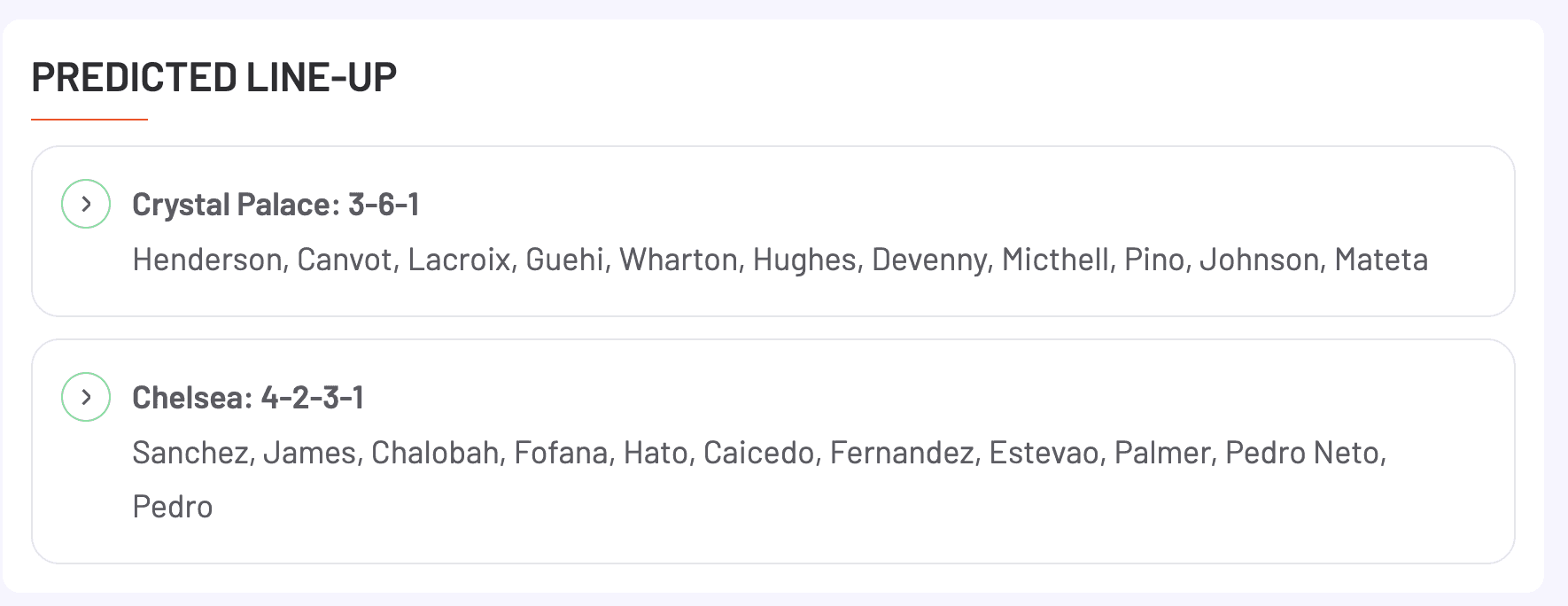
To see over/under goals betting in the wild, let’s look at a match between Crystal Palace and Chelsea played on 25 January 2026.
Under Goals Betting Works
Under Goals Betting Works
I was predicting a high-scoring affair because Palace were in terrible form with LLDLD across their last five and on an eight-match Premier League winless streak, while leaking goals consistently. Head-to-head data also flagged something important: the last five meetings averaged well over two goals, with only one ending 0-0 back in August.
Under Goals Betting Works Suggested bets
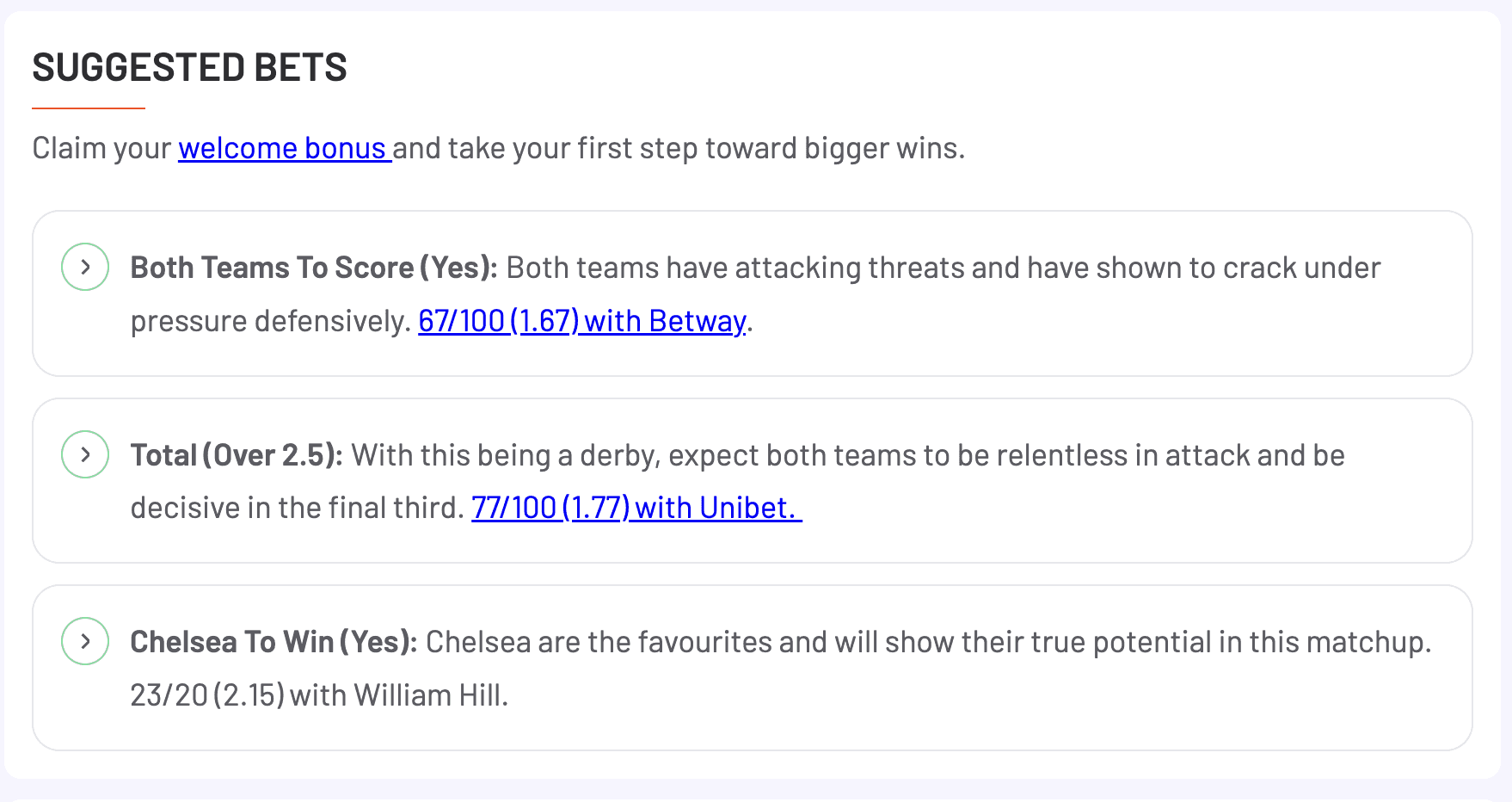
Based on SportsBoom’s guide to football betting operators, I went ahead and whacked down a £20 stake at 1.77. Based on these odds, the implied probability was 56.5% (1/1.77), and based on the under paying 2.00, the margin was 6.5% (1/1.77 - 1/2.0).
The wager couldn’t have gone smoother, as Estevao capitalised on a defensive error to put Chelsea ahead in the 34th minute. Joao Pedro doubled the lead five minutes after half-time, and Fernandez calmly converted a penalty just after the hour to make it 3-0 and booked me a £15.40 profit!
How Over/Under Goals Betting Works
Bookmakers set EPL Over/Under lines using a Poisson-based model fed with season-long averages, recent form, and home/away splits, but it has three blind spots you can exploit.
Casual punters overwhelmingly back overs, so bookmakers nudge totals slightly higher to attract under money. I’ve come to the conclusion that the over is fractionally overpriced, and the under slightly better value.
Bookies’ models overweight season-long data versus recent tactical shifts. A team averaging 2.8 xG over 12 games might only be producing 1.9 xG after a formation change. Additionally, late team news can move lines. You can lock in better odds by waiting until teamsheets have been announced.
Let’s look at Arsenal vs Manchester United on 25 January 2026. The bookmaker set Over 2.5 goals at 1.65, which implies a 60% probability.
Using my model, I calculated expected goals based on recent form. Arsenal’s weighted xG from their last eight home games was 1.0, while Manchester United’s weighted xG from their last eight away games was 1.6, giving a projected total of 2.6 goals for the match.
To convert this into probabilities, I applied the Poisson distribution, which estimates the likelihood of a specific number of goals. Calculating for 0, 1, and 2 goals gives probabilities of approximately 7.4%, 19.3%, and 25.1%, respectively. Summing these, the probability of 0-2 goals is about 51.8%, leaving a 48.2% chance of Over 2.5 goals and a 51.8% chance of Under 2.5 goals.
Comparing this to the bookmaker’s line, the Over at 1.65 was clearly overpriced relative to the model’s projection, and I decided to look for another to match to bet on!
How I Analyse Over/Under Bets
How I Analyse Over Under Bets
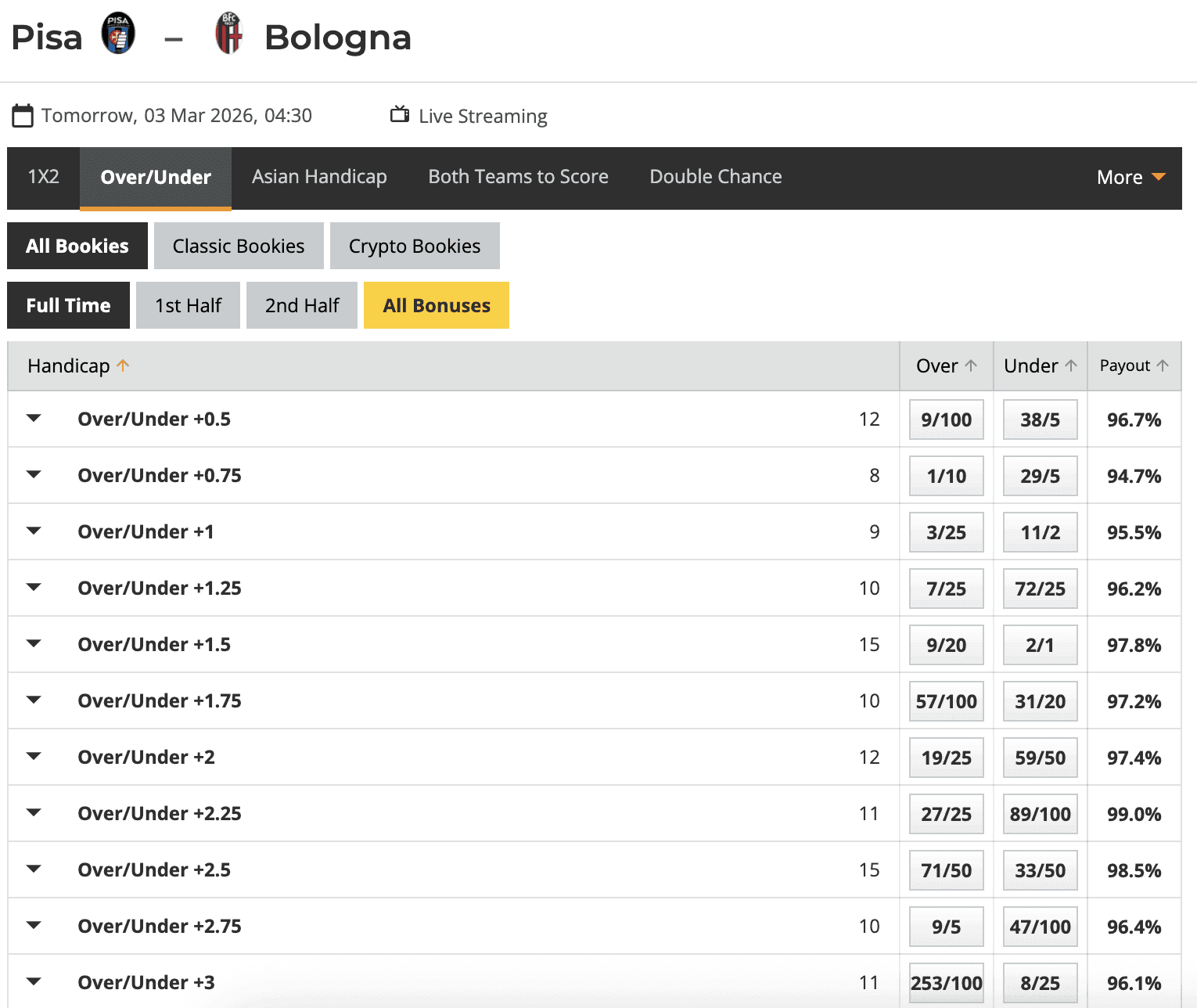
(Caption: Over/Under goals betting odds for Pisa vs Bologna FC 1909, showing bookmaker prices for multiple goal lines ranging from +0.5 to +3 in the full-time market)
First, I ignore the bookmaker’s line and build my own expected goals. I pull each team’s rolling xG from the last eight home/away games, weight the last four more heavily, and remove matches against extreme teams that skew results.
Then I adjust for three hidden factors: referee style (some slow the game), pitch conditions (heavy winter surfaces reduce goals), and managerial tenure (new managers often see lower-scoring matches).
Once I have my projected total, I only bet if there’s at least a 0.3-goal gap to the bookmaker’s line, enough to cover their 5-7% margin. Finally, I check line movement on OddsPortal, if sharp money has already moved it toward my view, the edge may be gone.
Pros & Cons
Pros
Focus on total goals
Under 2.5 is common; many games end 0-0, 1-0, or 1-1
Lots of markets available (1.5, 2.5, 3.5, BTTS, first-half totals)
Researchable edges: xG, goals conceded, weather conditions
Cons
One deflected goal or red card can kill your bet
Need to be right between 52% and 54% to break even
Team motivation is hard to read
3 Drivers of Value
Finding genuine value in over/under markets comes down to three repeatable situations where the bookmaker's model is consistently behind yours.
- The New Manager Effect
New managers struggle to get players to buy into their strategy for their first four to six games. The defensive shape isn't drilled yet, and they're instinctively attack-minded. The bookmaker is still pricing the old defensive record. Liam Rosenior's first derby at Chelsea ended in a 3-1 victory. - Fixture Congestion Collapse
Pressing-heavy sides in their third game in seven days show measurable PPDA drops. The bookmaker smooths this with season averages. - xG Overperformance Regression
When a team has scored 9 goals from 4.5 xG over five games, the bookmaker prices the scorelines. You back the under next time they face a low-block side, knowing they can’t keep that run of form up forever.
Settlement Rules
Don’t be like me and end up berating customer support over an incorrectly marked over/under bet only to be informed that extra doesn’t count!
- Only total goals matter - Your bet is settled on the combined goals scored by both teams, not the match result. A 3-0 and a 2-1 both count as 3 goals.
- Half-goal lines never push - Lines like 0.5, 1.5, 2.5, and 3.5 always result in a win or a loss. Over wins above the line, Under wins below it, with no refunds possible.
- Whole-goal lines allow a push - On lines such as 1.0, 2.0, or 3.0, Over wins above the line, Under wins below it, and landing exactly on the number returns your stake.
- A push means stake refunded - When a bet pushes, you don’t win or lose. Your original stake is simply returned, which is why these lines usually come with slightly shorter odds.
- Goals in stoppage time count - Any goal scored in added time is included in settlement, even a late 90+6′ heartbreaker.
- Extra time does not count - Over/Under bets apply to 90 minutes + stoppage time only, unless the market clearly states that extra time is included.
- Own goals count as normal goals - If it’s on the scoreboard, it counts toward the total, no matter who scored it.
Over/Under vs Other Betting Markets
Over/under totals is my preferred market precisely because it's the most model-friendly bet in football. Check out how it compares to other markets:
- Match Result
Match result is the most volatile market you can bet on in football. A controversial penalty or a red card can completely invert the outcome you backed. With over/under, a red card still leaves the game in play. Totals are also more predictable because goal volume regresses to xG far more reliably than win/loss outcomes do. - BTTS
Both teams to score and over/under are closely correlated, as a yes on BTTS implies at least two goals, which nudges heavily toward over 2.5. The key difference is in the edge case: a 2-0 game is an over 1.5 win and an under 2.5 win, but a BTTS no. This makes BTTS riskier when you're confident in goals but less certain about distribution. - Goalscorer
Goalscorer markets move the bet from a team outcome to an individual one, which introduces a layer of variance that no model handles well. A striker can play 87 minutes, hit the post twice, generate 1.4 xG, and still not score. With over/under, you're backed by the collective output of 22 players across 90 minutes, which smooths individual variance.
My Over/Under Betting Checklist
Prior to making any over/under total goals bet, I ask myself these questions:
- Is my projected xG total diverging from the bookmaker's line by 0.4 goals or more?
- Is the team I'm fading overperforming their xG by 1.5+ goals over their last five games?
- Has there been a managerial or tactical shift in the last four weeks that the bookmaker's model hasn't absorbed?
- Is either side playing their third game in seven days with significant rotation expected?
- Is the match low-stakes for one or both sides?
Common Mistakes
Common Mistakes
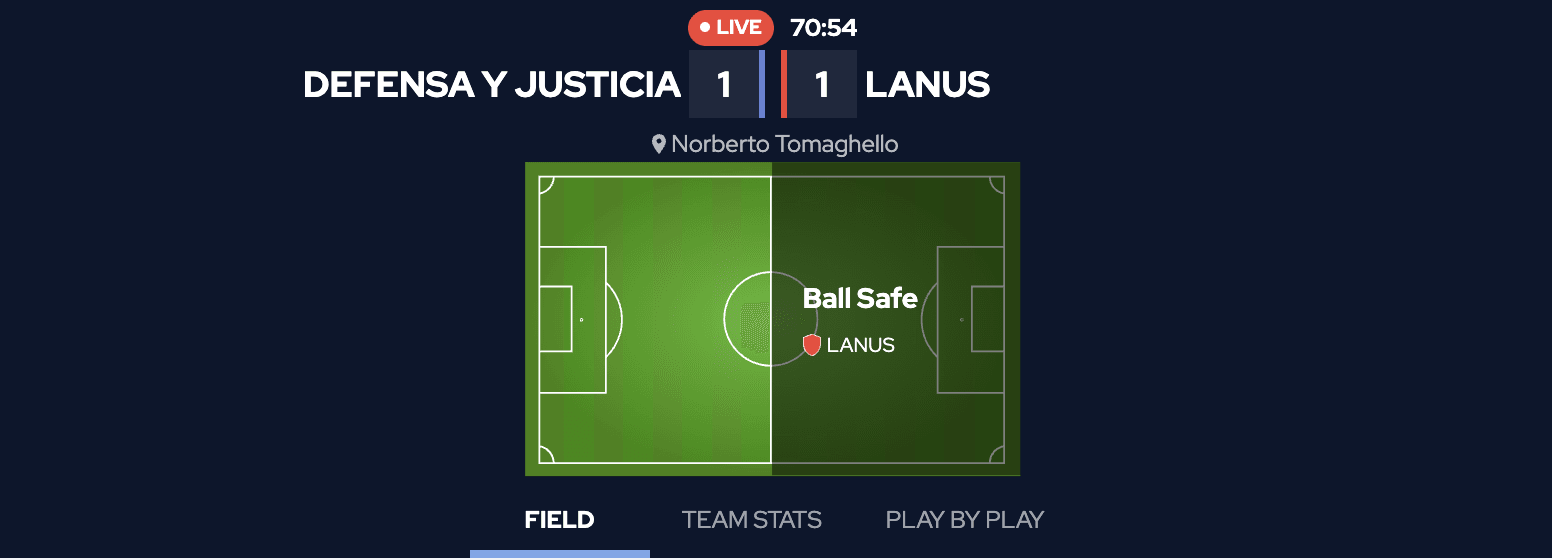
(Caption: Live Match Tracking Analysis: Avoiding Emotional Bias and In-Play Traps in Over/Under Betting.)
When I first got into Over/Under betting, I thought I could just plug in xG, average goals scored and conceded, and head-to-head goal totals in a model and easily predict goal totals. However, you need to factor in these variables:
- Not checking the lineup
- Ignoring the weather
- Failing to adjust for the referee
- Misreading the match context
- Forgetting last-minute changes
Best Matches for Over/Under Betting
Time and time again, I’ve noticed certain types of EPL matches follow clear total goals patterns!
- 1
The xG Divergence Game (Under)
This is where a team's actual goals scored is significantly higher than their underlying xG suggests, typically a side that has been riding a hot goalkeeper or converting a disproportionate share of low-quality chances.
- 2
The Fixture Congestion Game (Under)
When a side is playing their third game in seven days, particularly in January or around European weeks, rotated squads mean less press intensity, slower transitions, and deeper defensive shape to preserve energy. From what I’ve encountered, bookmakers are slow to fully adjust totals lines for fatigue because they're weighing season-long scoring data too heavily.
- 3
The Tactical Mismatch Game (Over)
Based on my dataset, when a high defensive line meets a team built on fast transitions, you can expect over 2.5 goals. I’m on the hunt for a possession-heavy side with a high line hosting a low-block counter-attacking team with a clinical striker.
Best Leagues for Over/Under Betting
Take advantage of low-scoring matches in Serie A or cash in on easy-to-pick overs every time Real Madrid gives a small club a hiding in La Liga!
EPL - Fade the Public Over, Hunt the Under After a Wednesday Night
Fade the Public Over
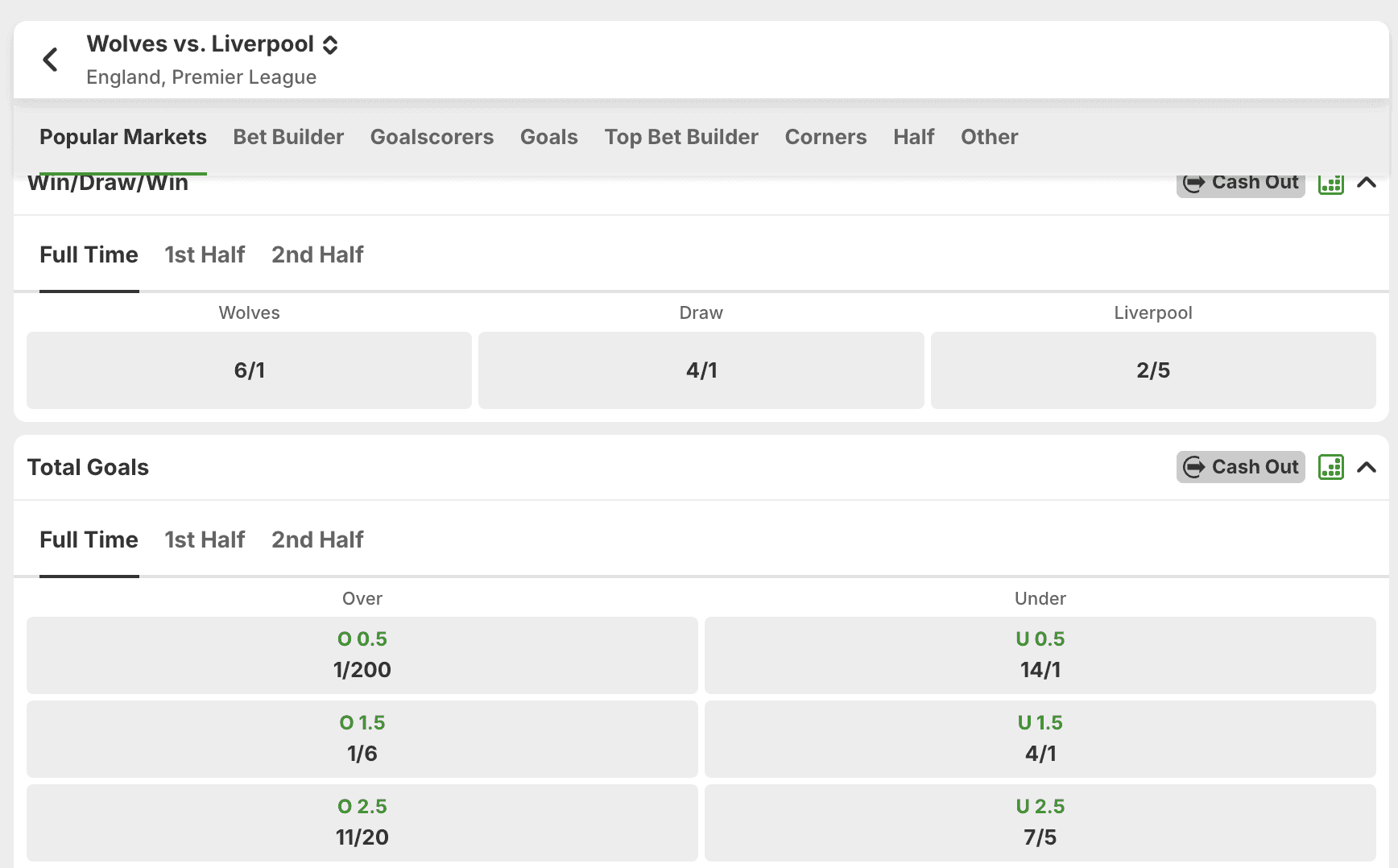
(Caption: Premier League football betting odds for the Wolves vs. Liverpool match featuring Win/Draw/Win and Total Goals markets.)
The EPL averages around 2.7 goals per game, which is not high enough to back overs blindly. Look for attacking-minded sides like Arsenal, Chelsea, or Man City, who pressed hard in a 90-minute European night three days earlier.
Serie A - Back the Under in Mid-Table Tactical Mirrors
Back the Under in Mid-Table Tactical Mirrors
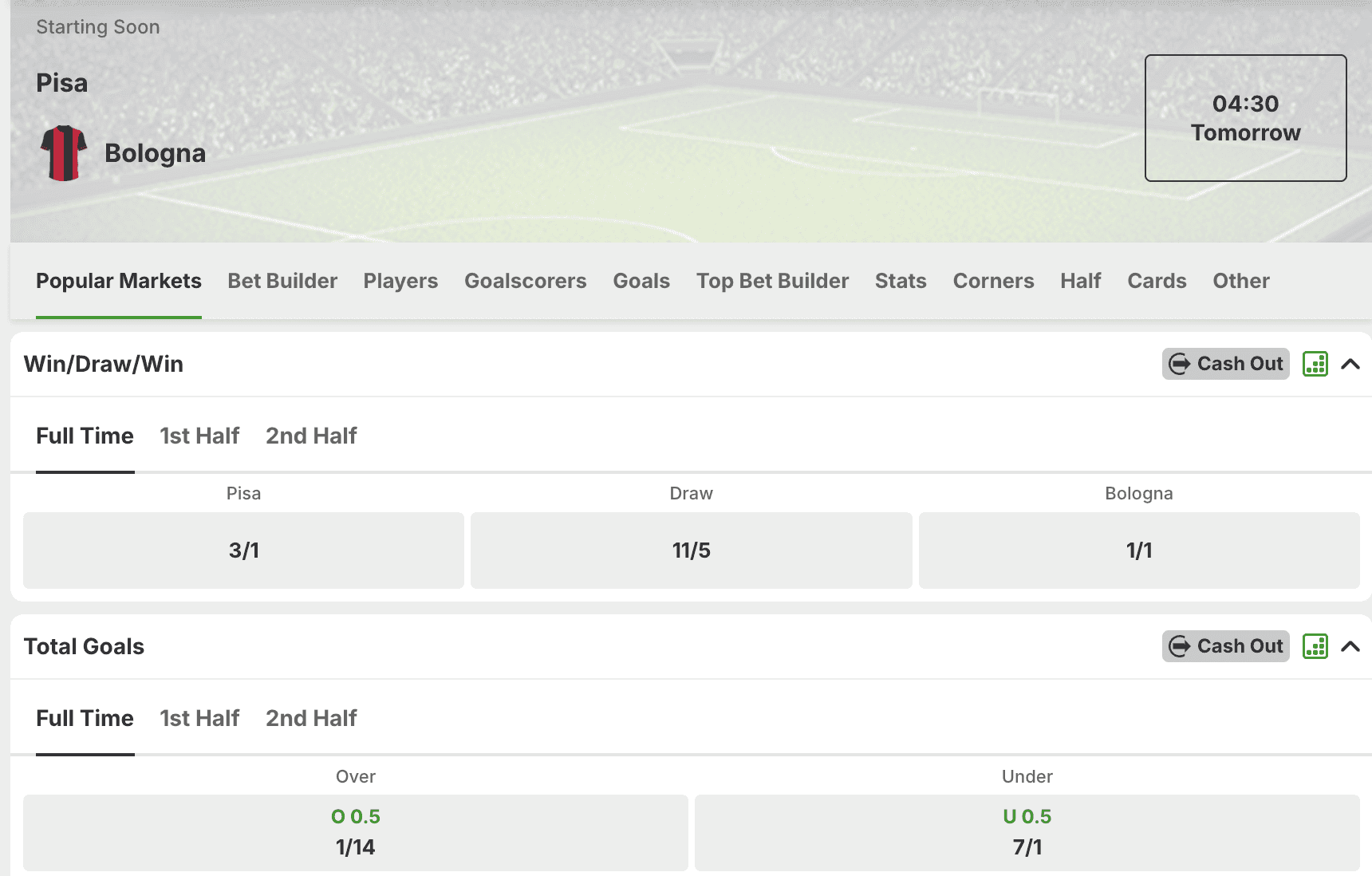
(Caption: Serie A betting analysis and fractional odds for the Pisa vs. Bologna match, highlighting a "Back the Under" tactical strategy for mid-table mirrors.)
Serie A averages around 2.5-2.6 goals per game, but the distribution is wildly skewed. Games involving Inter, Atalanta, or Lazio push the average up, while the bottom half of the table is a graveyard of 0-0s and 1-0s.
I look for mid-table games where two coaches who prioritise structure over transition are playing each other, like Torino vs Lecce or Fiorentina.
La Liga - Exploit the Barcelona/Real Madrid Inflation Effect
Exploit the Barcelona Real Madrid Inflation Effect
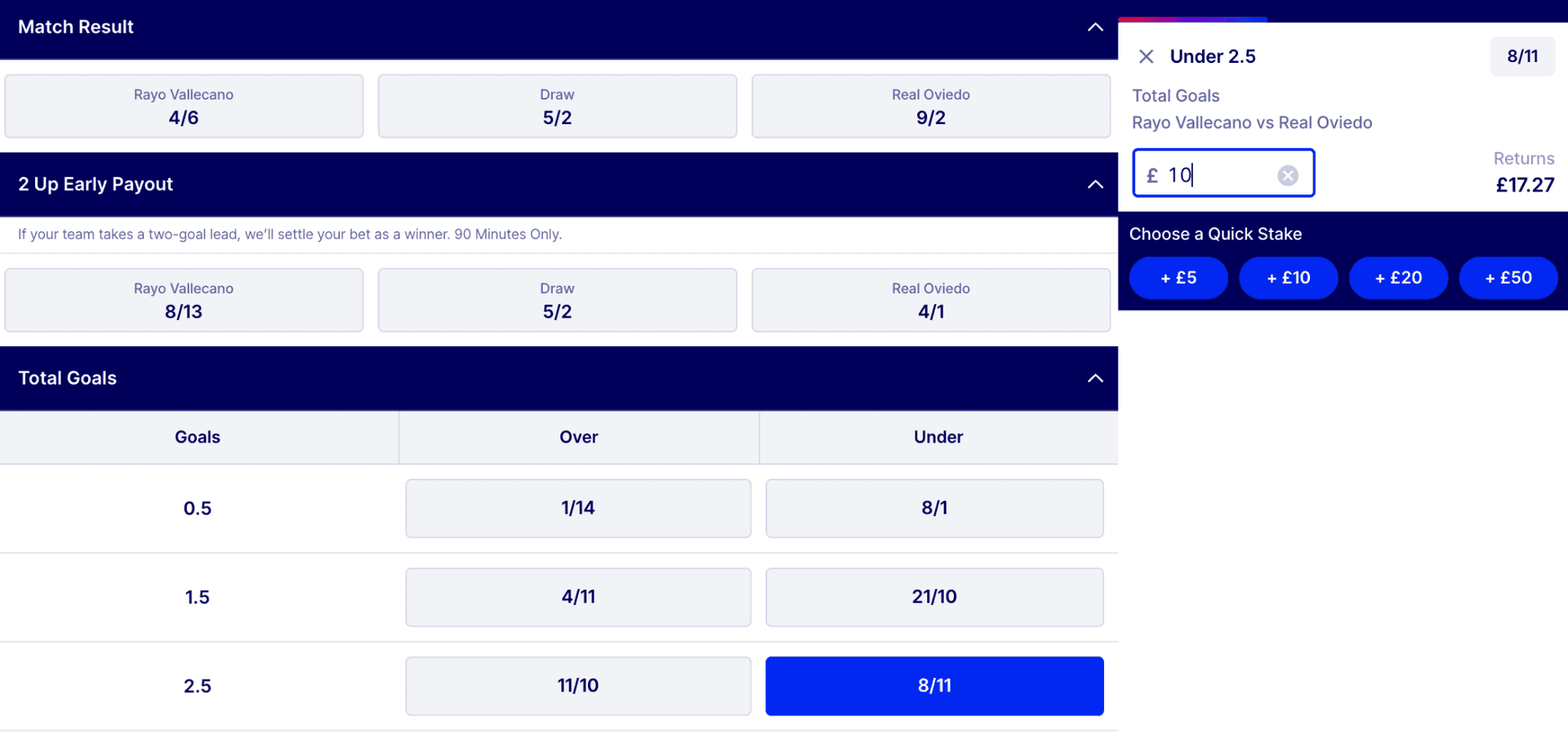
(Caption: La Liga betting strategy for Rayo Vallecano vs. Real Oviedo, focusing on exploiting market inflation and Under 2.5 goals odds.)
La Liga's average of 2.62 goals per game is heavily distorted by Barcelona and Real Madrid, whose fixtures average 3.7 and 3.05 goals, respectively. Strip those clubs out, and you're looking at a league closer to 2.3.
Bookmakers calibrate their league-wide over/under lines with the entire league in mind, which means games not involving either superclub are routinely overpriced on the over.
Bundesliga - Don't Chase the Over, Find the Outlier Under
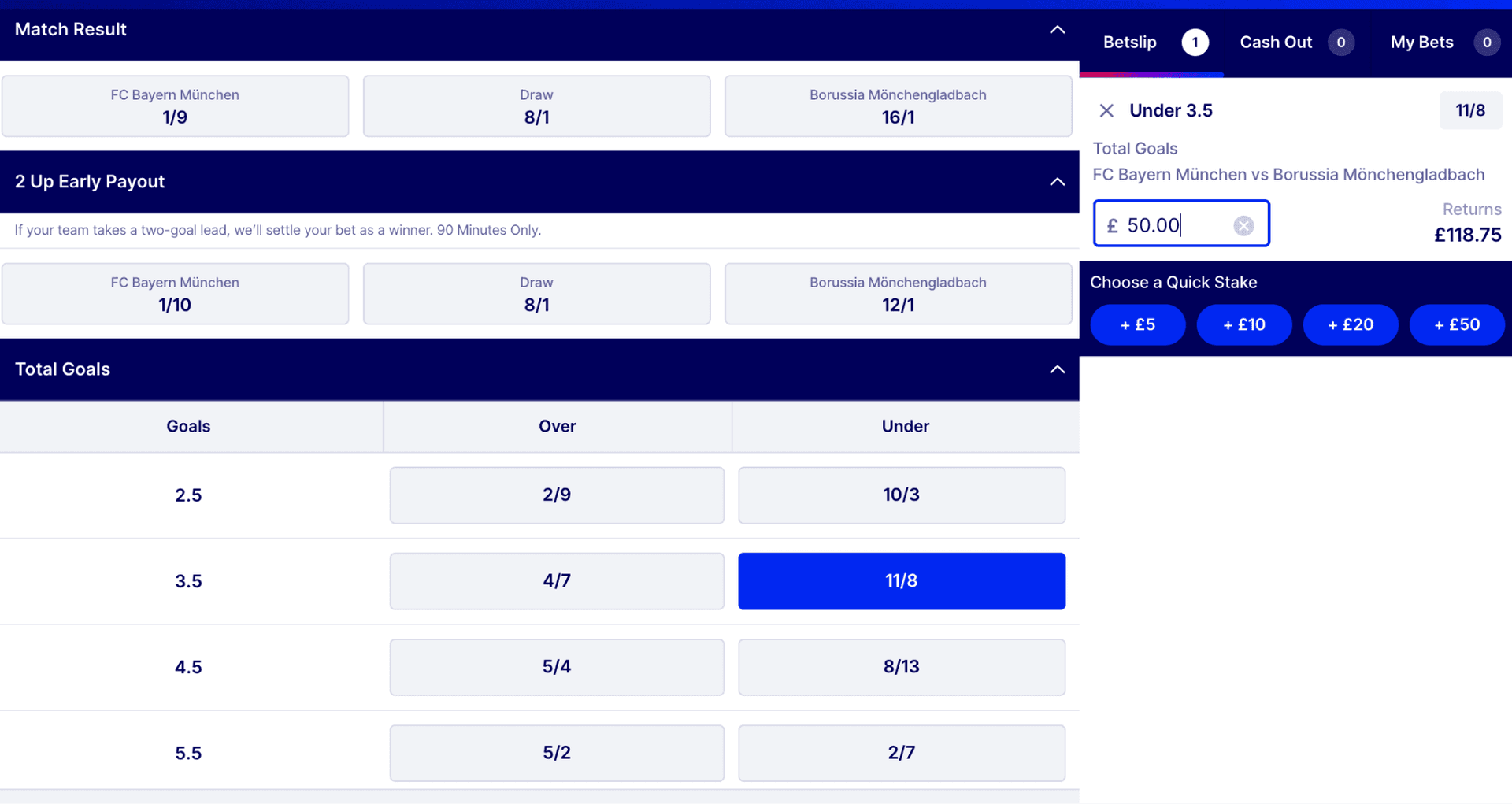
Don't Chase the Over, Find the Outlier Under
(Caption: Bundesliga betting strategy for FC Bayern München vs. Borussia Mönchengladbach, emphasizing the search for outlier "Under" markets over high-scoring trends)
The Bundesliga is Europe's highest-scoring major league at over 3.0 goals per game in 2024/25, with 65% of games going over 2.5, so the over bias is fully baked into every line. Bookmakers know this, punters know this, and the market is often efficient on overs as a result.
Hunt for a mid-table Bundesliga side hosting Bayern Munich when Bayern have a Champions League knockout leg within four days. Tuchel/Kompany-era Bayern routinely rotate in these fixtures, cutting their xG dramatically, while the home side sets up in a deep defensive block to nick a counter.
Conclusion
Over/under goals is one of the few football markets where you can accurately model results, but only if you're willing to do the work that 95% of bettors skip. Read our analysis, build your own xG projections, hunt the three game types that consistently misprice totals, and never pull the trigger unless your number diverges meaningfully from the bookmaker's line.
Always bet within your limits, record every selection, and if gambling stops being a thoughtful exercise and turns into desperation, step away. GamCare is available if you need support, and you can self-exclude from all UKGC bookies via GAMSTOP.
FAQs
What does Over/Under goals mean in football betting?
Over/Under goals is a bet where you predict how many goals are scored in the match overall.
How does Over 2.5 goals betting work?
Over 2.5 goals wins when the game produces at least three goals in total. Scores like 2-1, 3-0, or 2-2 all get the job done. If the match finishes 0-0, 1-0, or 1-1, the bet loses.
What is the difference between Over/Under 2.5 and 3.0 goals?
With 2.5 goals, you need three or more goals to win Over, or fewer than three to win Under. With 3.0 goals, it’s more than three for Over or less than three for Under, while exactly three goals is a push, and your stake is returned. Half lines always remove the possibility of a push.
Is Over or Under goals betting more profitable?
Neither Over or Under goals betting is more profitable. It all comes down to the specific match you’re wagering on and the odds/line offered by the bookie.
What is the best strategy for Over/Under goals betting?
Over/Under goals betting is a very stats-heavy market. You can fairly accurately gauge the number of goals by looking at average goals scored/conceded by both teams, recent match scores, and xG.

Bruce Douglas is an experienced editor and copywriting professional with a proven track record in shaping high-quality content across multiple platforms. With a career spanning journalism, editorial management, and digital content strategy, he brings a keen eye for detail and a passion for precision to every project he works on.
Comments
0 comments
No comments yet. Be the first to share your thoughts!
Related Resources to Betting Academy
- How Goliath Bets Work in Sports Betting
- Combination Bets Explained
- Cash Out or Let It Ride? How to Make the Right Call on Your Acca
- How Futures Betting Works 2026 Explained with Value Odds and Risk Factors
- Double Betting Explained: The Expert Strategy Playbook 2026
- Card Betting Explained: Strategy, Odds & How to Find Value
- Treble Betting Explained: How it Works
- Single Betting Explained: Odds, Probability & Value Guide
- System Betting Explained
- European Handicap Betting Explained
- Spread Betting Explained: Expert Playbook & Strategy Guide 2026