
Betting Academy
Spread Betting Explained: Expert Playbook & Strategy Guide 2026
When I first started betting, I used to pick teams just because they looked like the strongest on paper. I remember one game where the team dominated from start to finish – I thought it was a sure win. They did win, but only by six, and the spread was -7.5. I lost the bet. That’s when I realised that spread betting isn’t about picking the “best” team, it’s about looking at the numbers and spotting when the margin doesn’t reflect the reality of the match. In this guide, I’ll walk you through a framework for evaluating spreads properly, so you can make smarter bets without falling into the same trap I did.

SportsBoom offers honest and impartial UK bookmaker reviews to help you make informed choices. While we may earn commissions through affiliate links, our content remains independent and free from promotional influence. For more information, see our Content Transparency and How We Review pages.

Spread betting explained cover image
What Is Spread Betting?
When I first started betting spreads, I’ll admit I treated them more like enhanced moneyline bets. In actual fact, spread betting is wagering on whether a team performs better or worse than a margin set by the market.
Instead of simply asking who wins, you’re evaluating whether the favourite is better than the handicap it’s given (it can cover the spread), or whether the underdog can win given a head start. It can be helpful to read our analysis to get you started on the right foot.
In all spreads, the favourite is assigned a negative number and the underdog gets a positive one. Your job is to decide whether that number accurately reflects the gap in points/goals between the two sides.
In the NFL, roughly 15% of games finish with a margin of exactly three points. That’s why movement across the number three tends to dramatically alter value.
How Spread Betting Works (Core Mechanics)
Spread betting is not just deciding which teams wins, but rather by how much. Spread markets work as two-way markets, with no draw option - you are betting on one side covering or failing to cover the margin.
The favourite always receives a negative number (-6.5, -1.5, etc.) and the underdog receives the equivalent positive number (+6.5, +1.5).
Half-point lines remove the possibility of a draw, as the result can’t be a half point. The only time you’ll sort of see a draw option is in whole number spreads, where your stake can be pushed (returned) if the final margin exactly equals the line.
Tip: Overtime is included in spread settlement in most major sports, which really matters in tight games!
Let’s take a look at an example, so you can see a spread working in practice. We’ll focus mostly on soccer betting insights for UK fans in this guide, as football is such a common place to find this type of bet.
The bookmaker sets the spread as: Team A -3.5 and Team B +3.5.
You think Team A can win by 4, so you take that bet.
Option A: Team A wins by 4, which is more than 3.5, so your bet pays out.
Option B: Team A wins by 3, which is less than 3.5, so your bet doesn’t pay out.
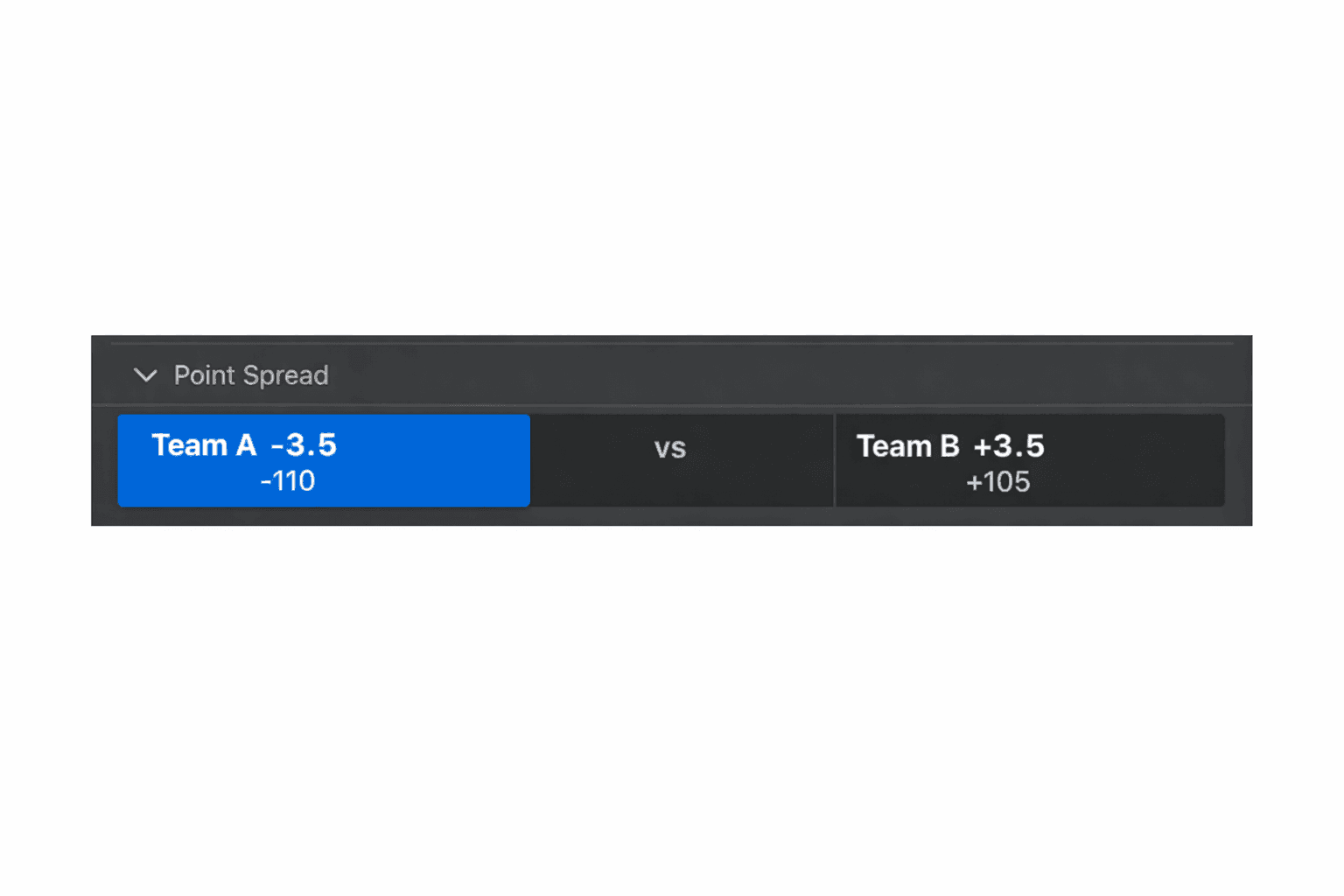
How Spread Betting Works
Best Sports for Spread Betting (Multi-Sport)
Spread behaviour varies massively by sport. Let’s take a look at some of the sports that really lend themselves to spread betting. In general, the more structured the scoring system and the higher the possession volume, the more stable margin projections tend to be.
Basketball (NBA)
Typically, high scoring games, which creates smoother margin distribution. A -7 line in the NBA carries statistical weight because teams have high possession counts.
Example:
Projected fair margin: -9
Market line: -6.5
Your Edge: 2.5 points

American Football (NFL)
Structured scoring (3s and 7s) makes key numbers extremely important.
Example:
Market: -2.5
Projected: -4
Crossing 3 significantly changes cover probability.
Rugby
Larger scoring units create wider spreads.
Example:
Six Nations favourite -11.5
Lower projected tempo can increase underdog cover viability.

Football (Soccer)
Lower scoring means smaller spreads and tighter margins.
Example:
-0.5 vs -1.0 changes cover probability considerably, as so many games end in a one-goal difference.
Hockey (NHL)
Spreads tend to be tighter as this game is low scoring, and at this level, there’s basically league parity.
Example:
A -1.5 puck line sounds simple, but requires a multi-goal win.

The NBA tends to offer the smoothest spread projections because of scoring frequency and possession count, with the NFL just behind it, thanks to key number clustering. Premier League spreads are smaller and more sensitive to individual moments, making precision more important.
A three-point edge in the NFL is not the same as a three-point edge in the NBA! Understanding how each league distributes margins is a massive part of correctly evaluating whether a line offers real value.
Best Leagues for Spread Betting
| League | Typical Spread Range | Why Spreads are Reliable |
| NBA | 3-12 points | Higher scoring game = fewer random outcomes |
| NFL | 2-10 points | Predictable margin clusters thanks to structured scores |
| Premier League | 0-1.5 goals | Endless historical data on goal differentials |
| NHL | 1-1.5 goals | Typically stable puck line pricing |
| Six Nations | 5-15 points | Consistent scoring increments |

The NBA tends to offer the smoothest spread projections because of scoring frequency and possession count, with the NFL just behind it, thanks to key number clustering. Premier League spreads are smaller and more sensitive to individual moments, making precision more important.
A three-point edge in the NFL is not the same as a three-point edge in the NBA! Understanding how each league distributes margins is a massive part of correctly evaluating whether a line offers real value.
Why Spread Markets Create Value
The biggest trade-off is late-game volatility. You can handicap a matchup correctly for 47 minutes in the NBA, led by 12, and then watch the bench concede meaningless points in the final minute. The favourite wins, but the underdog sneaks inside the number. That’s part of betting on the spread.
Pros & Cons of Spread Betting
Spread betting has structural advantages, particularly in certain sports, but like anything it comes with trade-offs.
Pros
Balanced odds on both sides
Clear, binary win condition (cover or fail)
Particularly effective in structured team sports
Cons
Vulnerable to late swings and ‘backdoor covers’
Requires precise margin projection
Small line moves can totally erase the edge
The biggest trade-off is late-game volatility. You can handicap a matchup correctly for 47 minutes in the NBA, led by 12, and then watch the bench concede meaningless points in the final minute. The favourite wins, but the underdog sneaks inside the number. That’s part of betting on the spread.
The 4 Drivers of Spread Value
When I evaluate a spread, I break it into four components, and each one needs a tick before I place that bet.
- 1
True Performance Gap
Look at power ratings, efficiency metrics, and matchup data.
Example: If my numbers show Team A is 7 points better on a neutral court and the market only lists -4.5, that’s a measurable edge.
- 2
Key Number Ranges
Check whether the line crosses common margin clusters (3, 7 in NFL, 5, 10 in NBA, etc.).
Example: Moving from -2.5 to -3.5 in the NFL changes probability more meaningfully than at other points because of how often games land on three.
- 3
Game Tempo & Possessions
Look at the pace ranking, expected possession count, and scoring environment.
Example: A slow-tempo matchup reduces blowout likelihood, so something like a -9 line in a low-possession game is much harder to justify.
- 4
Market Bias & Line Inflation
Look into public sentiment, recent results, and narrative-driven movement.
Example: A nationally televised blowout win often pushes the following week’s line one point too far toward the favourite. So that underdog might be worth your bet.
If those four items all align, I consider betting. If one breaks the case, I usually pass.
Settlement Rules & Common Grading Mistakes
Understanding settlement rules sounds basic, but this is where small misunderstandings cost real money.
To cover the spread, your team must perform better than the margin attached to them. If they fall short, they fail to cover, even if they win the match outright.
Half-point spreads (-3.5, -6.5) remove the possibility of a tie. Whole-number spreads (-3, -6) can result in a push, meaning your stake is returned if the final margin lands exactly on the line.
I learnt this lesson backing the Kansas City Chiefs at -3, confident they’d crush it against the Las Vegas Raiders. Well, they did, but by 3 - in whole numbers, that’s a push, which meant the win I was celebrating at all was simply getting my stake returned.
How I Evaluate a Spread Line (Professional Method)
When I look at a spread, I follow the same sequence every time. It can’t guarantee you the right result, but it creates a bit of discipline, which tends to lead to results more often.
- 1
Estimate Fair Margin
The starting point is always creating my own number using power ratings, efficiency metrics, and recent matchup data. If I can’t confidently produce a projected margin, the bet stops here.
- 2
Compare to the Posted Line
If my number differs meaningfully, then I carry on; if not, I’ll pass. The definition of meaningful varies a lot by sport (in football, it’s only a goal, but in the NBA, it should be at least 2 or 3.
- 3
Check Pace & Scoring Volume
High-possession games allow margins to express themselves more clearly - a win for spread bets. Slow games reduce blowout probability.
- 4
Check Matchup Style
Does one team’s strength directly attack the other’s weakness? Or is this stylistically closer than the ratings suggest?
- 5
Check Injury / Rotation Impact
Late injury news can wipe out any edge instantly. If I find some, I never ignore it.
- 6
Decide: Bet or Pass
If everything aligns, I bet. If even just one piece breaks, I pass.
Walkthrough
| Factor | My Assessment | Edge? |
| Fair Margin | -1.25 | Yes |
| Market Line | -0.5 | - |
| Tempo | Moderate | Neutral-positive |
| Matchup Style | Favourable | Yes |
| Injuries | None | Clear |
| Decision | Bet -0.5 | Confirmed |
Spread Betting Match Archetypes
Over time, certain spread patterns repeat. That’s why it’s important not to just look at teams, but to look at match types too.
- 1
Inflated Public Favourite
When I play: When a high-profile team is coming off a dominant win, and the line has clearly been shaded upward.
When I avoid: If the matchup genuinely supports a blowout.Example: An NFL favourite opens -6 after a big televised win and moves to -8.5 on public money. My projection is -6, so the numbers say that’s an underdog cover spot.
- 2
Slow-Tempo Underdog Cover
When I play: When both teams rank low in pace and possessions.
When I avoid: If the underdog is turnover-prone.Example: Premier League favourite at -1 in a low-scoring matchup where most games land 1-0 or 1-1.
- 3
High-Variance Matchup
When I play: Honestly? Very rarely.
When I avoid: Almost always.Example: Two NBA teams that rely heavily on three-point shooting. It’s games like these where the margin swings wildly.
Spread Betting vs Other Markets
Spread betting is just one way of betting, and sometimes it isn’t the best tool for the job. Below are some cases where a different kind of bet might be the smarter choice.
Spread vs Moneyline
Moneyline betting only asks one question: who wins? Spread betting asks by how much.
Use a Moneyline: If I foresee a very narrow win and the spread reflects that, I’ll often take the moneyline instead. I believe they’ll win, just not comfortably enough to justify the handicap.
Spread vs Totals (Over/Under)
Totals focus on combined scoring rather than margin.
Use Totals: If I expect a slow, tactical Premier League match but can’t confidently project who controls it, I may prefer Under 2.5 goals rather than picking a side against the spread.
Spread vs European Handicap
European handicaps introduce a third outcome (win, draw, loss).
Use a European Handicap: I’m sure the favourite will win comfortably with no risk of a draw, European handicap -1 can sometimes offer a better price.
Spread vs Asian Handicap
Asian handicap works similarly to spreads but can include quarter lines, too. This makes it handy for more closely matched games.
Use an Asian Handicap: If I project a team to win by one goal, -0.75 on the Asian handicap can offer partial win protection that a standard -1 spread doesn’t.
When I Avoid Spread Betting Completely
There are a surprising number of instances where the smartest play is walking away.
I tend to avoid spreads in extreme variance matchups, especially when both teams rely heavily on volatile scoring methods like three-point shooting or counterattacking football. Those games swing too quickly for margin projection to feel stable.
Motivation uncertainty is another red flag. Late-season fixtures where one side has secured qualification, and the other hasn’t, are notoriously unpredictable.
Late injury news can also destroy the edge you worked so hard to find. If a key playmaker or defender is questionable and clarity won’t arrive until close to kick-off, I’d rather protect my bankroll.
This exact situation happened for me when Tottenham winger Wilson Odobert suffered an ACL rupture. It came partway through the week, and though I’d been eyeing the Arsenal spread, his unexpected absence made me unsure how things would go. In the end, I passed entirely and waited for a matchup with more clarity.
Spread Betting Checklist
Before I place any spread bet, I run through this quick checklist:
- Fair margin vs line: Is my projected number meaningfully different from the market?
- Key number proximity: Am I crossing a major margin like 3 or 7 (NFL) or 0.5 / 1.0 (football)?
- Pace/possessions: Does the scoring environment support a margin of this size?
- Injury impact: Is every key player confirmed and priced correctly?
- Public bias: Has recent hype pushed this line too far?
Imagine the market shows -2.5, and my projection is -4. The pace is neutral, with no injuries, and the number hasn’t crossed 3. That’s a bet! But if there was a key player injury, it wouldn’t be anymore.
Conclusion
Spread betting changed for me the moment I stopped picking teams and started pricing margins. Before then, it was a fun option, but it was rarely a successful one!
Remember that this isn’t really about who wins, but rather about deciding if the bookmaker has got it right. That requires discipline, structure, and the willingness to pass more often than you bet.
Over time, I’ve learned that line discipline beats team loyalty, so if my number doesn’t meaningfully differ from the market, I move on without hesitation.
Spread betting rewards selectivity, not volume (in fact, most bets do!) When a bet checks off every item on my list, then I go for it, but until a bet does, I always wait. That patience is what separates betting from guessing.
FAQs
What does it mean to cover the spread?
To cover the spread means your team performs better than the margin attached to them. Always compare that final margin against the line, not just the result.
What is a push?
A push happens when the final margin lands exactly on a whole-number spread (for example, -3 winning by three). In this case, your stake is returned. Remember, half-point lines eliminate this possibility.
Why do favourites fail to cover often?
Most often, because public money tends to inflate popular teams. They may win outright, but not by enough to justify the adjusted number.
Are spreads better than moneyline bets?
Not automatically. If I project a narrow win, the moneyline often makes more sense. Spreads are strongest when you believe the margin is mispriced.
Which sports suit spread betting best?
Higher-possession, structured-scoring sports like the NBA and NFL tend to produce cleaner margin projections.
Do spreads include overtime?
In most major sports, yes. Always confirm the rules before betting, though!

Claudia Hartley is a versatile content writer and editor with a strong footing in digital publishing, particularly within the iGaming and affiliate space. With nearly a decade of experience, she has built a reputation for producing clear, engaging, and well-researched content that connects with readers while meeting SEO goals.
Comments
0 comments
No comments yet. Be the first to share your thoughts!
Related Resources to Betting Academy
- How Goliath Bets Work in Sports Betting
- Combination Bets Explained
- Cash Out or Let It Ride? How to Make the Right Call on Your Acca
- How Futures Betting Works 2026 Explained with Value Odds and Risk Factors
- Double Betting Explained: The Expert Strategy Playbook 2026
- Card Betting Explained: Strategy, Odds & How to Find Value
- Treble Betting Explained: How it Works
- Single Betting Explained: Odds, Probability & Value Guide
- System Betting Explained
- European Handicap Betting Explained