
Betting Academy
Treble Betting Explained: How it Works
I sometimes build a treble for the weekend - here’s one that didn’t go to plan: Man City to beat Fulham (odds of 1.60 Boston Celtics to beat Atlanta Hawks (odds of 1.50) New York Yankees to beat Texas Rangers (odds of 1.80)

SportsBoom offers honest and impartial UK bookmaker reviews to help you make informed choices. While we may earn commissions through affiliate links, our content remains independent and free from promotional influence. For more information, see our Content Transparency and How We Review pages.

Treble Betting Explained.
Treble Bet Video Explanation
My combined stake was £20, with the potential return of £86.40. I thought it looked like a disciplined treble. City had won consistently at home. The Celtics were definitely the stronger playoff team, and even the Yankees were slight favourites in a fairly even matchup.
The first two legs landed no problem. The Yankees, though, lost a tight game - and that was enough to wipe out the entire bet.
That moment captures the reality of treble betting. The payouts grow quickly, but the probability of success shrinks faster than most bettors expect.
The key lesson I’ve learned is simple: three strong-looking selections do not equal a high-probability outcome. Even when each leg has around a 60% chance of winning, the combined probability can quickly fall below 25%.
This guide breaks down how treble betting works at betting operators, how probabilities multiply across selections, and how to recognise when a treble offers genuine value.
Remember: Accumulator bets have lower hit rates than singles, and only those of legal betting age should participate within responsible financial limits.
What Is Treble Betting?
A treble bet is a three-selection accumulator where all picks must win for the wager to pay out.
Each selection contributes its odds to the final price, which means the combined return grows quickly compared to single bets. That increased payout potential only happens because the risk rises significantly, too.
Here’s where trebles sit between some other popular bet types:
- Single bets – one selection
- Doubles – two selections combined
- Trebles – three selections combined
- Larger accumulators – four or more selections
Trebles are some of the most common multi-leg bets placed at recommended football betting platforms. However, the mathematics behind them often surprises bettors who focus only on the payout rather than the combined probability.
How Treble Bets Work
Constructing a treble is straightforward; the slightly more fiddly part comes in combining probabilities. Here’s how to do it:
- Choose three selections
- Combine the odd
- Calculate potential payout
- All selections must win
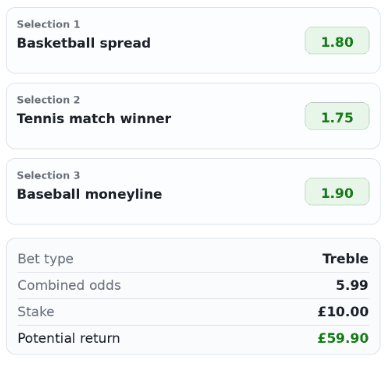
Here’s how that might look across a few different sports:
Selection Odds
Basketball spread 1.80
Tennis match winner 1.75
Baseball moneyline 1.90
How Treble Bets Work
Combined odds and potential return calculation:
1.80 x 1.75 x 1.90 = 5.99
£10 (stake) x 5.99 = £59.90 potential return
Best Sports for Treble Betting
I find that trebles work best when each selection represents an independent event. Markets with relatively stable pricing models are also better.
| Sport | Ideal Market | Typical Odds | Why It Works |
| Tennis | Match Winner | 1.40-2.20 | Clear individual match probabilities |
| Basketball | Moneyline | 1.80-1.95 | Consistent scoring models |
| Baseball | Moneyline | 1.60-2.10 | Daily markets with strong data |
| Football | Match winner/totals | 1.60 -2.00 | Deep statistical history |
Kicking things off by looking at expert betting tips and analysis is a good way to start. After that, check that each pick stands independently from the others. If you have three selections all in one football game, then if the first one fails, that impacts the likelihood of the next two.

Why Treble Betting Works
Trebles Are About Probability Multiplication
The maths behind accumulators often surprises people.
- Bet A probability: 60%
- Bet B probability: 55%
- Bet C probability: 50%
Combined probability of A, B & C: 0.60 × 0.55 × 0.50 = 16.5%
Even though each individual bet appears relatively strong, the overall chance of winning the treble is far lower.
Treble Betting Pros & Cons
Pros
Higher potential payout than singles
Efficient way to use small stakes
Interest across multiple matches
Cons
Lower hit rate
Greater variance
One losing leg cancels the bet
The 3 Drivers of Treble Value
Despite the lower probability, I still enjoy placing accumulators. These three factors are what I consider when looking for a good value treble.
- 1
Independent selections
Each leg should stand alone. Combining a tennis match and a basketball spread keeps events totally unconnected.
- 2
Fair odds pricing
Just like you wouldn’t take poor odds on a single bet, it’s the same for a treble.
- 3
Avoid correlated markets
A common mistake is stacking related outcomes like a football team to win and the same team over 2.5 goals.
- 4
Settlement Rules
Treble bets follow standard accumulator settlement rules.
- If one leg loses, the entire bet loses
- If a selection is void, odds recalculate as a double
- If a push occurs, that leg becomes void
- If all legs win, the bet pays at combined odds
Treble Betting vs Other Markets
| Number of Legs | Combined Odds | Hit Rate | Risk Level |
| Double | 3.0-4.0 | Moderate | Medium |
| Treble | 5.0-8.0 | Lower | High |
| 5-fold | 15+ | Very Low | Very High |
Trebles vs Singles
Singles prioritise consistency, while trebles trade that consistency for larger potential payouts.
Trebles vs Larger Accumulators
Five or six-leg accumulators dramatically increase variance. Trebles often strike a better balance between probability and return.
Trebles vs In-Play Betting
In-play betting reacts to live events, while treble bets are usually constructed before matches begin.
Calculating Treble Probability & Value
Knowing how odds convert to implied probability is important when betting trebles.
Odds Implied Probability
1.80 55.6%
1.90 52.6%
2.00 50%
Combined probability of above three prices: 0.556 × 0.526 × 0.50 = 14.6%
That means a treble with those odds would statistically land roughly once every seven attempts, assuming perfect pricing.
If the combined odds imply a probability lower than your own estimate, the bet may contain value. If the odds are shorter than your model suggests, then it’s not good value.
Drivers of Treble Success
Several factors tend to shape whether a treble performs well:
- Selection independence: Combining unrelated sports markets reduces ‘hidden’ correlation.
- Pricing efficiency: Some markets, especially niche ones, can misprice.
- Market stability: Late lineup changes, injuries, etc. can affect outcomes.
Example: A bet involving a rugby match, an MLB moneyline, and a tennis favourite. All three were priced between 1.65 and 1.90. Two legs won comfortably, while the rugby game turned after a late red card. Even well-researched selections can be undone by unpredictable events.
Case Study — Treble Outcome
Here’s a midweek treble of mine from 2023:
Selection Odds
Real Madrid vs Manchester City – Over 2.5 goals 1.70
Inter Milan to beat AC Milan 1.80
San Diego Padres to beat Kansas City Royals 1.75
Combined odds: 5.36
Stake: £15
This one felt well-structured at the time. The Champions League fixtures gave two high-profile matches with clear narratives, and the MLB leg rounded things out with a slight favourite.
Results:
- Real Madrid beat Manchester City 3–0
- Inter Milan beat AC Milan 1–0
- Kansas City Royals beat San Diego Padres 4–3
The two football legs played out exactly as I’d expected. The MLB leg, though, flipped late. The Padres led early but couldn’t hold it, with the Royals edging the game by a single run. That was enough to sink the entire treble.
The football selections were heavily analysed,narrative-backed, and relatively stable, but the basketball leg carried more game-to-game volatility. MLB outcomes can be influenced by:
- Starting pitcher variance
- Bullpen performance
- Small scoring margins
Adding a small edge selection from a high-variance sport can sometimes dominate the entire treble. That’s something I now actively account for when building trebles. It’s not just about whether a selection is likely to win; it’s about how stable that probability actually is.
Risk & Bankroll Management
Treble bets should represent a small portion of your betting bankroll. Hit rates are lower, so it’s sensible to allocate smaller stakes, for example:
- 70–80% bankroll for singles
- 10–20% for doubles or trebles
- Occasional larger accumulators
This structure allows the fun of a treble without allowing variance to dominate results.
When Treble Bets Create Value
Trebles make sense if:
- Selections come from independent markets (football, tennis, and baseball)
- Odds slightly underestimate probability (the odds are longer than your model suggests they should be)
- Markets overreact (there’s a big swing after some not-so-big news)
When to Avoid Treble Bets
Some situations make treble bets a bad idea:
- Correlated outcomes (a football team to score over 2.5 and win)
- Inflated odds on popular teams
- Lineup uncertainty
- Volatile markets
Common Treble Betting Mistakes
Several patterns appear repeatedly in accumulator betting.
- Adding too many legs: A three-selection treble already carries reduced probability.
- Betting emotionally: Backing your favourite team is rarely a good move.
- Stacking correlated markets: Related outcomes increase hidden risk.
- Chasing large payouts: Large returns often come with extremely low probability.
Treble Betting Checklist
Before placing a treble, I usually run through a short checklist:
- Are the selections independent events?
- Would I bet each selection individually?
- Do the combined odds reflect realistic probability?
- Is the stake within my bankroll limits?
If the answer to any of those questions is no, it’s usually a signal to reconsider.
Conclusion
Over time, I’ve come to view treble betting as a probability exercise.
Three selections may appear reasonable individually, yet their combined probability shrinks quickly once the outcomes multiply together. The edge comes from selecting balanced, independent events rather than chasing inflated returns.
When used carefully, treble bets can sit comfortably alongside single wagers in a betting strategy. The key is discipline - and remembering that every additional leg changes the equation.
FAQs
What happens if one leg loses?
If any selection loses, the entire treble loses.
Can treble bets include multiple sports?
Yes. Many bettors combine selections across sports.
Are treble bets profitable long term?
They can be profitable if selections consistently contain value, but the lower hit rate means results can vary significantly.
How are treble odds calculated?
The odds of each selection are multiplied together to produce combined odds.
Are trebles better than larger accumulators?
In many cases, they balance risk and reward more effectively than accumulators with five or more selections.

Claudia Hartley is a versatile content writer and editor with a strong footing in digital publishing, particularly within the iGaming and affiliate space. With nearly a decade of experience, she has built a reputation for producing clear, engaging, and well-researched content that connects with readers while meeting SEO goals.
Comments
0 comments
No comments yet. Be the first to share your thoughts!
Related Resources to Betting Academy
- How Goliath Bets Work in Sports Betting
- Combination Bets Explained
- Cash Out or Let It Ride? How to Make the Right Call on Your Acca
- How Futures Betting Works 2026 Explained with Value Odds and Risk Factors
- Double Betting Explained: The Expert Strategy Playbook 2026
- Card Betting Explained: Strategy, Odds & How to Find Value
- Single Betting Explained: Odds, Probability & Value Guide
- System Betting Explained
- European Handicap Betting Explained
- Spread Betting Explained: Expert Playbook & Strategy Guide 2026