
Betting Academy
System Betting Explained: My Math-Backed Strategy
The first time I placed a proper multi-leg system bet at Betway, it had absolutely no right landing. Three selections. One was a marginal underdog. One needed a late goal for BTTS. One scraped through in injury time. Statistically? It was thin. But it came in. The doubles paid. The treble hit. I walked away thinking I’d cracked something. That early win did more damage than an early loss ever could have. It took me a while to realise that system betting isn’t about stacking good opinions and hoping for magic. It’s about understanding how combinations multiply probability and how quickly exposure compounds when one leg fails. Once I started to study coverage probability and correlation between events, my approach shifted from hopeful to structured. This is the framework I now use before reviewing top betting platforms and placing a system bet.

SportsBoom offers honest and impartial UK bookmaker reviews to help you make informed choices. While we may earn commissions through affiliate links, our content remains independent and free from promotional influence. For more information, see our Content Transparency and How We Review pages.

System Betting Explained
Types of System Bets — Quick Intro
Before we get into tips and tactics, it’s really important to understand the structure of system bets.
- Doubles and Trebles: Here, you’ve got two or three selections that must all win. Clean. High variance. No safety net.
- Trixie: This takes three selections and creates four bets: three doubles and one treble. You gain partial coverage if one loses.
- Yankee: This uses four selections to generate 11 bets (six doubles, four trebles, one four-fold). Exposure rises quickly here.
- Patent: This includes singles alongside combinations (seven bets total), softening the downside.
Later, I’ll use these exact formats to break down real profit and loss outcomes and give some examples using football wagering platforms.
What Is System Betting?
Let’s take Liverpool vs Manchester City, for example. If I place a £50 single on Liverpool to win, one thing decides the outcome. They win, I’m paid. They don’t, I lose the stake.
If I instead pair a Liverpool win with an Arsenal win to nil, in a double, now both must land. If one team fails to win, it wipes out the whole bet.
System betting usually sits somewhere between those two extremes. It combines multiple selections into structured sets of bets, spreading your stake across combinations, rather than placing everything on one outcome.
The key difference is coverage. Except in the case of doubles and trebles, you’re not relying on every leg winning to see a return. That’s because in certain formats, partial wins can still generate profit (or at least reduce the loss) depending on how the combinations are built.
In a standard Trixie (three selections, four bets), you can still be paid even if one selection loses.
If two win, one of the doubles still pays out. Whether that creates profit depends on your odds and stake per line - but structurally, you’re not dead after one miss.
How System Betting Works
It’s easy to get carried away when you see expert football betting tips that can be bundled into a huge payout from a modest stake, but the figures behind the betslip tell a far more important story than the headline return.
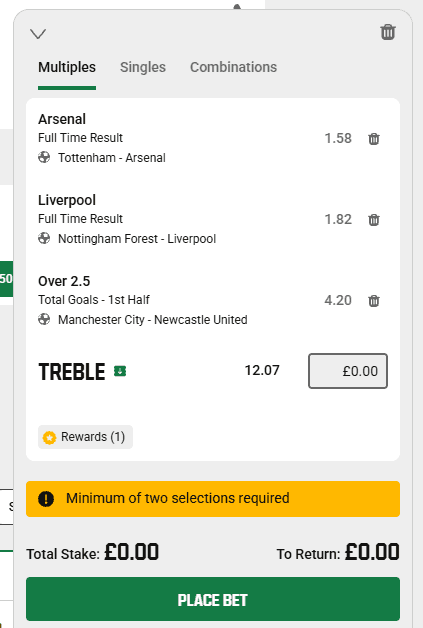
How System Betting Works
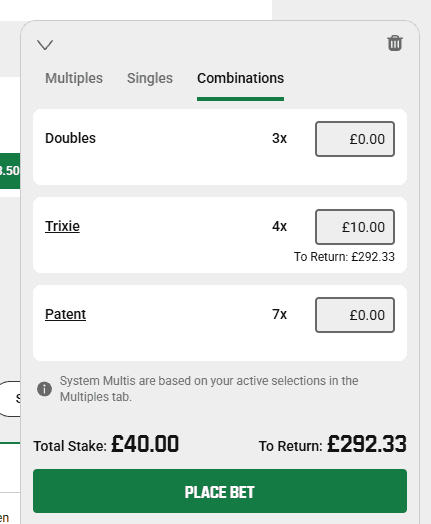
Using the three selections above at £10 per line
Using the three selections above at £10 per line, a Trixie creates four bets (three doubles + one treble). That means a £40 total stake, not £10.
Here’s how it’s distributed:
Selections:
- Arsenal - 1.58
- Liverpool - 1.82
- Over 2.5 Goals (1st Half) - 4.20
If all three win:
Double 1: (Arsenal) 1.58 × (Liverpool) 1.82 = 2.88 or £28.80
Double 2: (Arsenal) 1.58 × (Over 2.5) 4.20 = 6.64 or £66.40
Double 3: (Liverpool) 1.82 × (Over 2.5) 4.20 = 7.64 or £76.40
Treble: (Arsenal) 1.58 × (Liverpool) 1.82 × (Over 2.5) 4.20 = 12.07 or £120.70
Total return: £292.33 and potential profit: £252.33
If one loses:
If the 4.20 first-half goals bet loses (let’s face it, pretty likely!), but Arsenal and Liverpool both win:
Only one double survives (1.58 × 1.82 = 2.88)
Return: £28.80
Total stake was £40.
You still lose £11.20.
If instead one of the shorter-priced teams loses and the 4.20 lands, returns improve - because the surviving double is larger. That’s the nuance.
If two lose:
All combinations fail. Your full £40 is lost.
This is why I never judge a system bet on the maximum return shown on screen. Instead, look at:
- Which leg is carrying volatility (here, the 4.20)
- How often two selections realistically land together
- Whether the surviving doubles would cover the total stake
That’s the kind of structural thinking that’s important, rather than being blinded by the potential payout.
Remember: Combining selections doesn’t remove bookmaker margin!
Imagine a 1X2 market priced: 2.00, 3.60, 4.00
The implied probabilities are: 50.0% + 27.8% + 25.0% = 102.8%
That extra 2.8% is the overround.
Now take two selections priced at 1.95 that should be true 2.00 shots.
1 / 1.95 = 51.3% implied probability.
Combined in a double:
51.3% × 51.3% = 26.3%
But, a fair 50% × 50% double should be 25%?
That 1.3 percentage-point gap is margin being compounded.
System betting doesn’t eliminate that. It multiplies it. That’s why finding a genuine edge is so important.
Best Sports for System Betting
While you can place system bets on basically any sport, some markets tend to lend themselves to it better than others. Scoring patterns, price ranges and variance profiles are the areas that create (or decimate) value.
Here’s how I approach it across different markets:
Football: Goal & Result Doubles
Let’s take a look at one weekend’s Premier League slate for a classic system setup:
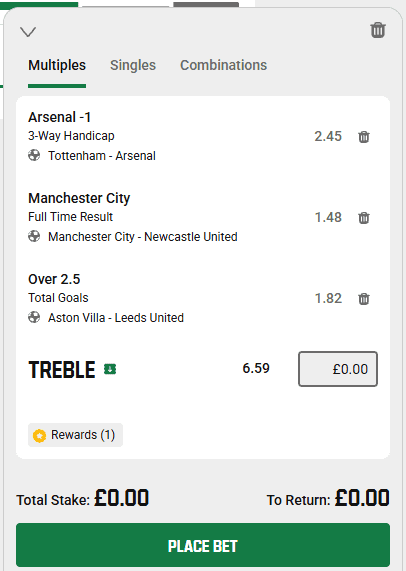
Goal & Result Doubles
Arsenal -1 Handicap - 2.45
Manchester City to win - 1.48
Aston Villa vs Leeds United 2.5 Goals - 1.82
Instead of rolling all three into a straight treble, I’ll often Trixie them. This gives you a bit more coverage for not too much of a drop in odds - though remember your stake rises!
Football prices tend to cluster between 1.50 and 2.50, which makes doubles viable if one selection fails. Plus, it’s often easy to find Premier League bet offers to give the value an extra boost.
When I’m structuring these, I’ll usually cross-check form and tactical angles against broader football betting insights before committing combinations.
Horse Racing: Across-Card Doubles
Let’s have a look at the upcoming card for the Cheltenham Festival.
Supreme Novices Hurdle - Talk the Talk (5.0)
The Arkle - Lulamba (2.63)
Unibet Champion Hurdle - Constitution Hill (3.50)
Racing is naturally high variance - after all, horses do have minds of their own! This can make straight accumulators brutal. A Yankee or Trixie allows you to survive one shock result, which, let’s face it, is common over jumps.
But the key is price clustering. If two short-priced runners win and the bigger one loses, you need those doubles to justify the total stake.
Tennis - Two-Leg Match Systems
Let’s look at a trio of mid-week indoor tennis matches:
Carlos Alcaraz to win - 1.40
Jannik Sinner to win 2–0 - 1.85
Daniil Medvedev Over 22.5 Games - 1.95
Rather than a three-leg accumulator, I may structure a patent if volatility looks high. Tennis can swing on one break of serve, so your coverage matters far more than headline payout.
NBA - Spread & Totals Systems
This NBA board offers another strong system angle:
Boston Celtics -6.5 - 1.91
Lakers vs Suns Over 228.5 - 1.91
Denver Nuggets ML - 1.65
Basketball works well because possession volume smooths variance a little, especially compared to football. Two-leg doubles on spreads and totals can provide stable combinations.
But! Correlation matters. I avoid pairing pace-heavy overs with heavy favourites, unless the data supports it.
System betting works best where pricing is relatively efficient, but variance isn’t extreme. Football, NBA, and tennis generally offer cleaner structures. Racing offers ample opportunity, but only if you’re comfortable absorbing those swings.
Best Leagues for System Betting (Multi-Sport Mix)
One of the best things about betting on sports is the huge difference across leagues. Sure, it makes things more challenging, but isn’t that part of the fun?
When I’m building a system bet, I’ve got a few league-specific questions that I always keep in mind.
- Does this league produce clustered odds?
- Are results binary or swing-heavy?
- Will two correct reads likely land together?
Best Leagues for System Betting (Multi-Sport Mix)
| League | Typical Odds Range | Suitability? |
| Premier League | 1.45 - 2.60 | Trixies and Doubles (Goal & Result) |
| NBA | 1.85 - 1.95 | Structured Doubles (Spreads & Totals) |
| NFL | 1.85 - 1.95 | Key Numbers Important (Spreads) |
| ATP/WTA | 1.35 - 2.10 | Patents & Controlled Doubles |
| Cheltenham | 2.50 - 8.00+ | High variance, partial coverage best |

The Premier League is ideal for combining a handicap with a totals market, as prices often sit in that small cluster, meaning one miss doesn’t always nuke the entire structure.
The NBA is arguably the cleanest system environment. Spread pricing is efficient, possession counts are high, and doubles on -110 style lines compound predictably.
You have to respect key numbers like 3 and 7 in the NFL. A -2.5 to -3 move really changes cover probability, which matters even more inside a system bet.
Then there’s Cheltenham - it’s a marmite sport and perhaps even more so at the big festivals, but I love them. There’s an incredible opportunity and huge liquidity, but shocks are common. I rarely play straight trebles there. If I’m involved, it’s usually structured for survival.
Why System Bets Create Value
System bets create value when they’re structured around probability rather than optimism.
The format controls variance, but it doesn’t create edge. Value only exists if the selections themselves are mispriced. Otherwise, you’re just multiplying neutral (or negative) expectation.
The obvious benefit is risk spreading. Instead of tying everything to one fragile accumulator, you distribute your stake across multiple combinations, increasing the chance of at least a partial payout if one leg fails.
The real edge comes from selective combinations. If you believe two markets are slightly undervalued and a third carries volatility but upside, a Trixie or Yankee allows the stronger reads to carry the bet.
Let’s look at a quick example:
You’ve got three selections at 1.80, 1.95, and 3.20.
In a Trixie, if the 3.20 loses but the two shorter prices win, the surviving double returns 3.51.
Depending on your stake per line, that can limit damage or even produce a small profit. Because you structured the bet right, you weren’t wiped out.
Winning vs Coverage in Systems
In a four-leg Yankee, you’re placing 11 bets. If three win and one loses, your four-fold dies immediately. Psychologically, that feels like failure - we all want all of the combinations to win. But structurally? It isn’t.
Those three winners still create three trebles and three doubles. As long as prices were in the 1.80-2.20 range, the combined returns from those surviving lines outweighed the total stake.
The key is understanding that a single loser doesn’t equal a losing bet. What matters is how many combinations survive and whether their compounded odds justify that bet that lost.
System betting doesn’t have to be about perfection; you just need to survive mistakes profitably.
Pros & Cons of System Betting
Pros
Spreads risk across multiple combinations rather than relying on one outcome
Creates partial payout opportunities when one selection loses
Works well across football, NBA, tennis, and racing
Rewards structured thinking for building probability coverage
Cons
Maths becomes more complex as combinations increase
A four-selection Yankee at £10 per line = £110 total stake
Two losing legs can significantly damage ROI
Higher upfront capital required compared to singles
The 4 Drivers of System Value
When I build a system bet, I always have structural drivers in mind - those are the factors that determine how the bet performs once the selections are combined.
Selection Confidence - Price vs Edge
It’s tempting (and far quicker) to include a leg just because it looks likely.’ But it’s not the way to get results. I only include a leg if the price is wrong relative to my projection.
Example: If I make a team 1.60 and the market offers 1.80, that edge compounds inside doubles and trebles. How much difference does this actually make? Let’s run through it.
If I make a team 1.60, that implies a true probability of: 1 / 1.60 = 62.5%
If the market offers 1.80, the implied probability is: 1 / 1.80 = 55.6%
That’s a 6.9% probability gap in my favour.In a system bet, you benefit (or suffer!) from compounding.
In a double it looks like this: 1.80 x 1.80 = 3.24 or ‘our price’ 1.60 x 1.60 = 2.56
And probability-wise: 55.6% × 55.6% = 30.9% or ‘our price’ 62.5% × 62.5% = 39.1%That makes an 8.2 percentage-point swing in win probability, because you’re not just multiplying odds, but also mispricing.
Correlation of Events - Avoid Tight Overlap
Too much correlation basically kills systems. Pairing a heavy favourite with an under 2.5 in the same match might feel logical, but if the game state shifts, both collapse together.
I prefer independent events so that if it all goes pear-shaped in one, you’ve still got a fighting chance at the other covering the damage. Think of an NBA spread and an unrelated tennis match total.
Stake Management - Proportional Across Lines
A Yankee, for example, isn’t one bet, it’s 11. If I’m staking £10 per line, I’m committing £110. I scale stake size based on total exposure, not per selection.
Market Volatility - Target Controlled Swings
High-volatility legs (like a 3.50 racing runner) belong in coverage formats like Trixies. If it wins, your upside accelerates. If it loses, then at least the structure survives.
Settlement Rules
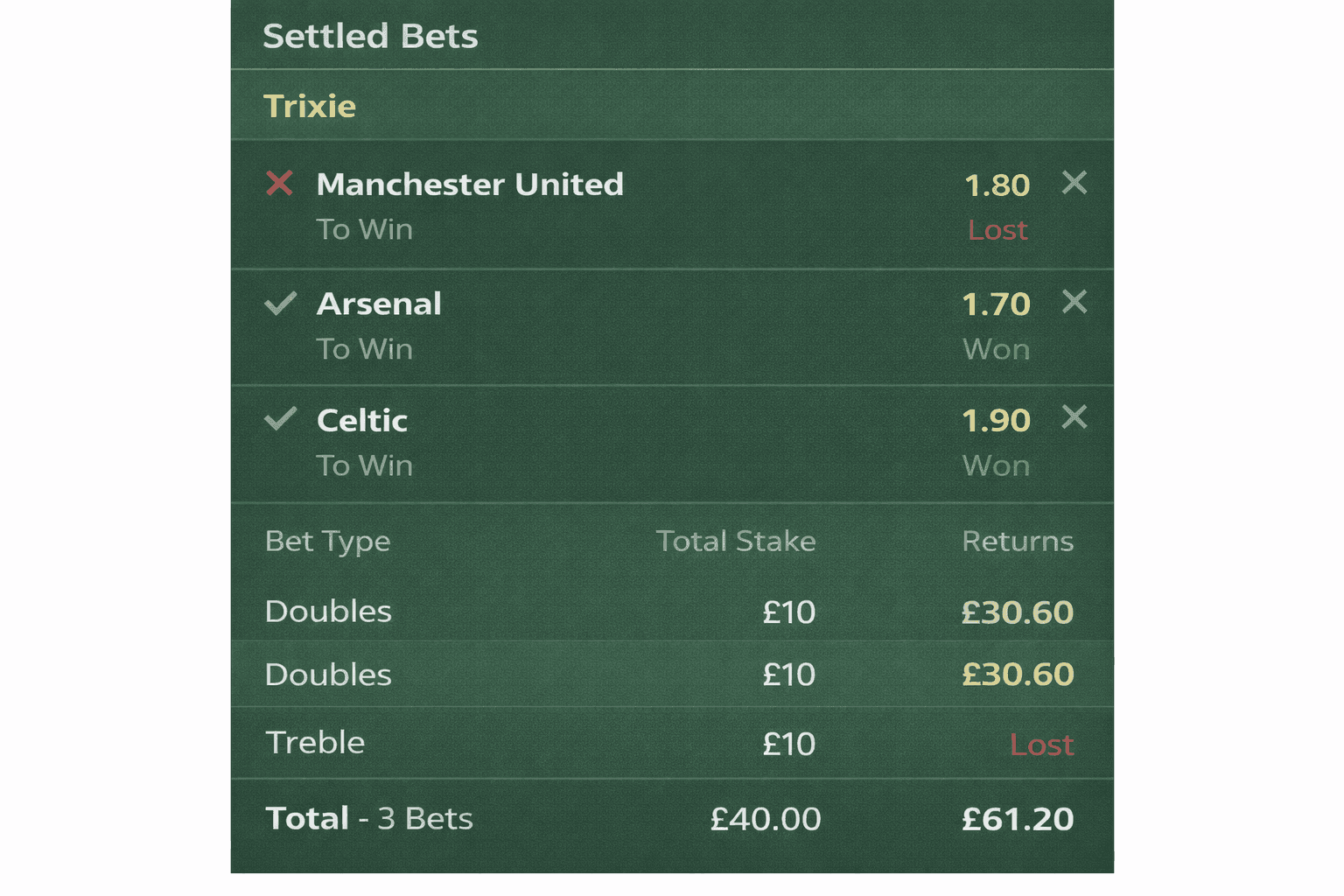
Settlement Rules..
Before placing any system bet, it’s super important to check how the settlement works.
- Full win: That leg counts normally inside every combination.
- Partial win: This doesn’t really exist in systems, you either win the leg or you don’t - but surviving combinations create partial returns.
- Voided selection: This reduces the number of active legs. In most formats, that leg is simply removed, and the affected lines recalculate at lower odds.
- Push rules: For example, a -3 spread (whole number) can push if the team wins by exactly three. A -3.5 can’t.
Example: In a Trixie, if one leg is void, you’re effectively left with a double. Your total exposure drops, but so does upside.
Common System Betting Mistakes
Everyone makes mistakes, and system bets are one of the easiest ways to make them.
Miscounting combinations: A four-selection Yankee isn’t one bet exactly, it’s 11 lines. At £10 per line, that’s £110 risked, not £10.
Ignoring correlation: Pairing a heavy favourite with an under in the same football match might look sensible, but one late goal can sink both legs at once.
Too much risk: Three 3.50 shots rarely produce stable doubles!
Push and void rules: These often get misread. I once saw a bettor assume a -3 spread win counted fully in a Yankee. It pushed, meaning several lines recalculated, and that decent expected profit - well, that evaporated.
Let’s look at a quick example of why losing runs are made worse by the system bet format.
Let’s say I place five consecutive Trixies, £20 per line (£80 total each). That’s £400 exposure across the run.
If results look like this:
Bet 1: Two wins, one loss = £15 loss
Bet 2: One win, two losses = £80 loss
Bet 3: Two wins, one loss = break-even
Bet 4: One win, two losses = £80 loss
Bet 5: All three lose = £80 loss
Drawdown = £255
Nothing reckless happened; six winners came in, with no wild 10.0 shots. Just normal variance.
The reality is that while systems smooth single-bet volatility, they do not prevent drawdowns.
How I Evaluate a System Bet
This is the exact checklist I run before committing money. If one step fails, I pass.
Identify Value Selections
I only start with prices I’ve made shorter than the market. If I can’t genuinely justify the edge, then it doesn’t make it to the bet.
Choose System Type
This is the step where I consider the risk tolerance of the bet. If I’ve included a high volatility leg, then I’ll lean Trixie or Patent. Four solid 1.85-2.10 reads? This is the kind of selection where a Yankee becomes viable.
Calculate Stake Per Line
I determine what I feel comfortable staking first, then divide that by the number of combinations. It sounds obvious, but you’d be amazed how many punters do it the other way around!
Assess Correlations
If I’ve come up with any same-match legs or tempo overlaps, they get scrutinised. If outcomes rise and fall together, then I restructure or remove one of those legs.
Decide: Bet or Pass
With all of that done, I check how my bet runs. If surviving doubles can’t realistically cover my stake, then I don’t make it.
Step
Question
Outcome
Value
Are at least two selections mispriced?
Yes
Volatility
Is one leg above 3.00?
Yes
Structure
Trixie or Yankee?
Trixie
Exposure
Comfortable with £60?
Yes
Correlation
Independent events?
Yes
Example:
- I’ve got three selections at 1.85, 1.95, and 3.20 that I believe to be priced long.
- One of those odds is above 3.00
- I choose a Trixie (£20 per line = £80 total).
- I’m comfortable with the total of £80, and none of the legs are in the same event.
- If the 3.20 fails but the two shorter edges land, the double returns 3.61.
- With the checklist ticked off, I place this bet.
Here’s how that might look on an afternoon’s horse racing bet slip:
System Betting vs Other Markets
System betting sits between singles and accumulators, but the unique format means systems can behave differently.
System Vs Singles
Singles offer clean risk/reward. One £50 bet, one outcome. If I strongly rate a 2.10 selection and don’t have other edges, I’ll stick with a single.
Systems are better when I have multiple modest edges rather than one strong conviction.
System Vs Accumulators
Accas magnify upside but provide zero forgiveness. Three legs at 1.90 in a treble, either all win or the bet dies.
In a Trixie, two winners still create a paying double. If I expect one leg to be fragile, I prefer that coverage.
System Vs Asian Handicap / Spread Bets
Spreads and Asian handicaps already build in margin logic. If I’m betting a single -2.5 handicap at 1.95, that’s a pure probability play. But, if I have two independent spread edges in different matches, pairing them inside a controlled double or Trixie allows me to compound price inefficiencies while limiting the risk of a total collapse.
Systems can give a solid payout size, but they come into their own because there are ways to be wrong and still survive.
When I Avoid System Betting Completely
I enjoy system betting because it often makes sense, but there are plenty of times when I won’t touch it.
Extreme variance events: These are first on the list. First goalscorer, red card markets, or small-field racing with unpredictable pace setups. Stacking volatile outcomes just multiplies randomness.
Motivation and Injury info: If a key striker is ‘50/50’ or rotation is likely before a European fixture, it’s not for me. While odds compound inside combinations, so does uncertainty.
Late-line steam: If prices have moved aggressively and I’ve missed the number, forcing it into a system just means compounding reduced value.
System Betting Checklist
Before placing any system, I run this quick filter:
- Value odds: Have I priced at least two legs shorter than the market?
- Event correlation: Are outcomes independent?
- Stake per line: Am I comfortable with total exposure?
- Coverage probability: Do surviving doubles realistically cover the stake?
- Market volatility: Is it only one leg high-variance?
Example: Three selections at 1.85, 1.95, and 3.10. Independent events. £15 per line Trixie (£60 total). If the 3.10 loses, the 1.85 × 1.95 double returns 3.60 - enough to limit downside. For this example, the checklist works, so I place the bet.
Conclusion
System betting isn’t about chasing inflated returns. It’s about structure.
Over time, I’ve learned that the format itself doesn’t create profit, the selection quality and stake discipline do. If I don’t have clear pricing value, I don’t force combinations. If the surviving doubles can’t justify exposure, I pass.
The real advantage of system betting is control. You decide how much coverage you want. You decide how much volatility belongs inside the structure - and you decide when the numbers simply don’t make sense.
When approached properly, system betting rewards organised thinking, not luck.
FAQs
What is a system bet?
A system bet splits your selections into multiple smaller combinations rather than tying everything into one accumulator. Instead of needing all legs to win, certain formats allow you to survive one mistake.
How do partial wins work?
Partial wins happen when some combinations land but others fail. For example, in a Trixie, if two selections win and one loses, the surviving double still pays. Remember to check whether that double would realistically cover your total stake.
Are systems safer than accumulators?
Structurally, yes, because they offer coverage. But they require higher upfront exposure.
Which sports suit system bets best?
Sports with clustered odds and stable scoring patterns, like football, NBA spreads,and tennis. While horse racing is also popular, avoid lots of long prices.
How do I calculate potential payout?
Multiply the odds within each combination, then multiply by your stake per line. Evaluate your worst-case surviving scenarios, not just max return.

Claudia Hartley is a versatile content writer and editor with a strong footing in digital publishing, particularly within the iGaming and affiliate space. With nearly a decade of experience, she has built a reputation for producing clear, engaging, and well-researched content that connects with readers while meeting SEO goals.
Comments
0 comments
No comments yet. Be the first to share your thoughts!
Related Resources to Betting Academy
- How Goliath Bets Work in Sports Betting
- Combination Bets Explained
- Cash Out or Let It Ride? How to Make the Right Call on Your Acca
- How Futures Betting Works 2026 Explained with Value Odds and Risk Factors
- Double Betting Explained: The Expert Strategy Playbook 2026
- Card Betting Explained: Strategy, Odds & How to Find Value
- Treble Betting Explained: How it Works
- Single Betting Explained: Odds, Probability & Value Guide
- European Handicap Betting Explained
- Spread Betting Explained: Expert Playbook & Strategy Guide 2026