
Betting Academy
Card Betting Explained: Strategy, Odds & How to Find Value
There are three things I look for when betting card markets: The temperature of the match The referee The tactical setup This market isn’t about who will win, who will score, or even who’ll play better - it’s about whether it’s a bad-tempered-enough fixture to offer Over value. Looking at referee averages helped me settle on this winning bet

SportsBoom offers honest and impartial UK bookmaker reviews to help you make informed choices. While we may earn commissions through affiliate links, our content remains independent and free from promotional influence. For more information, see our Content Transparency and How We Review pages.

Example of Total Cards Bet
John Brookes has high card averages, around 4.2 cards per match this Premier League season. So, when I saw he was refereeing the Chelsea v Brentford game, I thought it would be worth looking into.
Chelsea are regularly in the top table for Premier League fouls, while Brentford had one of the highest foul rates this season, too. So, with a referee that tends to hand out more cards per match and two teams that weren’t afraid of tactical fouls, the Over 4.5 cards at 1.83 seemed like a solid bet. That match ended with 5 yellows.
Remember that even well-researched card bets reflect probability, not certainty. Card markets can turn on one soft caution, so it’s best to keep stakes small and only bet at licensed sportsbooks
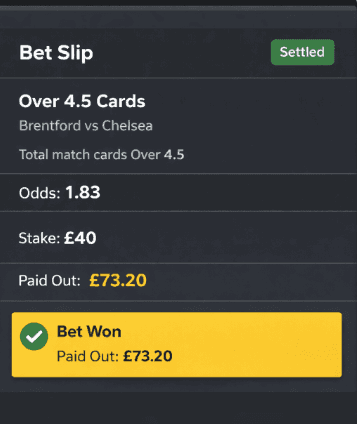
Bet Slip
How Card Betting Markets Work
There are a handful of different structures you can choose from when card betting:
- Total match cards - how many cards are given in the full match
- Team cards - how many cards one team receives
- Player to be carded - if an individual player receives a card
- First card - which player gets booked first
While total cards lean heavily on referee and match dynamics, player card bets depend more on that player’s role - and sometimes reputation. Most of the time, I stick to totals because there’s a lot more data available and I believe they’re less fragile. One substitution can ruin a player bet, but totals give you more margin for error.
Example of Total Cards Bet:
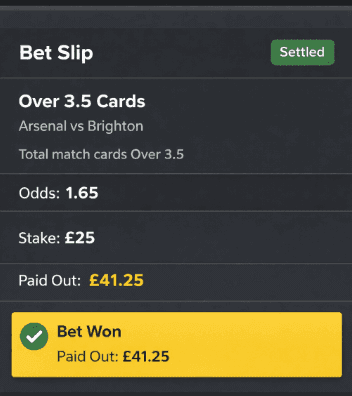
Example of Total Cards Bet
This bet offered odds of 1.65, which implies a probability of 60.6%. I felt that this game had a higher implied probability because of the referee and Arsenal being top of the table for cards this season.
Here’s the calculation for working out implied probability:
1/odds = implied probability
1/1.65 = 0.606 or 60.6%
Players are only booked for a fraction of fouls in the Premier League, roughly one card for every 4- 5. That’s why it’s important to consider factors outside of fouls as well.
How Card Betting Markets Work
There are a handful of different structures you can choose from when card betting:
- Total match cards - how many cards are given in the full match
- Team cards - how many cards one team receives
- Player to be carded - if an individual player receives a card
- First card - which player gets booked first
While total cards lean heavily on referee and match dynamics, player card bets depend more on that player’s role - and sometimes reputation. Most of the time, I stick to totals because there’s a lot more data available and I believe they’re less fragile. One substitution can ruin a player bet, but totals give you more margin for error.
Example of Total Cards Bet:
Example of Total Cards Bet
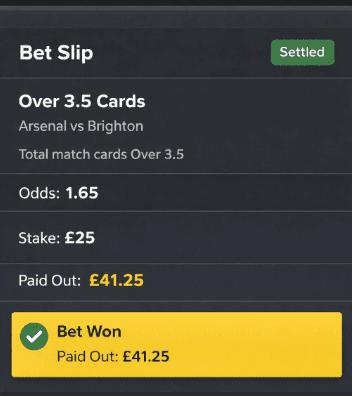
This bet offered odds of 1.65, which implies a probability of 60.6%. I felt that this game had a higher implied probability because of the referee and Arsenal being top of the table for cards this season.
Here’s the calculation for working out implied probability:
1/odds = implied probability
1/1.65 = 0.606 or 60.6%
Best Leagues for Card Betting
Some leagues naturally run hotter than others - and that can be where your over value is found.

Even with the best research in the world, sometimes it doesn’t go your way. Back in October 2019, I lost out on an over 5.5 total cards bet on Real Sociedad vs Getafe. The game finished with four yellows and a red, despite Getafe’s reputation as one of the more physical teams in a pretty physical league. It’s a good reminder that league averages and team profiles don’t guarantee outcomes.
Card Betting vs Other Markets
Match result betting is driven by team quality. Goals markets depend on finishing and chance creation. Player props rely heavily on minutes and role.
Card markets are more behavioural.
That makes them less tied to overall tea strength, but more sensitive to context. A poor-quality match can still produce high card totals. The big trade-off is volatility, as one refereeing decision can change the entire outcome. For me, card betting is a specialist, occasional angle rather than a core market.
Pros & Cons of Card Betting
Pros
Clear statistical patterns exist
Referee behaviour is measurable
More niche market
Cons
Decisions can be subjective
Game state can change quickly
Card Betting vs Other Markets
Match result betting is driven by team quality. Goals markets depend on finishing and chance creation. Player props rely heavily on minutes and role.
Card markets are more behavioural.
That makes them less tied to overall tea strength, but more sensitive to context. A poor-quality match can still produce high card totals. The big trade-off is volatility, as one refereeing decision can change the entire outcome. For me, card betting is a specialist, occasional angle rather than a core market.
Understanding Card Betting Odds
Odds tell you what the market expects, not necessarily what will happen. Here’s how to convert into implied probability:
Implied probability = 1 ÷ odds
So odds of 1.65 imply a probability of 60.6%.
If my odds are 1.65 and I believe the real probability of the outcome is higher than that, there’s potential value. If not, I leave it.
Card lines are usually built around league averages first, then adjusted slightly for teams and referees. That’s why you’ll often see similar lines across very different fixtures.
Sometimes you’ll notice odds move before fixtures; there are plenty of reasons, but the most common are:
- Referee gets appointed
- Team news changes
- Market reacts to perceived match intensity
It’s not all meaningful; it’s up to you to decide if it is!
Drivers of Card Betting Value
I find that value usually comes from small mismatches between the line and the underlying data. I look at:
● Referee assignment
● Team foul rates
● League baseline
● Match context
For example, I’ll pay much closer attention to a game where both teams rank highly for fouls, and the referee averages above five cards per match. That combination pushes the expected range upwards, even if the line hasn’t fully adjusted.
Remember, the edge rarely comes from one factor on its own. Ideally, you want multiple signals all pointing in one direction.
Case Study — Card Betting Outcome
I placed a bet on the over 4.5 cards market in a Tottenham vs Chelsea in November 2023. I took odds of 1.8 and had £40 on. Why?
- Both teams ranked highly for fouls
- The fixture carried intensity (London derby)
- Michael Oliver was the referee and often sits above league averages for bookings
The match produced 5 yellow cards and 2 red cards, clearing the line comfortably.
Rather than celebrating, I looked at how that result had happened. I’d combined three key drivers of card betting value and recognised that the general league average odds didn’t reflect the conditions of this match.
Risk & Bankroll Management
Card markets can be volatile, so stake sizing matters, perhaps even more than normal.
I tend to stick to 1–2% of my bankroll on a single card bet, so if I’m working with £1,000, that means £10–£20 per bet. Keeping stakes small helps keep variance under control.
The other key rule I stick to is avoiding emotional bets. A single decision going against you doesn’t mean the analysis was wrong.
When Card Bets Create Value
I see value when the market sets a generic line in a non-generic match. That could mean:
- A derby, but where neither team is known for aggressive play
- A strict referee that’s not been factored into the price
When to Avoid Card Bets
Sometimes card bets don’t make sense:
- Low-stakes matches
- Referees with limited data
- Passive or possession-heavy teams
If the match doesn’t naturally generate fouls, there’s no point forcing it.
Common Card Betting Mistakes
The biggest mistakes are:
- Ignoring referee data
- Betting rivalries blindly
- Focusing only on recent matches
- Assuming more fouls always means more cards
Card Betting Checklist
Before placing a bet, I run through a quick checklist:
- What is the referee’s average?
- Do both teams foul consistently?
- Does the match carry real intensity?
- Is the line aligned with the data?
If I can’t confidently answer all four, I usually pass.
Conclusion
For me, card betting isn’t about predicting chaos (though that part is fun), it’s more about spotting patterns.
Referees, team behaviour, and match context all leave clues. When those clues point in the same direction, and the price hasn’t fully caught up, that’s where the opportunity sits. Nothing lands every time, but consistency does help results.
FAQs
What counts as a card?
It depends on the bookmaker. Some use total cards, others use booking points where red cards equal two points. Always check the rules.
Do red cards count differently?
In booking points, yes. A straight red usually carries a higher value than a yellow or second yellow.
How are card lines set?
Primarily from league averages, then adjusted for teams and referees.
Which leagues produce the most cards?
Serie A and the Premier League tend to run higher than the Bundesliga.
Are player card bets worth it?
They can be, but they’re more fragile and rely heavily on role and matchup.

Claudia Hartley is a versatile content writer and editor with a strong footing in digital publishing, particularly within the iGaming and affiliate space. With nearly a decade of experience, she has built a reputation for producing clear, engaging, and well-researched content that connects with readers while meeting SEO goals.
Comments
0 comments
No comments yet. Be the first to share your thoughts!
Related Resources to Betting Academy
- How Goliath Bets Work in Sports Betting
- Combination Bets Explained
- Cash Out or Let It Ride? How to Make the Right Call on Your Acca
- How Futures Betting Works 2026 Explained with Value Odds and Risk Factors
- Double Betting Explained: The Expert Strategy Playbook 2026
- Treble Betting Explained: How it Works
- Single Betting Explained: Odds, Probability & Value Guide
- System Betting Explained
- European Handicap Betting Explained
- Spread Betting Explained: Expert Playbook & Strategy Guide 2026