
Betting Academy
What Is Total Corners Betting? Rules, Odds & How It Works
I once backed Over 10.5 corners in a match where one side dominated possession for long spells. It made sense to me at the time, but in reality, the team kept circulating the ball centrally and rarely crossed the ball or forced blocked shots. The game finished with just seven corners.

SportsBoom offers honest and impartial UK bookmaker reviews to help you make informed choices. While we may earn commissions through affiliate links, our content remains independent and free from promotional influence. For more information, see our Content Transparency and How We Review pages.

What Is Total Corners Betting
Watch Video of Total Corners Betting Explained
That experience forced me to rethink how corner markets work. According to Opta and FBref data from recent seasons (2022 – 2024) across Europe’s top five leagues, matches typically produce around 9–10.5 corners on average, although individual games can vary significantly depending on tactical style.
This guide explains exactly how I evaluate total corners markets. We’ll look at pressure, shot volume, and attacking width rather than simple possession statistics.
If you’re exploring corner markets across different football betting operators, understanding how lines are built is the first step.
Remember: Odds always represent probability rather than certainty, and betting carries financial risk. Only bet responsibly and within your limits, even on the most well-thought-out wagers.
What Is Total Corners Betting?
The first time I analysed a total corners market properly, I realised just how similarly it works to goal totals.
Total corners betting is simply predicting whether the combined number of corners in a match will finish over or under a bookmaker’s line. However, increasingly online sports bookmakers offer several corner markets beyond the basic totals.
Example: Total Corners Line
- Over 9.5
- Under 9.5
Tip: Half-point lines (like 9.5) remove the possibility of a draw.
Corners can be awarded from:
- Blocked shots
- Defensive deflections
- Pressured clearances
Both teams contribute to the total, which is why match dynamics matter much more than who is the stronger team.
Only around 4% of corners lead directly to goals, meaning teams typically need roughly 25 corners to score once from a set piece.
How Total Corners Betting Works
Most corner betting revolves around Over/Under markets. This is where bookmakers set a projected corner total based on historical team data, tactical styles, and league averages. Lines can be:
Half-point lines
Example: 9.5 (no push possible)
Whole-number lines
Example: 10.0 (push possible if exactly 10 corners occur)
An example of a corners bet might look like this in a match between Chelsea and Liverpool:
Total Corners Line: 9.5
Final Corners
- Liverpool – 6
- Chelsea – 5
Total = 11 corners
 Caption: Above, you can see an alternative corners market, with betting on 10-12 rather than strictly over/under.
The bet grading could look like this: this is the same type of market structure used across many licensed sportsbooks:
- Over 9.5 = Win
- Under 9.5 = Loss
Let’s look at a whole numbers line:
- Over 11 = Push (stake returned)
- Under 11 = Push (stake returned)
Why is it a push? When the number of corners lands exactly on the line, your stake is returned.
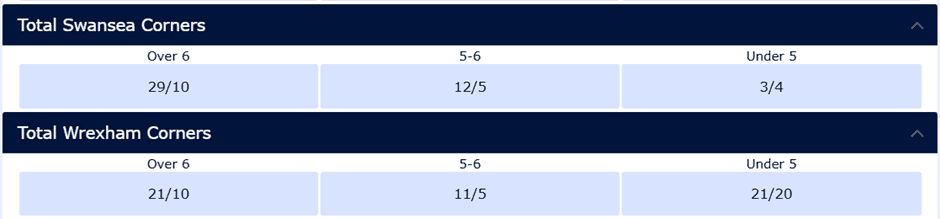
Caption: Here you can see an example of a team corners market, with options for Swansea and Wrexham.
Best Leagues for Total Corners Betting
Some leagues, such as the Premier League, produce far more stable corner patterns than others.
| League | Average Corners | Why Useful? |
| Premier League | 10.6 | Fast tempo and wide attacking play |
| Bundesliga | 10.1 | High shot volume |
| Serie A | 9.4 | Tactical but consistent averages |
I once evaluated a Bundesliga fixture where both teams averaged over 6 corners per match , individually. The line opened at 9.5 and moved quickly to 10.5 once market volume increased.
That type of movement often appears when football betting tips from experts start aligning with statistical projections.

Why Corner Markets Create Betting Opportunities
Corner markets can sometimes lag behind the tactical reality. While plenty of casual bettors focus on goals, corners are driven by different factors.
Situations that can increase corner counts include:
- High crossing frequency
- Teams trailing late in matches
- Blocked shots from crowded penalty areas
- Sustained attacking pressure
Example: A strong favourite scores early. The underdog begins pushing forward aggressively during the second half. Shot volume increases, and corners rise quickly - even if goals do not.
Possession vs Corner Production
One of the biggest misconceptions I see is assuming possession equals corners. In actual fact, possession-heavy teams that circulate the ball centrally often produce fewer corners.
Corners are usually driven by:
- Wide attacks
- Crosses into the box
- Blocked shots
- Defensive clearances
A good example is Leeds United during the 2020–21 Premier League season under Marcelo Bielsa. Despite not always dominating possession, Leeds regularly generated attacking
pressure through wide play and quick transitions. Matches involving Leeds averaged around 8.8 total corners per game, with the team producing roughly 4.4 corners per match.
Leeds’ style drove those numbers. Their attacking system relied heavily on wide overlaps, frequent crosses, and a high volume of shots inside crowded penalty areas. Those patterns regularly forced blocked shots and defensive clearances - both common sources of corners.
Pros & Cons of Total Corners Betting
Example: a match sitting on eight corners in the 80th minute can easily finish with eleven after late attacking pressure.
Pros
Less influenced by finishing luck
Tactical matchups matter
Reliable statistical data available
Cons
Late corners can swing outcomes
Referee decisions can affect totals
Some matches remain tactically unpredictable
The 4 Drivers of Corner Volume
When evaluating a corners market, I focus on four core drivers, every single time.
1. Team Playing Style
Wide attacking teams generate more corners through crosses.
Example: A team averaging 25+ crosses per match usually produces higher corner counts.
2. Shot Volume
Blocked shots frequently lead to corners. So, before betting I check average shots and shots blocked statistics.
3. Game State
Teams trailing late tend to push aggressively.
Example: An underdog chasing an equaliser creates multiple late corners.
4. Defensive Structure
Low-block defences clear the ball under pressure, which often increases corner counts for attacking teams.
Settlement Rules & Common Grading Mistakes
Corner bets follow standard Over/Under grading. These are the key rules to keep in mind:
- Injury-time corners do count
- Pushes occur on whole-number lines only
- Extra time usually does not count
One mistake I see often is assuming extra-time corners count in cup matches. In most markets, only 90 minutes (plus stoppage time) apply.
How I Evaluate a Total Corners Line
Here’s the process I run through to see if there’s value in a total corners bet:
- Check league averages
- Review team corner statistics
- Analyse tactical styles
- Consider possible game states
- Compare expected corners to market line
| Factor | What I Look For |
| League data | Average corners per match |
| Team stats | Corners won and conceded |
| Style | Crossing, shot volume |
| Game state | Favourite vs underdog pressure |
After going through this list, if my projected corners align closely with the market line, I usually pass.
Total Corners Betting vs Other Markets
Moneyline
Focuses only on match winner.
Example: a defensive underdog may lose but still create several late corners.
Goal Totals
Goal totals rely heavily on finishing efficiency, but corners often occur even when chances are missed.
Team Corner Markets
These focus on one team only.
Example: backing a dominant favourite to exceed 5.5 team corners.
Asian Corner Handicap
This market measures the difference between teams’ corner counts, instead of the total.
Example: Team A -2 corners means they must win the corner count by three or more.
When I Avoid Total Corners Betting
Sometimes (in fact often!) the smartest decision is simply not betting. I usually avoid matches with:
- Unpredictable tactical setups
- Inconsistent attacking patterns
- Severe weather conditions
- Major injury uncertainty
Example: a match where both teams changed formation the previous week made corner projections unreliable, so I skipped the market entirely.
Total Corners Betting Checklist
After a quick checklist? This is the one I use before betting:
- Review league corner averages
- Team corner stats
- Tactical matchup
- Likely game state
- Market line vs projection
Example: if both teams average five corners each but the line sits at 11.5, the price may already reflect the expected outcome too accurately to allow any value.
Conclusion
After years analysing corner markets, the biggest lesson is that they reward the combination of tactical thinking and statistics. Possession alone rarely explains corner totals.
Not every match produces a clear edge, and the difference between disciplined bettors and most bettors is that the disciplines ones often pass when the market line already reflects the expected outcome.
Like any betting market, total corners are based on probability rather than prediction. Betting should always be approached responsibly and within personal limits.
FAQs
What is total corners betting?
It’s a market predicting whether the combined number of corners will finish over or under the bookmaker’s line.
What happens if the line equals the final total?
If the line is a whole number (like 10) and exactly 10 corners occur, the bet is graded as a push, and the stake is returned.
Do injury-time corners count?
Yes. Corners awarded during stoppage time do count toward the final total.
Why do some matches produce very high corner totals?
Late attacking pressure, high crossing frequency, and blocked shots can rapidly increase corner counts.
Are corner markets reliable?
They can be, but they still contain variance. Tactical analysis improves decision-making, but as with everything in betting, nothing is a certainty.

Claudia Hartley is a versatile content writer and editor with a strong footing in digital publishing, particularly within the iGaming and affiliate space. With nearly a decade of experience, she has built a reputation for producing clear, engaging, and well-researched content that connects with readers while meeting SEO goals.
Comments
0 comments
No comments yet. Be the first to share your thoughts!
Related Resources to Betting Academy
- How Goliath Bets Work in Sports Betting
- Combination Bets Explained
- Cash Out or Let It Ride? How to Make the Right Call on Your Acca
- How Futures Betting Works 2026 Explained with Value Odds and Risk Factors
- Double Betting Explained: The Expert Strategy Playbook 2026
- Card Betting Explained: Strategy, Odds & How to Find Value
- Treble Betting Explained: How it Works
- Single Betting Explained: Odds, Probability & Value Guide
- System Betting Explained
- European Handicap Betting Explained
- Spread Betting Explained: Expert Playbook & Strategy Guide 2026