
Betting Academy
Four-Fold & Higher Betting Explained: The Expert Strategy Playbook 2026
Four-fold and higher accumulators look tempting because the odds multiply, but mathematically, they are stacked against you. Each leg carries the bookmaker’s margin, typically 2-5% per selection, and when four legs are combined, that margin compounds. The probability of winning collapses in the other direction. Even if each leg has a 50% chance independently, a four-leg acca only has a 6.25% chance of success. (Source: Pinnacle Odds Dropper) This guide explains how to evaluate each leg independently, account for correlation, and spot the small number of situations where a four-fold can carry genuine edge. I’ll also reveal tennis, basketball, and football betting odds across top sites.

SportsBoom offers honest and impartial UK bookmaker reviews to help you make informed choices. While we may earn commissions through affiliate links, our content remains independent and free from promotional influence. For more information, see our Content Transparency and How We Review pages.

Four-Fold & Higher Betting Explained
The average bookie’s margin on a four-fold bet is over 16%! (Source: BettorEdge)
18+ | Always gamble within your means. Help is available at GamCare.
What Is Four-Fold & Higher Betting?
A four-fold bet (or four-leg accumulator) combines four selections into a single wager. To win, all four picks must be correct. The odds multiply, giving a much bigger potential payout than separate bets.
For example, in the Premier League, you might back Manchester City to win, Liverpool to score first, Arsenal vs Spurs to go Over 2.5 goals, and Chelsea to win a corner count market. If each selection has odds of 1.80, 2.00, 3.00, and 1.70, the combined odds are 18.36, which gives an implied probability of 5.4% (1/18.36). A £10 stake would return £183.60 if all four land.
To compare, if you instead placed £2.50 on each bet as singles, and all four won, your total return would be only £21.25.
How Four-Fold Betting Works
Let’s look at a recent match between Newcastle and Aston Villa, which went down on 25 January at St James’ Park, to gauge four-fold betting in the wild. Discover how you can get an edge by comparing odds on sports bookmakers:
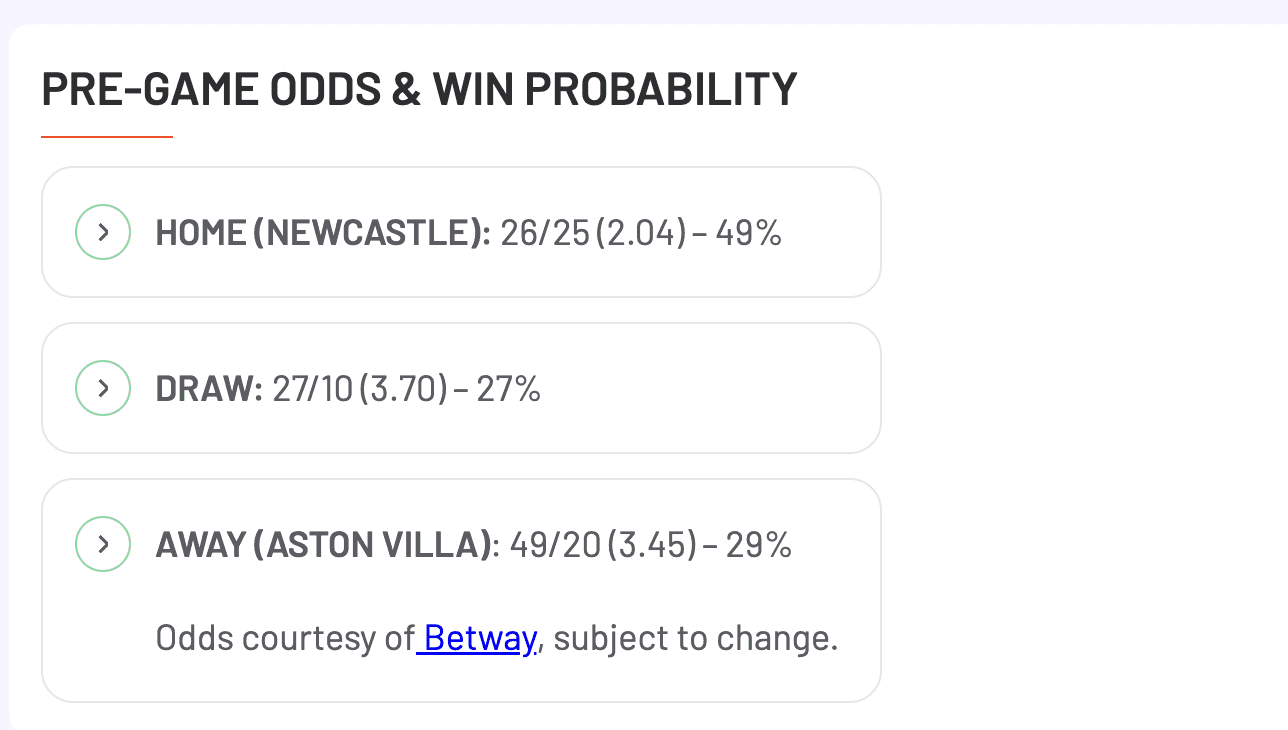
Newcastle sat 8th, buoyed by a midweek Champions League win over PSV, while Villa arrived 3rd and in strong away form. The big pre-match story was Bruno Guimarães missing for Newcastle, a huge blow given they had won none of their previous eight league games without him.
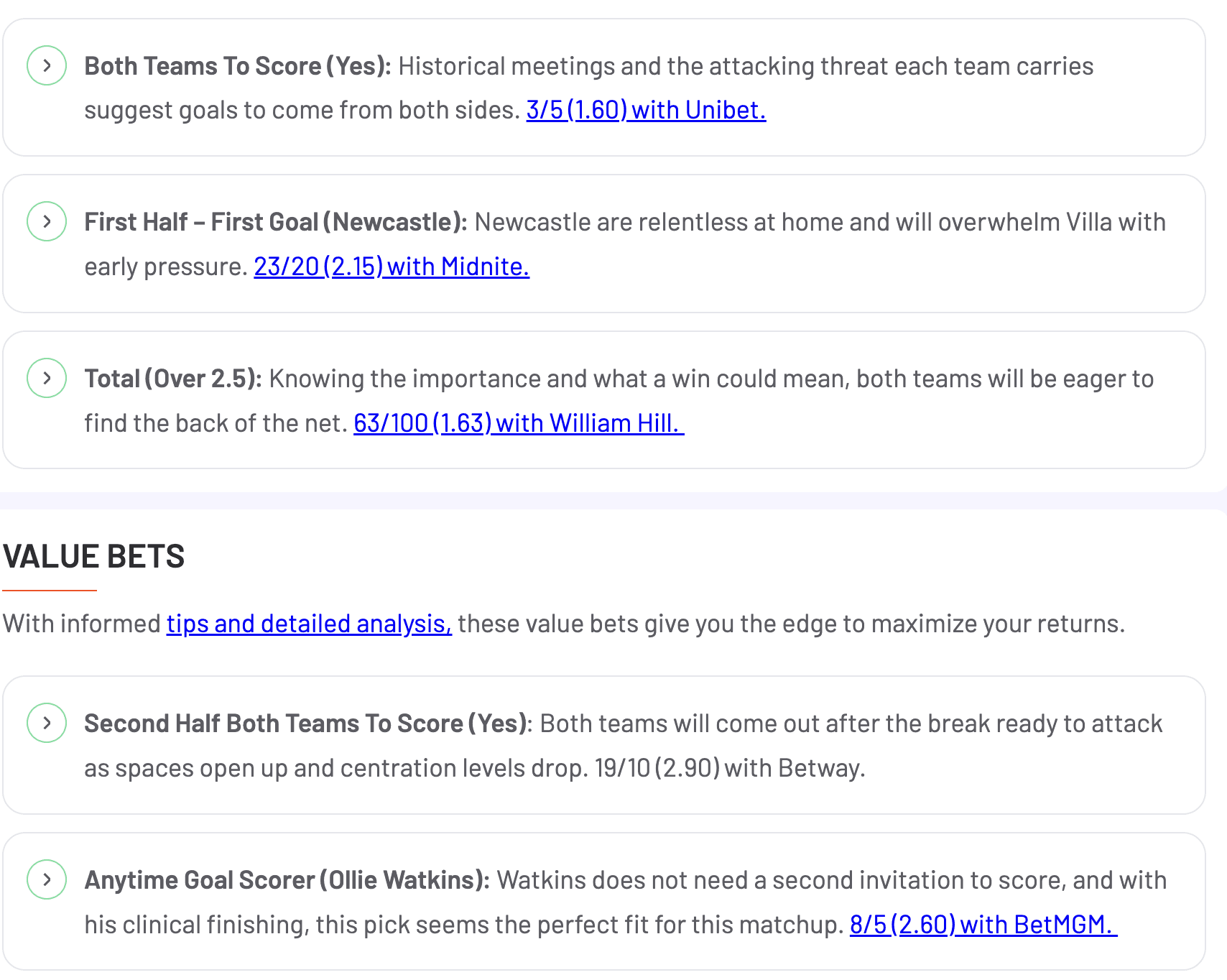
Value bets
After assessing the picks from SportsBoom’s tipsters, I decided to compile this four-fold wager:

four-fold wager
BTTS made sense given both teams' attacking quality and their head-to-head history for goals. Newcastle's first-half first goal was backed by their aggressive home record and the fact that they'd scored first in most recent home games
Over 2.5 felt safe, given Newcastle had scored 2+ in each of their last eight home league games. Watkins Anytime was a strong value pick, as he’s a clinical finisher and Villa's focal point of attack.
Unfortunately, the acca didn’t go my way. Emi Buendia's sumptuous finish and Ollie Watkins' late header secured Villa's victory at St James' Park, their first win on Tyneside since 2005. Of the four bets, only Watkins Anytime hit.
The Mathematics of Compounding Risk
A four-fold bet multiplies the odds of each selection together, which is why the potential returns look so attractive and why bookmakers love them. Take four legs at 2.0 (evens) each. You multiply 2.0 x 2.0 x 2.0 x 2.0 to get 16.0, so a £10 bet returns £160.
The probability of winning four-fold wagers is against you. Each leg at 2.0 implies a 50% chance of winning. Four legs at 50% each means a combined probability of 0.5 x 0.5 x 0.5 x 0.5, just 6.25%. When you add the bookmaker's margin to each individual leg, that true probability drops even further. (Source: Statsbet)
When I Consider a Four-Fold
I run my standard single-bet analysis across every fixture throughout the week and flag individual selections that clear my value threshold independently. If four happen to coincide in the same gameweek, I have an acca. If three do, I wait.
Once I have four qualifying selections, I stress-test the slip for correlation. Do any legs share players, managers, or outcomes that make them non-independent? A Chelsea win and a Palmer anytime scorer are not four independent legs across a slip, they're three and a half.
To adjust for correlations, you need to:
- Estimate conditional probability - instead of taking Palmer’s 50% chance at face value, calculate P(Palmer scores | Chelsea wins). If he usually scores in 80% of Chelsea wins, use 0.8.
- Replace the joint probability - multiply the probability of the first leg (Chelsea win = 0.5) by the conditional probability (Palmer scores = 0.8) → 0.5 × 0.8 = 0.4.
- Combine with other independent legs – multiply the adjusted joint probability by the probabilities of any remaining independent legs.
I then check each leg's line movement across three bookmakers on OddsPortal. Any leg that has moved more than 0.10 against my position since opening gets dropped immediately. Check out my decision tree for expert betting tips:
Question | Yes | No |
Does each leg clear my value threshold independently? | Proceed | Kill the acca |
Are all four legs genuinely uncorrelated? | Proceed | Drop correlated leg or adjust implied probability |
Has line movement stayed stable on all four legs? | Proceed | Drop moved leg |
Are confirmed teamsheets available for every fixture? | Proceed | Wait or drop |
Is my stake 0.5% of the bankroll or less? | Proceed | Reduce stake |
Am I placing this with a clear head? | Proceed | Do not bet |
Best Sports for Four-Fold & Higher Betting
The sport you choose for your acca legs is just as important as the selections themselves. I’ve had the best success with football, tennis and basketball!
Football
Football is the most statistically transparent sport for bettors with the right tools. Every match produces xG, PPDA, progressive pass data, and line movement history. Also one player’s off day rarely ruins a well-researched leg, unlike in golf or horse racing. With fixtures across the EPL, Championship, Bundesliga, and La Liga, it’s easy to find four independent value bets in any week.
Tennis
Tennis offers low-variance, highly modelable acca legs. Focus on hard-court match winners because top players like Djokovic, Sinner, and Alcaraz are very consistent on this surface and rarely lose to underdogs.
Basketball
The NBA is ideal for accas thanks to massive publicly available data: pace, offensive/defensive ratings, rest, travel, and back-to-back frequency. Look for heavy favourites at home vs bottom-five defensive teams, and road underdogs on zero days' rest.
Sports I Avoid
Not all suits are suitable for four-fold bets. I personally won’t touch:
- Horse Racing – Fields of 15+ runners mean even a strong favourite carries a 30–40% loss probability. If you string four together, you're essentially buying a lottery ticket across most places to bet on horse racing.
- Golf - Even backing four short-priced favourites produces a combined probability so small the bookmaker's margin becomes almost irrelevant; the maths already destroys you.
- Cricket - Weather alone makes this unbettable across four legs. A covers intervention or a damp pitch can completely invalidate any pre-match model overnight, which is something markets at many cricket betting sites struggle to price in advance.
- Boxing - One punch changes everything, regardless of how dominant a fighter has looked for eleven rounds. A single knockdown ends your bet in a sport where upsets are structurally built into the pricing.
Best Leagues for Four-Fold & Higher Betting
The best leagues for four-fold betting have low margins, plenty of games, high-quality data and consistent patterns. I recommend sticking to these leagues:
- Bundesliga - At 3.18 goals per game, matches are less likely to finish as one-goal grinders, which cuts down on legs undone by 90th-minute equalisers. (Source: FootyStats)
- La Liga - Average managerial tenure of 2.3 seasons in the top half versus 1.1 in the EPL, so tactical behaviour is stable enough to predict weeks out. A 27-28% draw rate with specific H2H pairs hitting 35-40% is a pattern you can build legs around.
- Premier League - Overround of 102-104% is one of the lowest of any sporting leagues out there.
- ATP Hard Court — Across the 2025 season, top-10 players won 85-90% of matches against opponents outside the top 50. (Source: Toolkit)
League | Typical Odds | Suitability | Why |
EPL | 1.40-2.20 | ⭐⭐⭐⭐⭐ | Sharp market, deep squad data, genuine competition in almost every fixture |
Bundesliga | 1.50-2.10 | ⭐⭐⭐⭐ | High-scoring, end-to-end football reduces single-moment variance that kills acca legs |
La Liga | 1.40-2.00 | ⭐⭐⭐⭐ | Tactically rigid sides behave predictably week-to-week under settled long-term managers |
NBA | 1.30-1.80 | ⭐⭐⭐⭐⭐ | 82-game schedule creates repeatable fatigue, motivation, and back-to-back patterns |
ATP Hard Court | 1.25-1.70 | ⭐⭐⭐⭐ | Elite players show minimal variance on preferred surface across the full season |
Championship | 1.50-2.40 | ⭐⭐⭐ | Softer market pricing creates mispriced legs but requires stronger independent research |
Four-Fold & Higher Betting vs Other Markets
To make £500 per month from singles at average odds of 1.70, you need a strike rate above 62% and a staking plan that most recreational punters simply cannot sustain. Singles also create a psychological trap: a run of seven losers at 1.70 seems catastrophic, even though it is statistically normal.
Trebles occupy a risky middle ground. The combined odds on a three-leg accumulator rarely exceed 8-10 on reasonably priced selections, which means a £10 stake returns £80-100. This is only slightly more than a single, yet it introduces three layers of bookmaker margin and three independent variance events that can each ruin the bet.
System bets, such as a Yankee, extract maximum value from punters who think they are being clever. Eleven bets across four selections are sold as insurance, but in reality, you are paying 11 separate bookmaker margins while accepting lower returns even if all four legs land.
The four-fold often sits at the optimal position on the risk-reward curve. Compounded odds generate significant returns from small stakes; for example, a £10 bet at 12.0 returns £120, while limiting selections to four legs keeps variance manageable.
Bankroll & Exposure Reality
Four-leg accas should represent 0.5% of your total bankroll, a quarter of what you'd stake on a single, because the mathematical variance is four times more severe. If your standard single unit is £20, your acca unit is £5.
To give a sense of risk, a typical four-leg acca with 1.80 odds per leg has an expected probability of success of around 10-12%, meaning the expected drawdown over several bets can easily reach 5-10 times your acca unit before a win occurs
Never place an acca within 24 hours of a significant losing bet. The neurological urge to recover losses through a high-return acca results in you forcing unprofitable wagers.
Common Four-Fold Mistakes
I’ve made every four-fold mistake in the book, from randomly adding UFC underdogs to my accas to forgetting to check the team sheet before realising Haaland is back from injury and Fulham have no chance. Don’t make these blunders:
- Backing NBA teams on back-to-backs - Rest data in basketball is the single most underused variable in acca building. Teams on zero days' rest lose against the spread at a statistically significant rate.
- Including horse racing to inflate odds - Adding a 2.0 shot from a seven-runner handicap appears safe until you realise handicaps are specifically designed to make every runner equally likely to win. You're adding a coin flip with a bookmaker's margin baked in.
- Ignoring travel fatigue in European football - A side returning from a 4,000-mile Champions League away trip to Azerbaijan or Kazakhstan on a Thursday before a Sunday Premier League fixture is likely to fade.
- Mixing sports with different settlement vulnerabilities - Combining football, tennis, and cricket in one acca exposes you to three completely different abandonment and void scenarios.
Four-Fold Betting Checklist
After turning too many four-folds into lottery tickets, I’ve learned to control myself by only betting when each pick passes my checklist:
- Are all four legs from markets where I have a demonstrable edge?
- Are the combined odds below 15.0?
- Have I confirmed teamsheets for all four fixtures?
- Have I avoided including any leg where the result hinges heavily on a single player's performance?
- Is the line movement on each leg stable, with no sharp money moving against my position?
- Am I avoiding fixtures where one side has nothing to play for?
Conclusion
Four-fold betting potential returns are big enough to justify the process, but look out for the variance. You need to treat every leg as a standalone value bet first and an acca component second. Also never manufacture a fourth leg just to hit a target odds number.
Before placing, cross-check line movement across three bookmakers, drop any leg that has moved more than 0.10 against your position, and avoid combining legs from sports with different settlement risks on the same slip. Remember to track your accas separately from singles and regularly monitor profitability.
FAQs
Are four-folds profitable long-term?
Only if every leg carries an edge above the implied probability. Most punters lose long-term on accas because they're stacking four legs where the bookmaker has a significant margin on each
What hit rate should I expect?
At typical four-leg acca odds of 10/1 to 15/1, you need to hit roughly one in eleven to one in sixteen bets to break even.
Are they better than singles?
Singles are mathematically superior for any punter with an edge because each bet stands alone and your edge isn't diluted by compounding margins across multiple legs.
How do I reduce risk?
Keep combined odds below 12.0, restrict selections to markets you follow rather than gut-feel picks and never include a leg where team news is unconfirmed.

Bruce Douglas is an experienced editor and copywriting professional with a proven track record in shaping high-quality content across multiple platforms. With a career spanning journalism, editorial management, and digital content strategy, he brings a keen eye for detail and a passion for precision to every project he works on.
Comments
0 comments
No comments yet. Be the first to share your thoughts!
Related Resources to Betting Academy
- How Goliath Bets Work in Sports Betting
- Combination Bets Explained
- Cash Out or Let It Ride? How to Make the Right Call on Your Acca
- How Futures Betting Works 2026 Explained with Value Odds and Risk Factors
- Double Betting Explained: The Expert Strategy Playbook 2026
- Card Betting Explained: Strategy, Odds & How to Find Value
- Treble Betting Explained: How it Works
- Single Betting Explained: Odds, Probability & Value Guide
- System Betting Explained
- European Handicap Betting Explained
- Spread Betting Explained: Expert Playbook & Strategy Guide 2026