
Football Betting Academy
What is Second Half Goals Betting Explained: How it Works
An early mistake of mine came from assuming a match would simply continue the way the first half had played out. Lots of bettors do just the same. I backed Under 1.5 second-half goals in a 2020 Spurs vs West Ham game. It had been an explosive first half with Tottenham leading 3-0 at half-time. Surely, they’d just keep cruising. No. West Ham took the defeat in their stride and equalised by the final whistle. Matches like that highlight an important truth: second halves can follow very different dynamics from the first. Understanding those late-game patterns can be helpful when betting on second-half goals at licensed sportsbooks. This is my framework for making better second-half goals bets, but remember any wagers you make carry financial risk.

SportsBoom offers honest and impartial UK bookmaker reviews to help you make informed choices. While we may earn commissions through affiliate links, our content remains independent and free from promotional influence. For more information, see our Content Transparency and How We Review pages.

Second Half Goals Betting Explained
What is Second Half Goals Betting?
Second Half Goals Betting focuses specifically on goals scored after half-time (including injury time), with wagers placed on whether the number of goals in the second period will be over or under a set line.
Rather than predicting the entire match, this market concentrates on late-game dynamics.
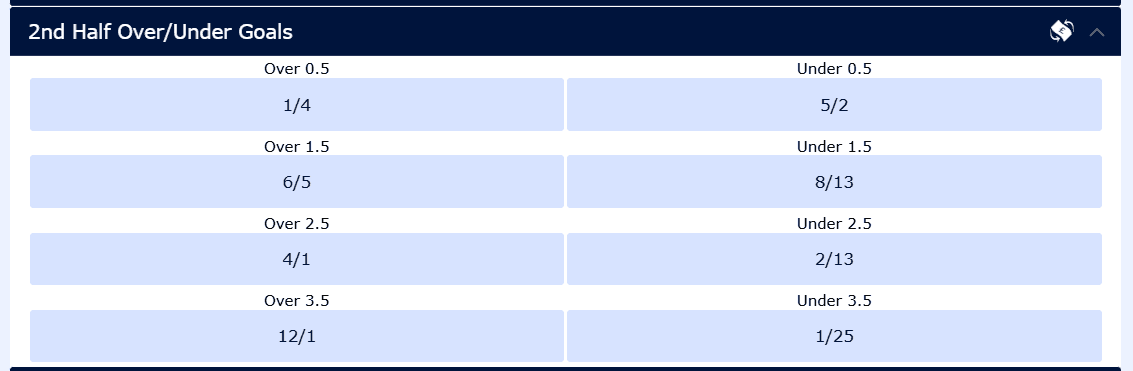
Example of a second-half over, under goals market.
How Second Half Goals Betting Works
Second-half goals betting is only concerned with the goals scored after half-time. Online bookmakers set a specific line for that period, which is generally 0.5, 1.5, or 2.5 goals.
It’s up to you to choose whether the total goals in the second half will land Over or Under that line.
Bookmakers price these markets based on:
- Expected late-game tempo
- The team’s play style
- Attacking strength
- How likely is a match to open up after halftime
Remember that odds can shift quite quickly, especially at the best Premier League betting sites, if tactical changes, substitutions, or the scoreline suggest the pace of the game is about to change.
Out of all teams in the Premier League, only 3 of them scored fewer goals in the second half than in the first last season. The rest all scored more goals on average after half-time.
How to Bet Second Half Goals Properly
I always start off my second-half goals bets by reading helpful betting tips and predictions, and then identifying teams that tend to change tempo late in matches.
Fatigue can play an important role, too. It’s really common for defensive organisations to weaken in the final 30 minutes or so - that creates more space for late goals.
Tactical changes are another key signal that’s most useful for in-play bets.
While you should focus on second-half tactics, don’t ignore the first half! Shot volume, territorial pressure, and the balance of chances before halftime often reveal how the second half is likely to unfold.
Example: Chelsea vs Manchester City in November 2023 was a game where both teams continued to push forward late in the match. The tempo was high, attacking subs were made, and constant transitions created the right catalyst for that 4-4 finish. If you think both sides will continue to chase rather than settle, those higher second goals bets can pay dividends.
Why Second Half Goals Betting Works
Second-half goals betting focuses on a period of the match where the game state often forces teams to change behaviour. As the clock runs down, sides chasing a result usually push forward more aggressively.
A classic example (and a crusher if you’d bet on QPR) came in Manchester City vs QPR back in 2012, when City scored twice in stoppage time to win the title - a brutal reminder that late-game pressure can produce sudden bursts of goals.
Game State & Pressure
The most important variable in second-half betting is game state, as it influences scoreline pressure.
- When a team falls behind, the tactical approach usually becomes more aggressive. This makes the defensive structure loosen, which can raise the probability of additional goals.
- When a team is in front, the tactical approach can be to become more defensive. They slow the tempo, keep possession, delay restarts, etc. In these moments, those under second-half goal bets become more attractive.
Pros & Cons
Like any betting market, second-half goals betting comes with both advantages and limitations.
Pros
Exploits late-game momentum and changes match dynamics
Opportunities to react to halftime score and tactical changes
Markets can switch after halftime
Cons
High volatility due to short time windows
A single goal can quickly reshape the entire market
Misreading tactical intent or game flow can lead to poor decisions
The 3 Drivers of Second Half Goal Value
I look for these core factors when placing second-half goal bets.
- Scoreline Pressure: Teams chasing the game often commit more players forward, increasing attacking frequency and leaving space at the back. For example, a team trailing 1-0 after 60 minutes may switch to a more aggressive formation.
- Fatigue Factor: As matches progress, defensive concentration can drop, and physical fatigue increases.
- Tactical Aggression: Managers often introduce attacking substitutions after halftime. A switch to two strikers, pushing full-backs higher, or replacing a defensive midfielder with an attacking player can significantly increase tempo and shot volume.
Settlement Rules
Second-half goals bets follow a straightforward settlement structure:
- Only goals scored in the second half count toward the bet.
- Injury time at the end of the match is included.
- Extra time does not count, as the market covers regulation time only.
- If a match is abandoned before full time, settlement depends on the bookmaker’s rules, but bets are usually void.
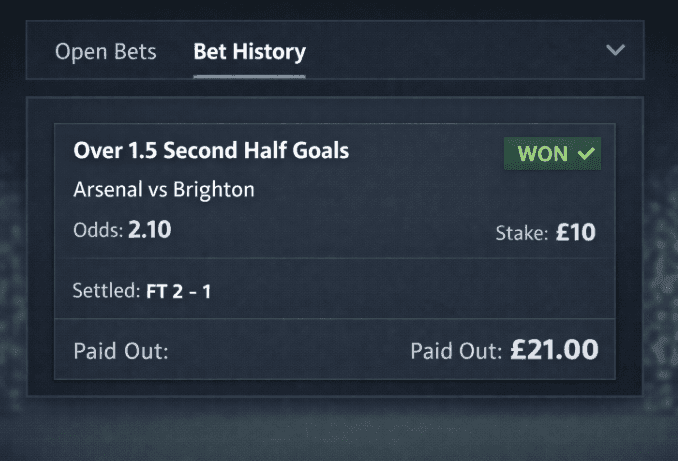
Example of a settled second-half goals bet
Second Half Goals Betting Examples (Football)
Sometimes the easiest way to spot the pattern is by seeing some examples. So, let’s take a look at some.
0-0 or 1-0 at Half-Time for Late Push (Over Value)
A tight halftime scoreline frequently creates pressure in the second half, particularly if one team needs points.
Example: Manchester United vs Aston Villa (2023). Villa led 2-0 at half-time, forcing United to attack aggressively after the break. The match opened up significantly, and United scored three second-half goals (and registered 13 second-half shots) to win 3-2.
Comfortable Lead for Slower Tempo (Under Value)
When one team leads comfortably, the match often becomes more controlled, leading to fewer second-half goals.
Example: Manchester City vs Fulham (2022). City led 2-0 at halftime and focused on controlling possession (about 70% in the second half) rather than pushing. The tempo slowed considerably after the break, and the match finished 2-1.
Must-Win Situation for Aggressive Late Attacks (Over Value)
Matches with high stakes, relegation battles, or title races often produce intense late-game pressure.
Example: Chelsea vs Manchester City (2023). This game finished 4-4, as both sides continued attacking deep into the second half rather than settling for a draw, leading to multiple late goals.
Second Half Goals vs Other Markets
Understanding how second-half goals betting differs from other markets is the best way to know when it’s the right tool to use.
Second Half vs First Half Goals
First-half goal markets focus on early tempo and starting tactics. It’s almost entirely a pre-match market.
Second-half markets are much more heavily influenced by scoreline pressure and late-game urgency.
Second Half vs Full Match Over/Under
A full match Over/Under bet covers all 90 minutes, meaning the first and second halves both contribute to the result.
Second-half goal betting isolates just the final 45 minutes. So, a game that’s expected to start cautiously may still produce second-half opportunities.
Second Half vs In-Play Betting
Second-half betting can be placed before kickoff, at halftime, or during the second half itself.
In-play betting, however, focuses on reacting to events as they happen. Odds change constantly based on goals, substitutions, red cards, and momentum swings.
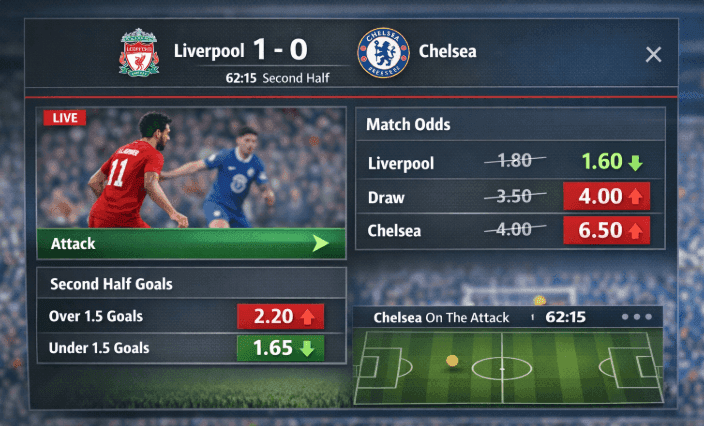
Example of how in-play betting odds shift second-half goals markets.
Best Leagues for Second Half Goals Betting
Some leagues produce more late goals than others due to differences in playing style, tactical approaches, and overall match tempo.
| League | Best Second Half Angle | Why it Works | Risk |
| EPL | Chasing late goals | High-tempo attacking teams | Medium |
| Bundesliga | Fast transition attacks | Fitness and pace create late chances | Medium |
| Serie A | Tactical adjustments | Substitutions often reshape temp | Low-Medium |

Universal Second Half Goals Checklist
Before I place a bet on second-half goals, I always run through a mental checklist:
- Is the half-time scoreline clear and meaningful?
A team trailing or needing points often ups the ante. - Is there urgency from one or both teams?
Look for sides pushing players forward or increasing shot volume. - Are there signs of defensive fatigue?
Tired defenders can lead to positional mistakes and late chances. - Have tactical changes been made?
Substitutions or formation shifts can increase tempo and attacking intent. - Do the odds reflect the likely match behaviour?
Value appears when the market underestimates how the second half may unfold.
I don’t have to tick off all of them, but the more I can tick, the stronger that bet looks.
Conclusion
Second-half goals betting focuses on a phase of the match where late-game dynamics really do reshape how teams play. As the clock runs down, scoreline pressure, fatigue, and tactical adjustments often change the tempo and risk level of the game.
Understanding those patterns is key. Sticking to structured frameworks, analysing the game properly, and understanding common match scenarios helps to move second-half betting away from guesswork and toward a better understanding.
FAQs
Does stoppage time count in second-half goal bets?
Yes. Goals scored during stoppage time at the end of the second half are included in the settlement.
Is second-half goals betting profitable long-term?
Like any betting market, profitability depends on whether the odds offer value relative to the true probability of an outcome. Second-half goal markets can sometimes present opportunities because game dynamics change after halftime
What are the most common second-half goal lines?
Bookmakers typically offer lines such as Over/Under 0.5, 1.5, and 2.5 second-half goals.
Do second-half bets include goals from extra time?
No. Second-half bets are settled based on goals scored in the second 45 minutes plus stop-page time only. Extra time is not included unless explicitly stated.
When is the best time to place second-half goal bets?
The best time is typically during halftime or early in the second half, once you’ve assessed game flow, xG, tempo, and tactical adjustments from the first half.

Claudia Hartley is a versatile content writer and editor with a strong footing in digital publishing, particularly within the iGaming and affiliate space. With nearly a decade of experience, she has built a reputation for producing clear, engaging, and well-researched content that connects with readers while meeting SEO goals.
Comments
0 comments
No comments yet. Be the first to share your thoughts!