
15 Best UK Betting Sites – Licensed Online Bookies for 2026
What Happens to the Odds After a Manager Is Sacked
Few events shake up a Premier League betting market quite like a managerial sacking. The moment a club confirms a head coach has been dismissed, bookmakers react within minutes, adjusting match odds, relegation prices, and outright markets simultaneously. That window of volatility is where the real opportunity lives.

SportsBoom offers honest and impartial UK bookmaker reviews to help you make informed choices. While we may earn commissions through affiliate links, our content remains independent and free from promotional influence. For more information, see our Content Transparency and How We Review pages.
What Happens to the Odds After a Manager Is Sacked
The Immediate Reaction - Markets Go Into Flux
When a manager is sacked, the first thing bookmakers do is suspend or widen their markets on that club. They're essentially pricing in uncertainty. A team that was 5/2 to win their next match might drift out to 3/1 or beyond while the new appointment remains unknown.
Conversely, if the sacking follows a catastrophic run, the act of dismissal can actually shorten a team's survival odds slightly, because the market now expects a reactive improvement.
During the 2025/26 season, after West Ham's dismal start, they saw their relegation odds were shortened drastically from pre-season, and as a result, Graham Potter was sacked on 27th September 2025 and was replaced by Nuno Espirito Santo.
The Hammers' relegation price had already ballooned during Potter's tenure, and the sacking represented a market reset and saw West Ham’s relegation odds increase.
The Immediate Reaction
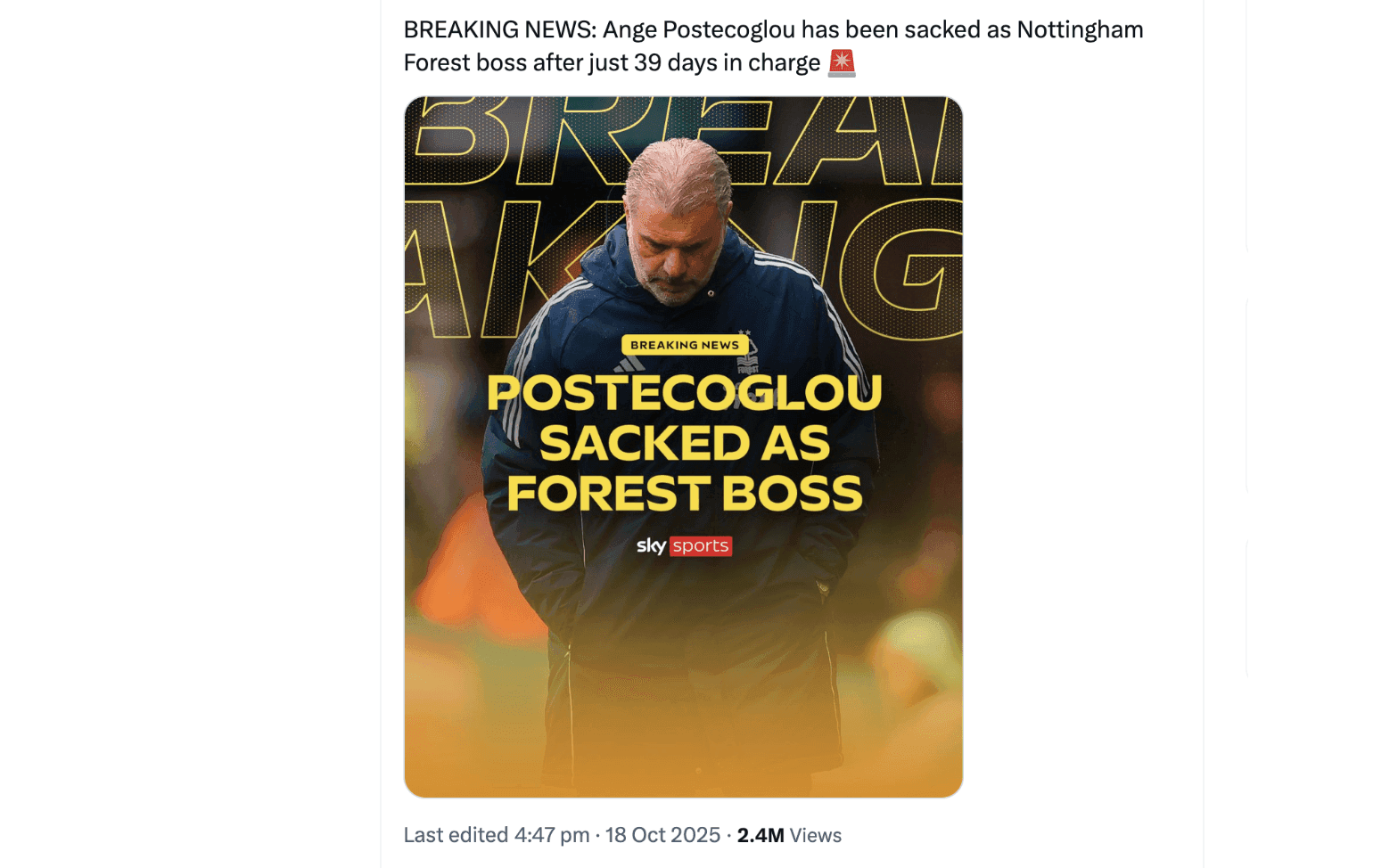
Nottingham Forest offered an even more extreme case. Ange Postecoglou took over at Forest after Nuno's exit but went eight games without a win and was shown the door in the middle of October, 2025. Each sacking triggered a fresh re-pricing across relegation and match markets.
Forest cycled through three managers in a single season, and each time, bookmakers had to recalibrate their entire model.
Why Bettors Should Treat the New Manager Bounce With Caution
A managerial change can often immediately improve a side’s results. Players respond to fresh tactics, a change in training intensity, or simply the motivation factor. Experienced betting sites in the UK know this and price it accordingly.
That means the window to find value on a newly managed side is extremely short. By the time a permanent appointment is confirmed, odds on their next match have already tightened to reflect the expected bounce.
After Ruben Amorim's departure from Man Utd in January 2026, the club underwent a new manager bounce under Michael Carrick as they went on a three-match winning streak. If you waited until Carrick’s first match in charge, you missed soft odds on Man Utd squeezing into the top 4.
However, this streak didn’t last forever, and the side experienced a regression to the mean after losing to Newcastle in March.
Relegation Odds Are the Most Sensitive Market
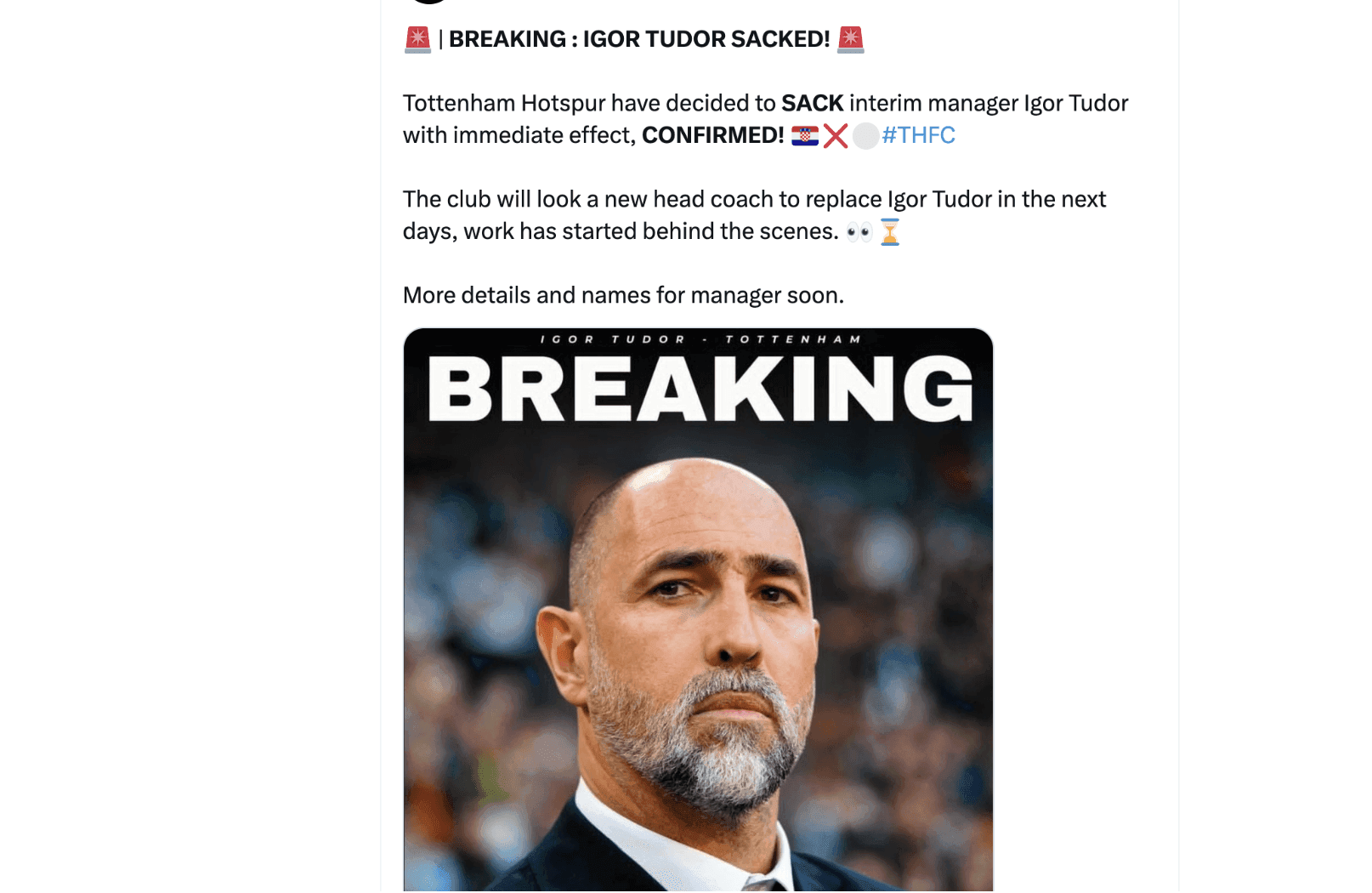
No market reacts more violently to managerial change than relegation betting. At the start of the 2025/2026 season, Tottenham were seen as safe from relegation, with odds as long as 50/1. But by early February, their continued poor form had seen their relegation odds shrink to around 6/1. The club then cycled through Thomas Frank, Igor Tudor (who lasted just 44 days), and Roberto De Zerbi.
Relegation Odds
Spurs' 13-game winless run in the league, the club's worst since 1935, showed that sometimes there’s nothing a new manager can do. Each managerial change failed to arrest the slide, and each time the market re-priced accordingly, with De Zerbi's appointment doing little to restore confidence.
Many bettors mistakenly assume that a new manager based on a small sample size automatically leads to improved results. However, more often than not, a managerial change deals just with problems on the surface. Tottenham's relegation odds barely moved after each appointment because the underlying squad problems remained unchanged.
Reading the Pre-Sacking Signals
The sack race market itself is a leading indicator. Scott Parker, who, after a dreadful 3-0 away defeat to Sunderland, saw his odds of being sacked plummet from 28/1 to 3/1.
That kind of rapid compression from 28/1 to 3/1 in a single result signals that the market has moved well ahead of the boardroom. When a manager's odds collapse that sharply, it’s not a statistical anomaly and tends to mean that their club's next-match odds are already drifting because the market is anticipating disruption.
How You Can Exploit These Shifts
The richest value in a team's next-match odds exists in the 12-48 hours between a sacking and a permanent appointment, so you need to act fast. Bookmakers widen their lines during this uncertainty window, which can create mispricings against the opposition.
Check whether the bounce is already priced in. Teams with managerial changes often see volatile market shifts. Some managerial changes spur teams on with a new manager bounce, while others can't prevent the rot.
If a new appointment is widely celebrated and odds have already tightened, the value may have evaporated. Fading the newly appointed side in their second or third match after the initial bounce can be a contrarian play worth checking out.
Track the sack race market as a proxy for broader instability. A manager whose odds have compressed from 33/1 to 5/1 in a matter of weeks represents a club in disarray.

Chad’s career in the sports betting industry began in October 2013 when he joined Hollywoodbets. During his time there, he wrote football betting content for the Hollywoodbets Sports Blog and contributed extensively to their weekly betting publication, Soccer Betting News. His work and leadership eventually led to him being appointed Editor-in-Chief of the publication in February 2016.
Comments
0 comments
No comments yet. Be the first to share your thoughts!