
Betting Academy
Cash Out During Live Betting: What It Is and How It Works
Cashing out lets you decide between securing a return right now, albeit a lower one, or letting the bet continue until the end of the event. While there’s no concrete ‘right or wrong’ time to cash out, there are some bets that lend themselves to cashing out better than others.

SportsBoom offers honest and impartial UK bookmaker reviews to help you make informed choices. While we may earn commissions through affiliate links, our content remains independent and free from promotional influence. For more information, see our Content Transparency and How We Review pages.

Cash Out During Live Betting
Imagine you’ve placed a five-leg football accumulator. You’ve managed to get four of the five legs up, and your bookie offers you a cash-out offer:
£150 to take the cash out, or the potential for £270 if you let the accumulator finish and your team wins.
In that moment, you need to decide whether you think the reduction in returns is justified or whether you want to risk it for the higher potential payout.
What Is Cash Out During Live Betting?
Cash out is a sportsbook feature that allows you to settle a wager before the event has finished [1].
Bookmakers calculate what they believe the bet is currently worth based on live probabilities, and you get that figure, instead of the odds you originally took [2].
The amount you are offered depends on lots of factors, including:
- Live odds movements
- Remaining time
- The current score or race position
- Match conditions
- Changes in estimated probability
Cash out converts a future uncertain outcome into an immediate known return.
Many bettors assume cash out reflects a fair mathematical value based purely on probability. In reality, bookmakers often incorporate a margin into cash-out pricing. This means the offer you receive may very well be lower than the theoretical value suggested by the live odds.
How Live Cash Out Works
In order to use live cash out, you’ll need to place a bet. Once the event begins, the process goes like this:
- Live odds begin to update and do so continuously.
- The bookmaker reassesses the probability of your selection winning.
- A cash-out value appears.
- You decide whether to accept or decline the offer.
Credit: AI Generated - Captured by Claudia Hartley on 15th June 2026
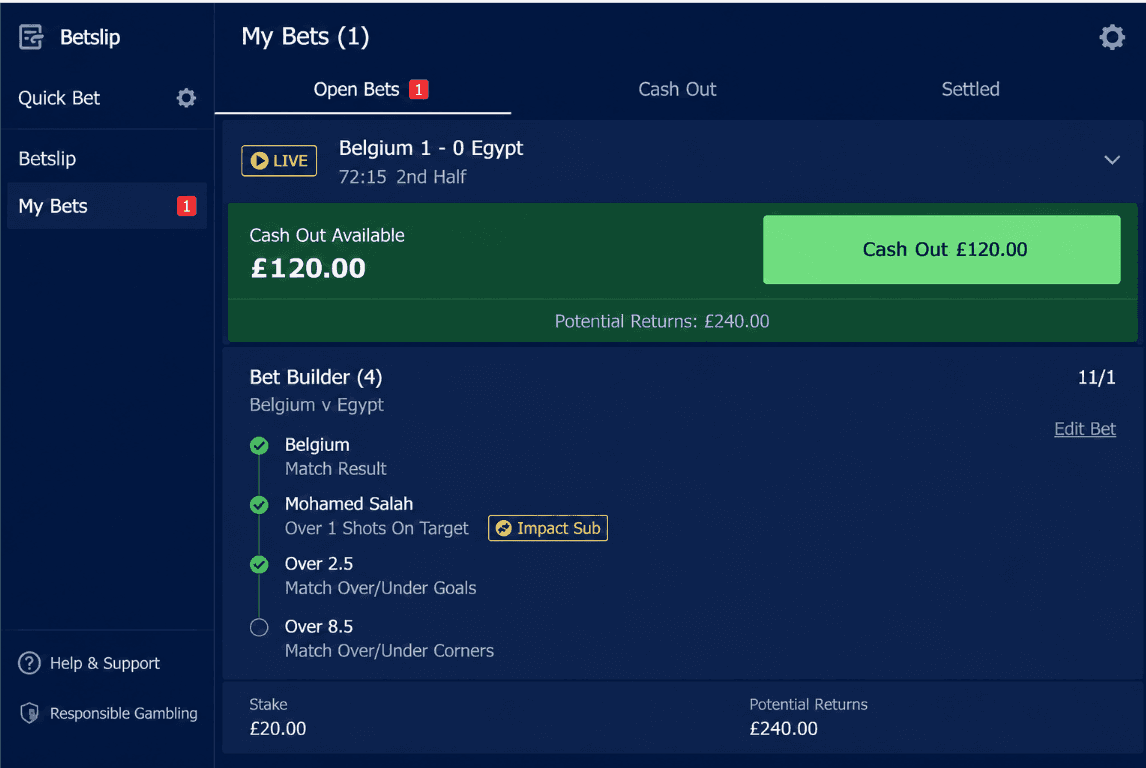
In this example, we’re only waiting for corners to secure the total potential return of £240, but the bookmaker is offering a £120 cash out if we close the bet now. The alternative is to let it run and win either £240 or nothing.
How Bookmakers Calculate Cash Out Value
Cash-out values are primarily driven by current probability. Bookies will continually reassess the likelihood of your bet winning using the most up-to-date information. This probability will then be converted into a settlement offer, taking into account their margins.
For example, if you’ve backed a football team to win and they’re leading 2-0 after 85 minutes, your cash out offer is likely to be much higher than if that team was leading only 1-0 or even drawing.
In essence, the probability of your bet winning is much higher than it was at kick-off. It’s really important to remember that bookmakers aren't calculating offers based on your original potential payout; they're pricing it according to what they believe it is worth right now.
Cash Out vs Letting the Bet Run
Sometimes you won’t have both options available to you. But if you do, it’s important to understand the tradeoff of picking one over the other.
Taking Cash Out
Accepting the cash-out offer reduces your exposure to future events to zero, in fact! You can secure a smaller payout now and remove the possibility of seeing the bet collapse late on.
The price you pay is potentially the full return.
Holding the Bet
Allowing the wager to roll on until the finish obviously preserves your potential upside. Of course, the bet might lose, which especially hurts if you could’ve had a decent return from cashing out.
Option | Benefit | Risk |
Cash Out | Secures current value | Misses full payout |
Hold Bet | Maximum return chance | Can lose everything |
Partial Cash Out Explained
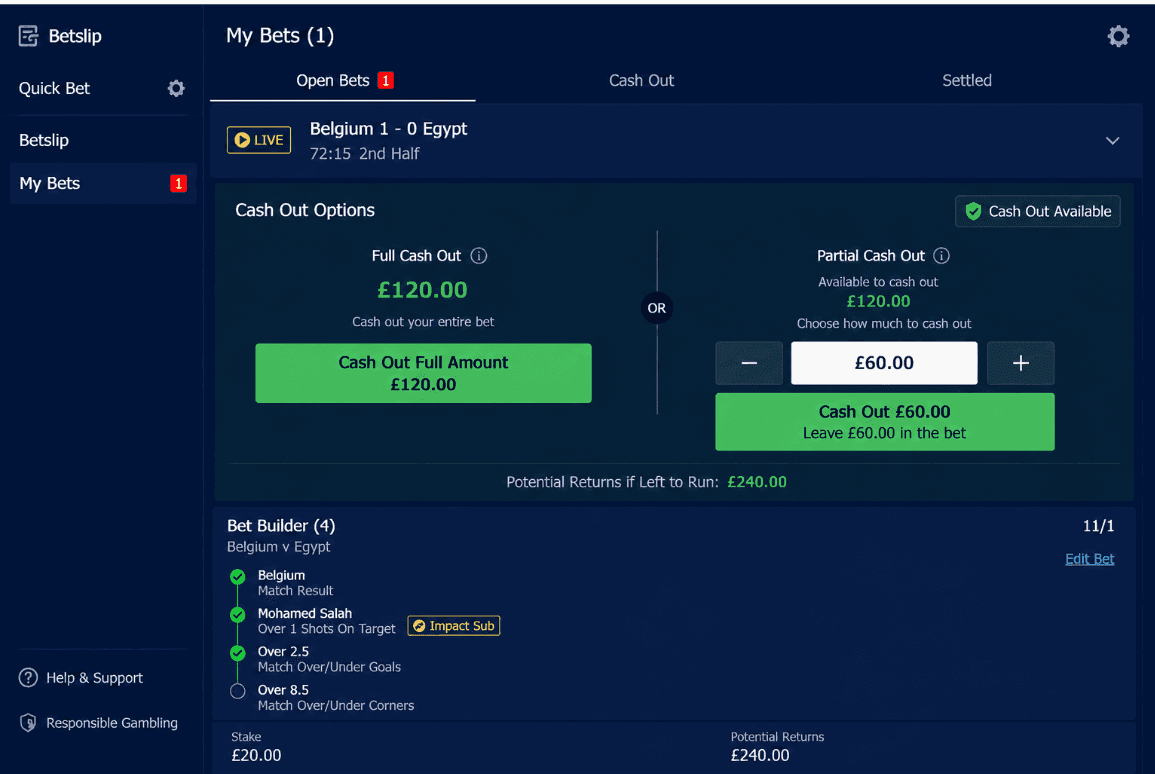
A partial cash-out combines elements of both approaches. So, instead of settling the entire bet, you get to choose how much exposure you want to remove.
This approach can:
- Reduce overall exposure.
- Lock in some return.
- Maintain the possibility of further profit.
Partial cash out doesn't totally eliminate uncertainty, but it provides greater flexibility while locking in some returns.
Credit: AI Generated - Captured by Claudia Hartley on 15th June 2026
Why Cash Out Values Change During Live Betting
Live sports are fluid, which means cash-out offers move all the time. This is because the probability of that bet’s success is constantly changing. In football, the following all influence the probability of a bet settling successfully and with it, the cash out value:
- Goals
- Red cards
- Injuries
- Momentum shifts
- Possession changes
- Tactical substitutions
That’s why if your team is leading a comfortable 1-0 in the 80th minute, you’ll get a pretty decent cash-out offer. The moment they concede, the cash-out collapses with their chances.
Cash Out in Different Sports
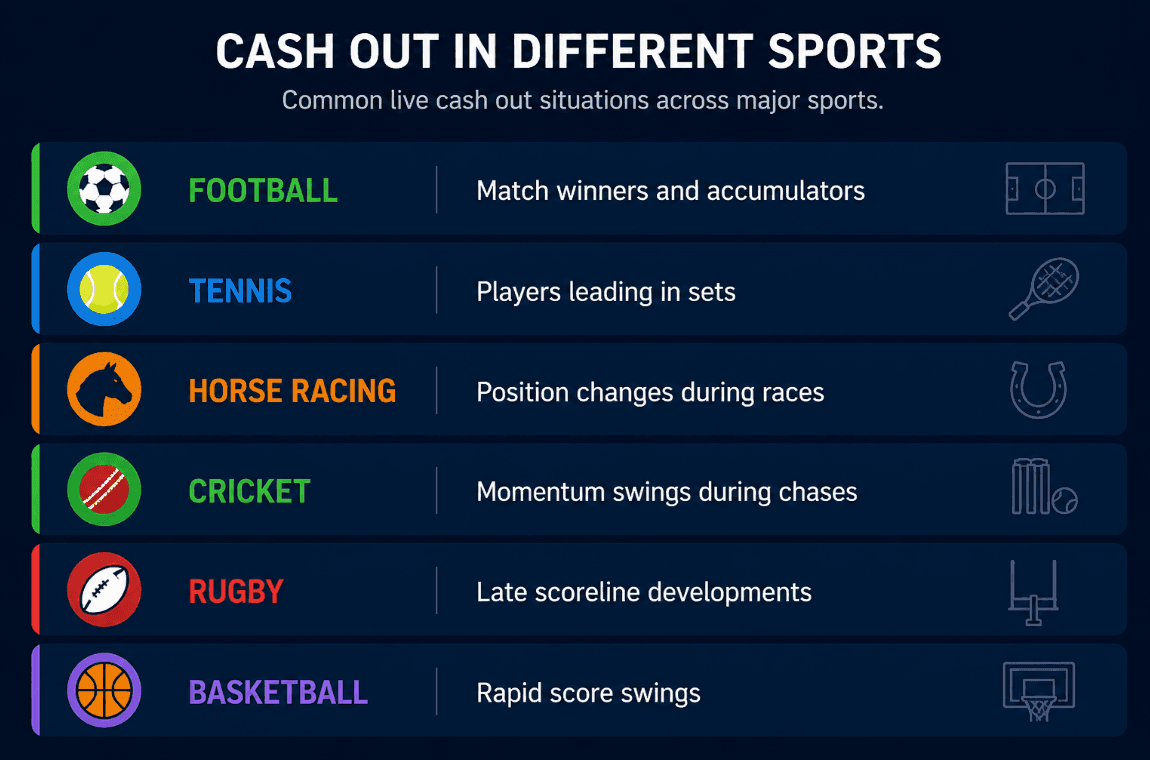
Different sports behave surprisingly differently when it comes to cashing out – sometimes simply down to whether or not cashing out is even available. Bookies devote plenty of power to offering cash-out options on football and horse racing. Basketball is another common cash-out option, too, but with highly volatile offers because of the frequent scoring runs. Cricket is another highly volatile sport when cashing out.
Credit: AI Generated - Captured by Claudia Hartley on 15th June 2026
Why Cash Out Works (and Where It Fails)
Cash out exists because having flexibility is valuable, but that’s not to say you’re automatically signing up to a better outcome.
Managing Uncertainty
Cash out allows you to exit your positions before the final settlement. Sometimes at a loss, sometimes at a gain. Either way, it can be useful if the probability of success has changed enough that reducing your exposure will benefit you.
Reduced Final Value
The trade-off with cash-out betting is immediate certainty at the expense of maximum return. You’re not going to get an offer for more than the expected future value of the bet.
Pros & Cons
Pros
Reduces exposure
Creates flexibility
Can help manage large probability swings
Cons
Sacrifices upside
Values change quickly
Not always available
Drivers of Value in Cash Out Decisions
Absolutely loads of things can influence whether accepting a cash-out makes sense, but here are some I regularly come back to:
Remaining time: A team leading by one goal after 20 minutes carries is a whole different ball game from that same team leading by one goal in the 88th minute.
Attitude/Game State: You don’t want to see your team hanging on under sustained pressure, ideally you want to be controlling possession comfortably.
Changes in probability: Let’s assume the likelihood of your bet settling successfully has changed. Does the cash out on offer accurately reflect that, or are they under/over offering?
Potential return: Protecting a sizable return is usually the way to go. It can be tempting to squeeze out every last bit of value, but it’s not always the best route.
The gap between the cash-out offer and maximum payout: Giving up £10 from a £240 return is a very different decision from sacrificing £120 of potential upside.
Emotional decision-making: Cashing out because the match has become difficult to watch is somewhere we’ve all been! But it isn't the same as cashing out because the underlying probability has genuinely changed.
Ultimately, you want to be using cash out as a risk-management tool rather than a panic button.
Cash Out and Accumulator Bets
Accumulators naturally increase uncertainty because multiple outcomes must occur in order for you to get any payout at all. That means cash out becomes particularly relevant when several selections have already won and only one or two legs remain. It’s even more relevant when the remaining selections carry significant risk.
Thinking back to our World Cup bet builder example. We’d got four total outcomes, and three of them had happened with a relatively short window of opportunity for the fourth to land. In this instance, cash out provides an alternative outcome to waiting it out.
There is no universally correct choice. It depends on how much value you place on certainty versus maximum return, and arguably, your risk tolerance too.
Common Cash Out Mistakes
Avoid these common pitfalls when making live cash-out decisions:
Cashing out after every small swing: Frequent exits can chip away at long-term value.
Assuming cash out guarantees profit: Accepting an offer often means sacrificing potential returns.
Ignoring the remaining probability: A tense finish doesn't necessarily mean your bet has become less likely to win.
Making emotional decisions: Stress and excitement can lead to impulsive choices.
Chasing previous losses: One cash-out outcome shouldn't dictate your next betting decision.
Cash Out and Bankroll Management
Cashing out should fit within a broader bankroll strategy instead of being a hastily pressed replacement for one. Always think about:
- Appropriate stake sizing
- Avoiding emotional exits
- Managing your overall exposure
- Preventing excessive live betting activity
Using cash out repeatedly or impulsively can increase your transaction frequency and move you from considered to reactive decision-making.
When Cash Out May Be Useful
Cash out may be helpful when:
- Exposure has become larger than originally intended.
- Managing a long accumulator.
- Reducing excessive late-stage risk.
- Securing a previously planned return threshold.
Cash Out Checklist
Before accepting a live cash-out offer, consider:
- What is the current probability of winning?
- How much potential return am I giving up?
- Is the cash-out value reasonable?
- Has the match situation genuinely changed?
- Am I making a logical decision or an emotional one?
Conclusion
Cash out allows you to lock in a return before the event concludes. Instead of eliminating risk exposure, it allows you to change it.
Cash-out offers change quickly during live betting based on live odds, game state, and bookmaker pricing models. Sometimes reducing that uncertainty aligns with your objectives; other times it’s better to let the wager continue.
Whatever your choice, understanding how cash out works can only be beneficial to your live betting strategy.
Frequently Asked Questions (FAQs)
What is cash out in live betting?
Cash out allows you to settle an active wager before the event finishes. You can choose to accept a current amount offered by the bookmaker – or not.
How does live cash out work?
Bookmakers continuously reassess the probability of a bet winning using live information. Using this, they give you a ‘settlement offer’ that you can either accept or decline.
How do bookmakers calculate cash-out values?
Bookies use factors such as live odds, remaining time, probability estimates, and their own margins to work out your cash-out value.
Is cashing out always the better option?
No, definitely not. Cashing out certainly reduces uncertainty, but it also sacrifices potential winnings.
Can cash out be unavailable during a live event?
Yes, quite often. Markets may suspend following major incidents. In football, that could look like goals, penalties, injuries, or red cards.

Claudia Hartley is a versatile content writer and editor with a strong footing in digital publishing, particularly within the iGaming and affiliate space. With nearly a decade of experience, she has built a reputation for producing clear, engaging, and well-researched content that connects with readers while meeting SEO goals.
Comments
0 comments
No comments yet. Be the first to share your thoughts!
References
- 1.Cash Out Feature Bet365 - Bet36. Accessed June 15, 2026
- 2.In-play or in-running betting - Gambling Commission. Accessed June 15, 2026
Related Resources to Betting Academy
- Betting Models Explained
- What is Five-Fold Betting & How it Works
- Learn How Betting Odds Work in Sports Betting
- What Is Correct Score Betting and How Does It Work?
- What Is Head-to-Head Betting and How Does It Work?
- What Is Value Betting and How Does It Work?
- How Goliath Bets Work in Sports Betting
- Combination Bets Explained
- Cash Out or Let It Ride? How to Make the Right Call on Your Acca
- How Futures Betting Works 2026 Explained with Value Odds and Risk Factors
- Double Betting Explained: The Expert Strategy Playbook 2026
- Card Betting Explained: Strategy, Odds & How to Find Value
- Treble Betting Explained: How it Works
- Single Betting Explained: Odds, Probability & Value Guide
- System Betting Explained
- European Handicap Betting Explained
- Spread Betting Explained: Expert Playbook & Strategy Guide 2026