
Betting Academy
Combination Bets Explained: How They Work, Risks & Strategy
The other day, I was on a UKGC-regulated sportsbook searching for a combination bet. A fourfold looked promising: Manchester City, West Ham, Bournemouth, and Leeds to win.

SportsBoom offers honest and impartial UK bookmaker reviews to help you make informed choices. While we may earn commissions through affiliate links, our content remains independent and free from promotional influence. For more information, see our Content Transparency and How We Review pages.

Combination Bets Explained
If I had made this bet, I would have lost due to West Ham. The ref marked no goal and no penalty in stoppage time for the Hammers. Therefore, even though my winnings would have been multiplied by the combination bet, so was my implied probability. One loss wiped out the entire bet.
That’s the magic of combination bets. It’s possible to win higher amounts. The price paid, though, is a larger stake exposure and compounded probability.
What Are Combination Bets?
A combination bet on a UKGC sportsbook is when multiple selections are grouped within a single slip. This is either through accumulators or system combinations. The payout structure depends on the bet type, with odds, probability, and the bookmaker's margin compounding across every selection.
A bettor turned a 30p stake into £500,000 in 2001 with a 15-leg accumulator priced at 1,666,666 to 1.
How Combination Bets Work
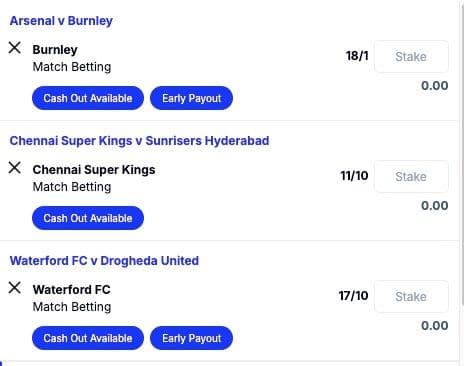
Credit: Boyle Sports - Screenshot captured by Samuel Barclay on 18 May 05:59
Combination bets come in various formats. This includes accumulators as well as betting systems like Lucky 63 betting. Some allow for partial wins and coverage, while others require all selections to win for a payout.
Regardless, when using any combination bet, implied probability is compounded. Therefore, the odds of 18/1, 11/10, and 17/10, would mean 5.26% x 47.62% x 37.04% = 0.93%. So the treble above has less than a 1% chance of hitting.
Types of Combination Bets
There are many combination bet types available at football bookies, from singles to Lucky 15’s:
| Bet Type | Selections | Total Bets | Pros |
| Double | 2 | 1 | Low variance |
| Trebles | 3 | 1 | Manageable probability |
| Four-fold | 4 | 1 | Good weekend acca format |
| Accumulators | 5+ | 1 | Large returns from small stakes |
| Yankee | 4 | 11 | Partial returns from 2+ winners |
| Heinz | 6 | 57 | Partial returns from 2+ winners |
| Lucky 15 | 4 | 15 | Returns from a single winner |
Each bet type has its pros and cons. While a Lucky 15 offers coverage from a single leg win, it lacks the risk-to-reward ratio that accumulators offer.

Combination Bets vs Other Betting Markets
vs Singles
Singles betting are settled per leg. Therefore, each leg is independent of the others. One loss doesn’t affect the others, so the probability is higher. As the probability is higher, the payout potential is lower. Combination bets, on the other hand, directly impact each other, lowering the probability of a win but increasing the potential payout.
vs System Bets
A combination bet is an all-or-nothing structure. With an accumulator, for example, one leg losing can wipe out the entire bet. However, on the other hand, they’re more affordable due to the low probability of a win.
System bets use a combination of bets, often including singles, doubles, and more, which pay out individually, so you get coverage but at a higher cost.
vs Straight Accumulators
A straight accumulator is a combination bet. All legs must win for a payout. A single losing leg ends the betting slip. Other betting systems, like system bets, can offer coverage through singles and doubles, but they are more expensive.
Understanding Probability in Combination Bets
Knowing the mathematics behind combination probability can help showcase the pros and cons of such bets.
Converting odds to percentages is the first step. Manchester City at home was priced at 2/9 vs Southampton. 2/9 = 1.25. 1 ÷ 1.25 = 0.80 (80%).
When using combination bets, this percentage is multiplied by each selection. For example, 0.80 × 0.70 × 0.60 × 0.55 = 0.1848 (18.5%).
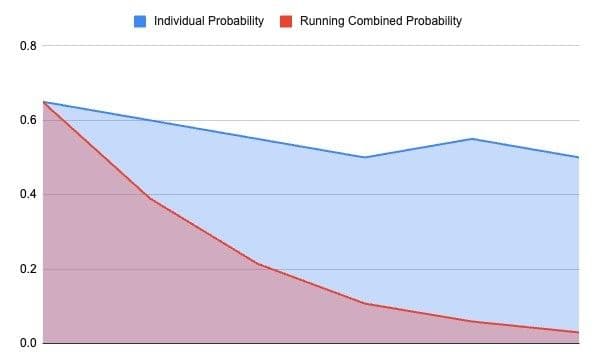
Credit: Samuel Barclay - Screenshot captured by Samuel Barclay on May 18 2026 - 06:51
As you can see, each selection lowers the probability rapidly. Even if selections appear strong individually, the probability can decrease quickly.
Remember, however, odds represent implied probability. They don’t represent certainty, and a bookmaker's margin is also in this percentage.
How Bookmakers Price Combination Bets
Bookmakers' pricing on combination bets multiplies the odds across selections. Alongside this, margins compound too.
If a sportsbook builds a 5% margin into each leg (which is pretty normal), a four-fold can carry an overall margin of close to 18%.
Because of this, longer combinations at Premier League bookies become statistically more difficult even before variance is factored in.
Why Combination Bets Appeal to Bettors
Larger Potential Returns
Combination bets multiply odds across selections, so a £5 stake could potentially produce a payout of hundreds or thousands. The trade-off, however, is that larger theoretical returns mean lower probability.
Entertainment Value
If planned correctly, combination bets can be used across multiple fixtures over a weekend. Bets can include multiple fixtures from football, rugby, tennis, and more, keeping bettors engaged for a long period of time.
Psychological Biases
Large wins can be appealing for some. They shouldn’t forget compounded risk, though. A slip of four 70% favourites offers an implied probability of about 24%. Such a low probability means it’s unlikely to win.
Why Combination Betting Works (and Where It Fails)
Odds Multiplication
Returns multiply leg by leg. Combining four selections at 2.00, 2.50, 3.00, and 4.00 produces combined odds of 60.00. This turns a theoretical £5 stake into £300, so returns can quickly rise.
Compounding Risk
Every added leg odds reduce due to the combined probability. Four selections at 75%, 70%, 65%, and 60% offer a combined probability of 20.5% overall. A fifth favourite of 60% drops the slip below 13%.
Pros & Cons
Pros
Flexible betting structures
Larger payout potential
Cons
High variance
Compounded bookmaker's margin
Increased emotional decision risk
Best Sports for Combination Betting
Combination bets work best in sports that have independent outcomes and deep fixture pools.
| Sport | Ideal Market | Risk Level | Why It Works |
| Football | Match result | Med | Great fixture volume |
| Horse Racing | Winners | High | Rewarding odds |
| Rugby Union | Handicap | Med-high | Good favourite structures |
| Tennis | Winners | Med | Lower variance |
Drivers of Value in Combination Bets
The value of combination bets comes from quality selections, not from chasing higher odds. Stronger slips that favour independent outcomes, moderate odds ranges, and selections that don’t move together are recommended.
Risk & Bankroll Management
Disciplined risk helps absorb the higher variance in combination bets. Losses are expected, so they need to be planned for. Somebody with a £1,000 bankroll should try to keep to a 1% exposure (£10).
Remember, the more selections, the higher the variance. Implied probability suggests that the chances of winning a full payout are dramatically lower with each selection added.
When Combination Betting Works
Combination betting tends to work best when:
- Selections are independent of one another
- Odds have moderate ranges and are not stacked
- Risk is calculated by bankroll
- Sources like Opta and FBref back selections
When to Avoid Combination Betting
Such betting should be avoided when;
Bet slips are being built to chase unrealistic outcomes
Weak selections are added just to chase payouts
Multiple legs from one match collapse into hidden variance
Losses are being chased rather than controlled
Sources like StatsBomb and Racing Post go against a position
Common Mistakes
The most common mistakes with combination bets are:
Building excessively long bet slips just to chase odds and forgetting about the combined probability.
Underestimating compounded probability and forgetting that four 70% favourites equals 24% implied probability.
Misunderstanding the impact of the bookmaker's margin. Each leg has a margin built into it, and it’s compounded with each selection.
Adding selections to purely increase odds without an independent probability case.
Combination Betting Checklist
When making combination bets, I go through the following checklist before proceeding:
Are the selections independent of each other?
Is the number of selections chosen realistic?
Does the total exposure fit with my bankroll?
Are odds proportionate to actual probability?
Are correlated outcomes avoided?
Is my decision backed by Official Premier League / EFL / ATP / Rugby data?
Conclusion
As seen, grouping selections into a single bet slip can increase payout potential as odds are multiplied together. However, alongside odds, the multiplication continues to the winning probability. Bookmaker's margin is also added to this multiplication, so odds are lower than many think.
Without question, hit rates of combination bets are lower than singles. If a bettor uses proper risk management and bankroll management techniques, they can use this betting structure effectively. It doesn’t, though, eliminate risk. It redistributes risks and rewards over multiple betting selections.
Remember, punters must be 18+ and should only use a UKGC-regulated sportsbook when using combination bets.
Frequently Asked Questions (FAQs)
What are combination bets in sports betting?
Combination bets put multiple selections into a single betting slip.
How are combination bets different from accumulators?
Accumulators are a type of combination bet. The wider category also covers betting systems, like Heinz and Lucky 15s.
Why do combination bets have higher variance?
It’s because every leg added multiplies the probability required to win the slip.
Can system bets be considered combination bets?
Yes. A system bet groups multiple selections together, so they can also be called combination bets.
How does bookmaker margin affect combination betting?
It compounds across each leg. This means a 5% margin per leg builds to about 18% on a four-fold.

Sam is a British content writer who’s now living in the Netherlands. He has 5+ years of experience producing SEO content for casino and sports bettors in Tier-1 markets. Working on campaigns for brands like Buzz Bingo, Paddy Power, Betfred, and Sun Bingo, he’s written 1M+ words of content spanning casino reviews, sportsbook reviews, slot guides, betting strategies, and industry news.
Comments
0 comments
No comments yet. Be the first to share your thoughts!
Related Resources to Betting Academy
- How Goliath Bets Work in Sports Betting
- Cash Out or Let It Ride? How to Make the Right Call on Your Acca
- How Futures Betting Works 2026 Explained with Value Odds and Risk Factors
- Double Betting Explained: The Expert Strategy Playbook 2026
- Card Betting Explained: Strategy, Odds & How to Find Value
- Treble Betting Explained: How it Works
- Single Betting Explained: Odds, Probability & Value Guide
- System Betting Explained
- European Handicap Betting Explained
- Spread Betting Explained: Expert Playbook & Strategy Guide 2026