
Betting Academy
Betting Odds Explained: What They Mean and How They Work
When betting on sports, you should compare odds across multiple bookmakers to ensure you’re getting the best price. But what do these betting odds mean?
SportsBoom offers honest and impartial UK bookmaker reviews to help you make informed choices. While we may earn commissions through affiliate links, our content remains independent and free from promotional influence. For more information, see our Content Transparency and How We Review pages.
Betting Odds Explained!
Betting odds are a representation of implied probability, which is the expected likelihood of something happening. They also dictate your potential payout should that bet land successfully.
Odds are not a guarantor of any given outcome… even the bookies get it ‘wrong’ on occasion!
What Are Betting Odds?
Betting odds are a numerical representation of the probability of an outcome happening.
Each bookmaker prices a market independently; hence the different prices available at each.
Odds can be displayed in three different ways: fractional, decimal and American. You can choose your display type at each betting site/app.
How Betting Odds Work
A simple way to remember how sports betting odds work:
- The shorter the odds, the higher the implied probability
- The longer the odds, the lower the implied probability
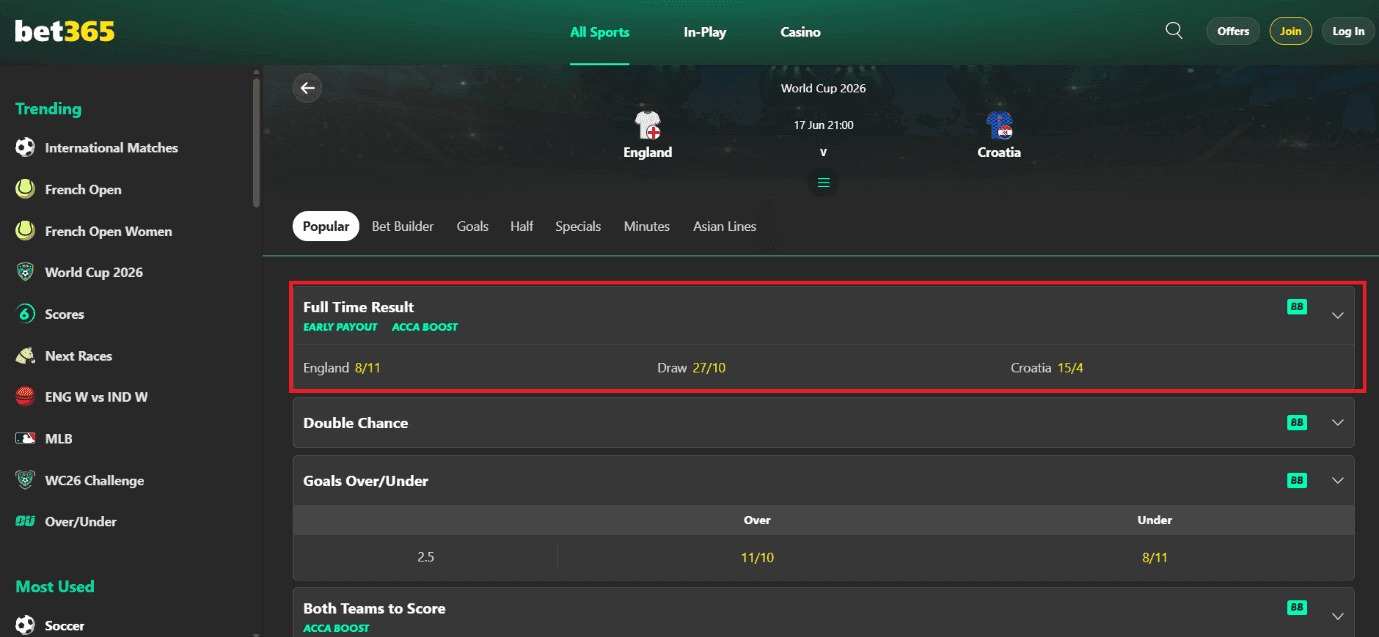
In the football betting screenshot below, England are priced at 8/11… these are considered ‘short odds’ due to the payout calculation:
- A £10 bet at 8/11 returns £17.27
(Credit: Bet365 sportsbook – screenshot captured by Richard Trenchard on 2 June 2026 – 08:40)
Bets on the draw or Croatia to win are long odds selections:
- A £10 bet on the draw at 27/10 returns £37
- A £10 bet on Croatia to win at 15/4 returns £47.50
Decimal Odds Explained
The example above is displayed in fractional odds.
Some punters prefer decimal odds as they can be easier to understand. The even money point is 2.00, with numbers smaller than that ‘short odds’, with numbers greater than 2.00 considered long odds.
When betting on the Premier League, one of the teams in the match will be short, while the draw and the underdog will be longer odds – although in some tight games, even the favourite can be around 2.00.
The decimal number reflects the implied probability of the event occurring.
Decimal Odds Explained
| Decimal Odds | Potential Return (from £10 stake) | Implied Probability | Descriptors |
| 1.50 | £15 | 66.6% | Odds on, short odds |
| 1.75 | £17.50 | 57.1% | Odds on, short odds |
| 2.00 | £20 | 50% | Even money |
| 2.33 | £23.30 | 42.9% | Odds against, long(ish) odds |
| 4.15 | £41.50 | 24.1% | Odds against, long odds |

Fractional Odds Explained
With fractional odds, your return can be calculated by multiplying the number on the left (the numerator) by the number on the right (denominator), which also represents your stake.
For example, a £10 bet at fractional odds of 2/1:
- 2 x £10 = £20. So that’s £20 of profit, plus our £10 stake back for a return of £30
We can perform this calculation with any fractional price by dividing the numerator by the denominator. For example, a £10 bet at 5/2 (5/2 is 2.5/1) could yield a profit of £25 (2.5 x £10), with our £10 stake back for a total return of £35.
Fractional Odds Explained
| Fractional Odds | Potential Return (from £10 stake) | Implied Probability | Descriptors |
| 1/2 | £15 | 66.6% | Odds on, short odds |
| 3/4 | £17.50 | 57.1% | Odds on, short odds |
| 1/1 (evens) | £20 | 50% | Even money |
| 2/1 | £30 | 33.3% | Odds against, long(ish) odds |
| 100/30 | £43.33 | 23.1% | Odds against, long odds |
American Odds Explained
In American odds, a minus number reflects an odds-on selection, e.g. -200. A plus number is an odds-against selection, e.g. +150.
With the negative odds, the number displayed shows how much you need to bet to win £100. With positive odds, the number displayed shows how much you would win from a £100 stake.
American Odds Explained
| Negative Odds | Positive Odds |
| -300 (£10 to return £13.33) | +300 (£10 to return £40.00) |
| -250 (£10 to return £14) | +250 (£10 to return £35) |
| -200 (£10 to return £15) | +200 (£10 to return £30) |
| -175 (£10 to return £15.71) | +175 (£10 to return £27.50) |
| -125 (£10 to return £18) | +125 (£10 to return £22.50) |
Understanding Implied Probability
By converting odds to a percentage probability, it can be easier to make an informed betting analysis.
For example, if Carlos Alcaraz is playing Jannik Sinner and you consider that to be a 50/50 match. But the odds make Sinner a 25% underdog… perhaps that’s good value.
But remember, implied probabilities are just an estimate; not a guarantee.
You can calculate implied probability from decimal odds:
- Implied probability = (1/decimal odds) x 100
Understanding Implied Probability
| Decimal Odds | Implied Probability |
| 1.60 | 62.5% |
| 2.20 | 45.5% |
| 3.00 | 33.3% |
| 4.50 | 22.2% |
| 7.00 | 14.3% |
How Bookmakers Calculate Odds
Online Bookmakers deploy advanced statistical models to help calculate their odds.
Just some of the inputs (for football) include form, league position, player availability, strength of schedule, historical data and more besides.
In addition, they include a margin on top of their prices, which effectively acts as a buffer and prevents them from being wiped out when popular selections land.
Bookmakers also alter their live odds based upon market behaviour, e.g. a popular pick will be shortened in price accordingly.
What Is Bookmaker Margin (Overround)?
The bookmakers’ margin is essentially the same as the house edge at the casino: an in-built mathematical edge that manages risk.
Sometimes known as ‘overround’, ‘vig’ or ‘juice’, the margin can be calculated by adding up the sum of the odds in the market and seeing how far they exceed 100%, e.g.:
- England (8/11) – Probability of 57.9%
- Draw (27/10) – Probability of 27%
- Croatia (15/4) – Probability of 21.1%
- 57.9 + 27 + 21.1 = 106%
Why Betting Odds Change
Betting odds change when there is a stimulus that attracts new money.
For example, if a football manager rotates their starting eleven with fringe players, money will come in for the draw or the other team.
If there is heavy rain on the day of a major horse race, the market will move in favour of those with form on softer ground.
Favourites vs Underdogs
Although not true in every single case, in the vast majority of events, there will always be a favourite and an underdog.
Favourites
The favourite is the shortest odds of the available selections, which therefore has a higher implied probability of landing.
Underdogs
Underdogs are longer-odds selections that have a lower implied probability of winning.
Important Clarification
But not all favourites win… and not all underdogs lose. Remember: higher implied probabilities do not guarantee a win, and vice versa.
Betting Odds Across Different Sports
Different sports have their own pricing structure.
Generally speaking, the more possible outcomes there are, the higher the odds for each available selection.
| Sport | Market | Odds | Behaviour |
| Football | Match Winner | Short | Volatile |
| Horse Racing | Race Winner | Longer | Variance, larger fields |
| Tennis | Match Winner | Short | No draw possible |
| Cricket | Match Winner | Short | Odds fluctuate in-play |
| Rugby Union | Handicaps | Short(ish) | High scoring sport |
Common Betting Odds Mistakes
Here’s a quick bullet point list of common mistakes:
Assuming favourites will win
Assuming underdogs will lose
Chasing big winners (longshot bias)
Not considering implied probability
Failure to factor in bookmaker margin
Betting Odds and Bankroll Management
The higher the odds, the lower your implied probability of winning – this needs to be factored into your staking plan.
Meanwhile, lower odds picks may have higher probabilities, but their returns are lower – meaning that win ratio has to be higher.
That’s why we always advocate disciplined staking and long-term thinking, while accounting for the possibility of losing streaks.
And you should always avoid ‘emotional’ betting decisions, which manifest themselves as chasing losses etc.
In Conclusion: Why Understanding Odds Matters
It’s vital that you understand how betting odds work: it helps you to make better informed decisions, for starters.
Be ‘probability aware’, manage risk carefully and understand how your payout is impacted by the price you take.
Remember, odds are a guide only: they are not wholly predictive of the outcome of sporting events.
FAQs
What do betting odds mean?
Betting odds are calculated as an implied probability of an event occurring, e.g. Arsenal to beat Liverpool.
How do decimal odds work?
Decimal odds are implied probabilities, with 2.00 acting as even money and numbers lower than 2.00 as odds on – therefore, prices higher than 2.00 are odds against.
What is implied probability in betting?
Implied probability is the perceived percentage chance of a particular sports result happening.
Why do betting odds change?
Betting odds change when a stimulus sees money come in for a selection, e.g. when a football team is without their star player, punters may back the opponent instead.
What is bookmaker's margin?
The bookmaker margin is an added buffer that helps to limit the bookies’ financial liability.
Are low odds safer than high odds?
Low odds have a higher implied probability than high odds. But in sport, anything can happen!
Which odds format is most common in the UK?
Fractional odds is the most common format in UK betting, although you can switch to decimal or American with your chosen bookmaker.
How do bookmakers calculate betting odds?
Bookmakers utilise advanced statistical modelling, which includes form, historical data, team/player strength, recent schedule etc.
Richard comes to SportsBoom with more than a decade of iGaming and sports betting experience behind him, and we're delighted to have such a respected writer on our books.
Comments
0 comments
No comments yet. Be the first to share your thoughts!
Related Resources to Betting Academy
- What Is Correct Score Betting and How Does It Work?
- What Is Head-to-Head Betting and How Does It Work?
- What Is Value Betting and How Does It Work?
- How Goliath Bets Work in Sports Betting
- Combination Bets Explained
- Cash Out or Let It Ride? How to Make the Right Call on Your Acca
- How Futures Betting Works 2026 Explained with Value Odds and Risk Factors
- Double Betting Explained: The Expert Strategy Playbook 2026
- Card Betting Explained: Strategy, Odds & How to Find Value
- Treble Betting Explained: How it Works
- Single Betting Explained: Odds, Probability & Value Guide
- System Betting Explained
- European Handicap Betting Explained
- Spread Betting Explained: Expert Playbook & Strategy Guide 2026