
Betting Academy
What Is Head-to-Head Betting and How Does It Work?
A bettor backs Rory McIlroy at 1.80 with a head-to-head (H2H) against a longer-priced rival on a licensed online sportsbook, believing that the short price offers a higher chance of winning.

SportsBoom offers honest and impartial UK bookmaker reviews to help you make informed choices. While we may earn commissions through affiliate links, our content remains independent and free from promotional influence. For more information, see our Content Transparency and How We Review pages.

Head-to-Head Betting Explained
During the event, Rory hits fairways, greens, and even shoots a par. He was destined to win based on the short odds, but he lost. The underdog won.
That’s H2H betting. The market is settled on outright results, not statistical performance, and even though he was meant to win, betting variance occurred, like with all bets.
What Is Head-to-Head Betting?
Head-to-head (H2H) betting is a two-outcome market where a bet is placed on one of two competitors to win their match or event, regardless of margin. For example, an outright winner market like a tennis match between Cezar Cretu and Denis Yevseyev.
The odds of each side reflect the implied probability of the bet, plus the bookmaker's pricing. It isn’t a guaranteed outcome, but it gives us a market view on who’s more likely to win, with favourites carrying shorter prices and underdogs longer ones.
How Head-to-Head Betting Works
UK bookmakers price each side of an H2H bet based on their perceived probability of winning.
Take a tennis match between Cezar Cretu and Denis Yevseyev, for example:
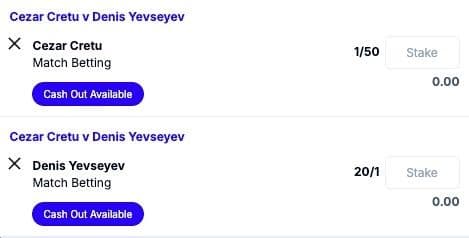
Credit: Boyle Sports - Screenshot captured by Samuel Barclay on 25 May 2026 - 10:52
To understand the winning probability, convert the fractional odds to decimal. For Cezar’s 1/50 that’s 1 ÷ 50, then + 1 = 1.02 and for Denis’s 20/1, that’s 20 ÷ 1, then + 1 = 21.00.
The implied probability is then 1 ÷ decimal odds. For Cezar, this is 1 ÷ 1.02 = 98%, and for Denis, this is 1 ÷ 21.00 = 4.8%. Together, that equals 98% + 4.8% = 102.8%.
Cezar clearly has favourite pricing as he has a 98% implied probability of winning. Denis, on the other hand, has underdog pricing, which is represented by his longer odds.
The 2.8% above the 100% implied probability is the bookmaker's margin. That’s the house edge that’s baked into the bet.
Head-to-Head Betting vs Other Betting Markets
vs Handicap Betting
H2H bets settle based on an outright result, like a winner or loser. Handicap betting, on the other hand, operates on a margin-adjusted market, meaning a virtual head start or deficit is applied to one side, such as a -1.5 goal handicap in football.
vs Correct Score Betting
An H2H bet only focuses on who wins or loses. Correct score betting, however, requires predicting the exact final scoreline, making it harder but offering longer odds. For example, 1-0 to Man United or 3-1 to Chelsea.
vs Draw No Bet
Both are two-outcome markets, but an H2H bet settles a win or a loss, which is why it’s popular in markets like tennis or golf. For markets like football, though, a Draw No Bet acts like an H2H, as it refunds the bet if the match ends in a draw.
Understanding Implied Probability in H2H Betting
Implied probability can be calculated by dividing 1 by the decimal odds.
For example, 1 ÷ 1.5 (odds) = 0.667, aka 66.7%. It quickly tells us what the bookmaker believes may happen, not what will happen.
As a rule of thumb, shorter odds have a higher implied probability and longer odds have a lower implied probability.
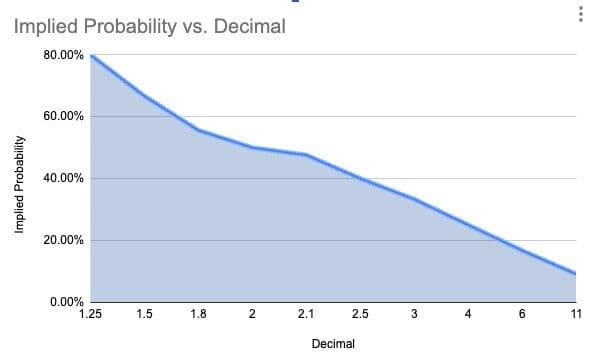
Credit: Samuel Barclay - Screenshot Captured by Samuel Barclay on 25 May 2026 - 11:22
Remember, each premier league sportsbook has different margins. Margins are baked into implied probability naturally, so these aren’t exact percentages. Regardless, it gives us a good understanding of who the favourites and underdogs are.
How Bookmakers Set H2H Odds
Sportsbooks combine statistical models, recent form, team news, and betting activity to price H2H markets.
Data from providers like Opta, StatsBomb, Racing Post, Cricbuzz, and Tennis Abstract feeds into base probability estimates. Injuries (often reported via ESPN), home advantage, and betting trends adjust the pricing further.
The bookmaker's margin is then added. This is why implied probabilities always exceed 100%; anything over 100% is the bookmaker's margin, otherwise known as their edge.
Why Favourites Lose in H2H Betting
Higher implied probability doesn’t guarantee a win. It only suggests the likelihood of something happening.
Everything from finishing variance to red cards, weather conditions, tactical mismatches, and low-scoring football volatility can impact results.
Why Underdogs Appeal in H2H Markets
Higher Potential Returns
Underdogs provide longer odds, meaning a higher payout but a reduced implied probability. For example, a £10 stake at 5.00 returns £50 if the prediction is right; however, a 5.00 odds has an implied probability of 20%.
Variance in Sports Outcomes
Implied probability isn’t perfect, but it represents what the bookmaker expects to happen. An early red card, goal, or even a change could increase the probability of an underdog winning despite being priced with longer odds.
Market Overreaction
Public perception often inflates favouritism pricing, meaning heavy betting on the popular side shortens their odds beyond what the data justifies. This pushes underdog prices even longer, increasing payout possibilities.
Why Head-to-Head Betting Works (and Where It Fails)
Simpler Market Structure
H2H bets are inherently simple, as the prediction is only the winner vs the loser. There’s no margin to calculate, no exact score to predict, no handicap to cover, and no 5+ selections to research. It’s just one simple selection that focuses on an outright winner.
Variance Remains High
Short H2H bets' results offer high implied probability at a reduced payout. Though the implied probability seems attractive, anything can happen, so variance remains higher regardless of the H2H bet made.
Pros & Cons
Pros
Simple market structure
Widely available in sports
Easy implied probability comparisons
Cons
Bookmaker margin reduces value
Favourite may become overpriced
Variance can impact short odds
Best Sports for Head-to-Head Betting
The best sports to be on with H2H betting are those with no draw outcome, like:
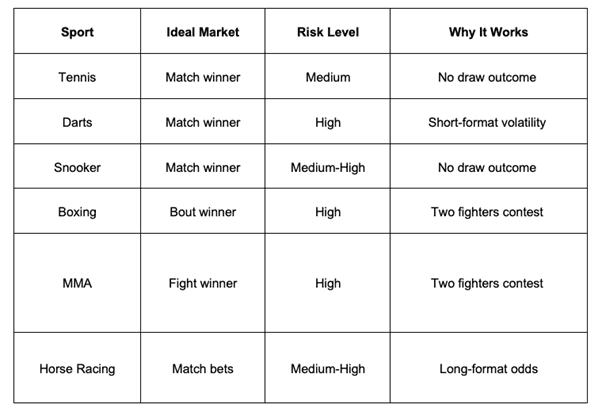

Drivers of Value in H2H Markets
Value depends on the probability assessment, not necessarily just trying to pick winners. Injuries, fixture congestion, tactical mismatches, market overreaction, and statistical indicators all move true probability.
A strong setup is when an undervalued away side has favourable matchup metrics that aren’t priced in yet. A weak set-up would be backing a favourite team at inflated odds without any analytical data to back it up.
Head-to-Head Betting and Bankroll Management
Even though H2H betting is simple, bankroll management is important, and variance is unavoidable. Flat staking and percentage staking work best. For example, £1 or 5% of an account. Avoiding emotional betting is always recommended as well.
Common Head-to-Head Betting Mistakes
The most common mistakes when it comes to H2H betting are:
Assuming favourites are safe, and variance doesn’t exist
Ignoring the bookmaker's margin when calculating implied probability
Overreacting to recent form and not on underlying metrics
Chasing losses after upsets using betting strategies like Martingale
Thinking implied probability means certain outcomes
When Head-to-Head Betting Works Best
H2H betting works best when:
Data support the decision
Realistic probability is assessed correctly
Bankroll managed is controlled and disciplined
House margin is taken into consideration
When to Avoid H2H Betting Assumptions
All bettors should avoid H2H betting when:
Bets are made emotionally
Lineup or injury news isn’t studied
Recent results are overestimating possible results
Betting variance is misunderstood
Head-to-Head Betting Checklist
Before making an H2H bet, every bettor should ask themselves these questions:
Are the odds justified by realistic probability?
Is the bookmaker's margin considered in the maths?
Are injuries and suspensions updated and used in the decision?
Is the public sentiment inflating the long or short market?
Is bankroll exposure controlled or not?
Conclusion
Head-to-head betting, or H2H betting, focuses on selecting outright winners rather than margins. These only work with events and markets that have two outcomes, like a tennis bet on a winner or loser.
When calculating whether or not a selection is good, use implied probability, bookmaker pricing, and external data from sources like Opta. These will help reinforce a decision while removing emotions.
Remember, variance can occur, and losers are inevitable. Bettors must be 18+, and they should only use UKGC-licensed bookmakers if they’re based in the UK.
FAQs
What is head-to-head betting?
Head-to-head (H2H) betting is when a bet is placed on a sporting event that has a winner or loser.
Is H2H betting the same as handicap betting?
No, Handicap betting can be a goal-based market where H2H bets are just winner or loser.
Do favourites always offer H2H betting?
No, as it depends on the sport.
How do bookmakers calculate odds for H2H bets?
They calculate odds based on betting data, news, external data, team data, and more.
Does extra time count in H2H betting?
Yes, it doesn’t change the structure of an H2H bet.
Why do favourites lose H2H betting?
Because variance still exists regardless of the betting strategy.
Is H2H betting available for all sports?
No. It’s only for sports with two outcomes, like tennis, where there’s either a winner or a loser.
No. It’s only for sports with two outcomes, like tennis, where there’s either a winner or a loser.
Very, as variance means losers will still occur.

Sam is a British content writer who’s now living in the Netherlands. He has 5+ years of experience producing SEO content for casino and sports bettors in Tier-1 markets. Working on campaigns for brands like Buzz Bingo, Paddy Power, Betfred, and Sun Bingo, he’s written 1M+ words of content spanning casino reviews, sportsbook reviews, slot guides, betting strategies, and industry news.
Comments
0 comments
No comments yet. Be the first to share your thoughts!
Related Resources to Betting Academy
- What Is Value Betting and How Does It Work?
- How Goliath Bets Work in Sports Betting
- Combination Bets Explained
- Cash Out or Let It Ride? How to Make the Right Call on Your Acca
- How Futures Betting Works 2026 Explained with Value Odds and Risk Factors
- Double Betting Explained: The Expert Strategy Playbook 2026
- Card Betting Explained: Strategy, Odds & How to Find Value
- Treble Betting Explained: How it Works
- Single Betting Explained: Odds, Probability & Value Guide
- System Betting Explained
- European Handicap Betting Explained
- Spread Betting Explained: Expert Playbook & Strategy Guide 2026