
Betting Academy
Betting Models Explained: Types, Benefits and Limitations
It’s very difficult to beat the bookies using basic data or even gut instinct. The margin that bookmakers build into their odds means that your win ratio has to be remarkably good in order to turn a long-term profit.
SportsBoom offers honest and impartial UK bookmaker reviews to help you make informed choices. While we may earn commissions through affiliate links, our content remains independent and free from promotional influence. For more information, see our Content Transparency and How We Review pages.

Betting Models Explained
One way to potentially increase your chances of success is to build an advanced statistical model effectively taking on the odds-makers at their own game.
By devising your own model, you can generate what you consider to be the ‘true’ odds for, say, a Premier League game. You can then compare these prices to what’s available, identifying possible value scenarios.
A betting model is only a tool for estimating probabilities… it’s not a silver bullet for sports betting success. But it can help to add key insights when placing your bets.
What Are Betting Models?
A betting model is a statistical framework for predicting the outcome of sporting events. It utilises a variety of data points to assign implied probabilities to each possible outcome, which can then be converted into ‘fair’, i.e. margin-less, betting odds.
You can then compare your model’s results to the odds provided by bookmakers, identifying potential situations in which betting value exists.
Bookmakers use their own models, with inputs ranging from Poisson distribution to regression analysis, as well as machine learning, to set their opening betting lines.
How Betting Models Work
So how do you build a betting model?
The cornerstone is the data that is fed into it. The two key variables here:
- Identifying data that has predictive valu
- Finding reliable, accurate sources of said data
For football, as an example, you might choose to build a model around Expected Goals (xG); specifically, non-penalty xG.
As for a source, there are paid options like StatsBomb [1], who offer granular level detail across unique data points, or free providers like FotMob [2].
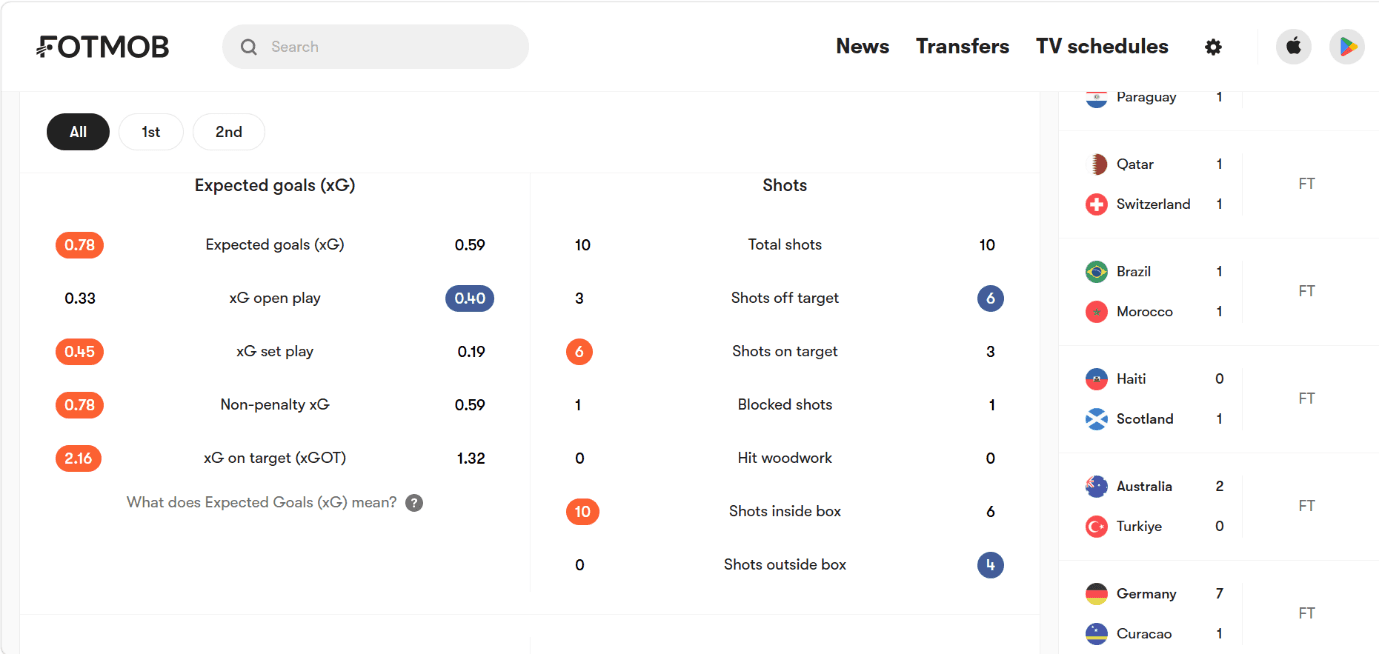
(Credit: FotMob – screenshot captured by Richard Trenchard on 15 June 2026 – 10:20)
Then it’s about manipulating and interrogating your data, applying a formula or algorithm that adds the most value to the numbers.
The key is to generate a probability output for each outcome, which can then be converted to odds using an implied probability calculator.
Use an odds comparison site to see how your odds stack up against the bookies’… there may just be value opportunities out there.
Types of Betting Models
Statistical Models
Statistical models use performance data to assess the quality of a player/team compared to their opponent.
- Open play xG (football)
- First serve points won % (tennis)
- Fractional times (horse racing)
The data can then be interrogated with an appropriate formula – be it Poisson distribution, regression analysis etc – to offer implied probabilities of possible outcomes.
Machine Learning Models
In our AI-centric world, machine learning models can be programmed to identify trends and patterns within a dataset.
Simulation Models
Some models use thousands of simulations of an event to provide probabilities of each possible outcome from a large sample size.
How Betting Models Calculate Probability
The more data inputs the better when devising your model; be it historical performance, head to heads, current form, player-specific or team-specific metrics or contextual factors (home/away, travel distance etc).
Win percentages can be converted to betting odds:
- Player A – 55% -> 1.82
- Player B – 45% -> 2.22
Betting Models vs Bookmaker Odds
In the example above, let’s say you find a betting site that is offering odds of 1.90 on Player A.
Your model has identified a possible value opportunity. But it’s still worth doing more qualitative research before hitting the ‘place bet’ button.
Understanding Value Betting with Models
Betting models can identify moments where you shouldn’t bet, as no value is available.
Expected Value (EV) can be positive (where your model implies good value in the odds) or negative EV, where outcomes have been so efficiently priced by the market that, in the long run, this would be a losing bet when factoring in variance, bookmaker margins etc.
Remember, positive EV does not automatically mean your bet will be profitable… it’s simple a useful decision-making guide.
Betting Models Across Different Sports
The data inputs for betting models across each sport are different by necessity:
| Sport | Data Inputs | Complexity |
| Football | xG, shot volume, possession | High |
| Horse Racing | Form, speed ratings, fractional times | High |
| Cricket | Player stats, form, format, conditions | High |
| Tennis | Serve reliability, ranking, surface win % | Medium |
| Basketball | Pace, efficiency | Medium |

Why Betting Models Work (and Where They Fail)
Betting models can be useful… but they can present issues, too.
Data-Based Decision Making
Emotion-led betting often leads to losses. A mechanical betting model, meanwhile, allows for a more disciplined and methodical approach.
Data Limitations
But a model is only as strong as its data inputs. If the stats you apply are inaccurate, out of date or missing key elements, your model can suffer diminished efficacy.
Changing Conditions
A betting model is ‘static’; it cannot react to dynamic changes in weather or conditions. This is where ‘human’ context is also essential.
Building a Simple Betting Model
You can actually get your preferred AI bot to build you a betting model if you don’t want to do the heavy lifting.
- 1
Choose your sport and market
- 2
Select the most predictive variables (form, player availability, home advantage, conditions, historical records etc)
- 3
Add weightings if you wish (i.e. in countries where home advantage is a key factor due to travel distances etc)
- 4
Review the results
Don’t always take your model’s results as gospel. Test its efficacy… and remember, if your implied probabilities are way off the odds, there’s a chance that your model is ‘wrong’ given the efficiency of the betting market.
Back-Testing Betting Models
It’s important to back-test your model, as past results do not always predict future performance.
You can test out historical games that have already happened, applying your model’s probability outputs to the odds offered by the bookmakers – there are sites that archive old betting prices.
Examine if the model would have been successful. Would you have secured a positive ROI on betsplaced? Did your model deliver CLV (closing line value) when analysing starting odds?
Common Betting Model Mistakes
Some considerations to ponder:
- Using too few data points
- Inaccurate data
- Small sample sizes
- Trying to model highly volatile events
- Model can’t account for unexpected changes, e.g. key players being rested
- Outputs are probability, not certainty
Betting Models and Bankroll Management
Modelling can improve your predictive powers, but it does not remove the risk associated with betting on sports.
This is why you need to account for variance by managing your bankroll effectively. You can create a unit-based system staking plan, or simply opt for flat stakes of around 2-5% of your bankroll each time.
This limits your exposure and protects against long losing streaks, which can (and readily do) occur.
Human Analysis vs Betting Models
There’s strengths and weaknesses to human analysis and algorithmic modelling:
Strengths of Models
Models remove the manual workload of data processing and provide useful insights in seconds. They are consistent and devoid of emotion.
Strengths of Human Analysis
Human eyes and minds can add context, while reacting to the latest information, e.g. player availability and tactical changes.
Best Approach
The best approach is to apply your own analysis to the outputs presented by a model. Take the implied probabilities and interpret them alongside team news, weather conditions etc.
Conclusion
Betting models can be a useful way to add extra insight to your predictions.
They should not be treated as an all-powerful deity, but rather as support to your decision-making process.
A model is only as effective as the human providing it with data and analytical instructions.
FAQs
What is a betting model?
A betting model takes data inputs, applies advanced mathematical formulas to them and provides implied probabilities of how a sporting event may play out.
How do betting models work?
Betting models provide an implied probability, typically in percentage form, that users can convert to betting odds to see if value opportunities exist in the market.
Can betting models predict winners?
Yes they can… although all sports are unpredictable and volatile, so losing streak are possible – stake sensibly at all times.
Are AI betting models accurate?
AI betting models are only as accurate as the data sources they are provided with.
What data do betting models use?
Each sports has its own key data points, from Expected Goals in football to sectional times in horse racing.
What is expected value in betting models?
Expected value is determined by whether your model’s outputs suggest there is positive value or negative value in a betting market.
How do betting models compare to bookmaker odds?
An efficient betting model should be very close to the bookmakers’ odds, ideally with some small discrepancy to indicate value.
Richard comes to SportsBoom with more than a decade of iGaming and sports betting experience behind him, and we're delighted to have such a respected writer on our books.
Comments
0 comments
No comments yet. Be the first to share your thoughts!
Related Resources to Betting Academy
- What is Five-Fold Betting & How it Works
- Learn How Betting Odds Work in Sports Betting
- What Is Correct Score Betting and How Does It Work?
- What Is Head-to-Head Betting and How Does It Work?
- What Is Value Betting and How Does It Work?
- How Goliath Bets Work in Sports Betting
- Combination Bets Explained
- Cash Out or Let It Ride? How to Make the Right Call on Your Acca
- How Futures Betting Works 2026 Explained with Value Odds and Risk Factors
- Double Betting Explained: The Expert Strategy Playbook 2026
- Card Betting Explained: Strategy, Odds & How to Find Value
- Treble Betting Explained: How it Works
- Single Betting Explained: Odds, Probability & Value Guide
- System Betting Explained
- European Handicap Betting Explained
- Spread Betting Explained: Expert Playbook & Strategy Guide 2026