
Betting Academy
What is Five-Fold Betting & How it Works
Five-fold accumulators are one of the most common multiple bets offered by bookies - UK bettors seem to love them.

SportsBoom offers honest and impartial UK bookmaker reviews to help you make informed choices. While we may earn commissions through affiliate links, our content remains independent and free from promotional influence. For more information, see our Content Transparency and How We Review pages.

Five-Fold Betting Explained
The upside is you can take a small stake and potentially receive a large payout. The downside is that with every selection you add, the probability of landing the five-fold bet decreases.
You might combine five Premier League selections into one acca. They’re all short-priced, all kicking off at the weekend, and you’ve done your due diligence in terms of value. It seems to make sense to combine them as the payout is much larger as a five-fold rather than individual bets.
However, the third leg of your bet fails when an unexpected red card derails play and your team lets in a late goal. If you’d had the five individual bets, you’d be up, but with the acca, it’s all or nothing.
Five-fold bets dramatically decrease probability and increase risk. It’s up to you to decide if the larger payout is worth it.
What Is a Five Fold Bet?
A five-fold bet is an accumulator with five selections. In order for your bet to win, every single selection must win.
Calculating odds for accumulators is simple, just multiply the odds of all five picks together. As such, you get much larger combined odds than if you’d bet on each selection individually, but also, your overall probability drops sharply.
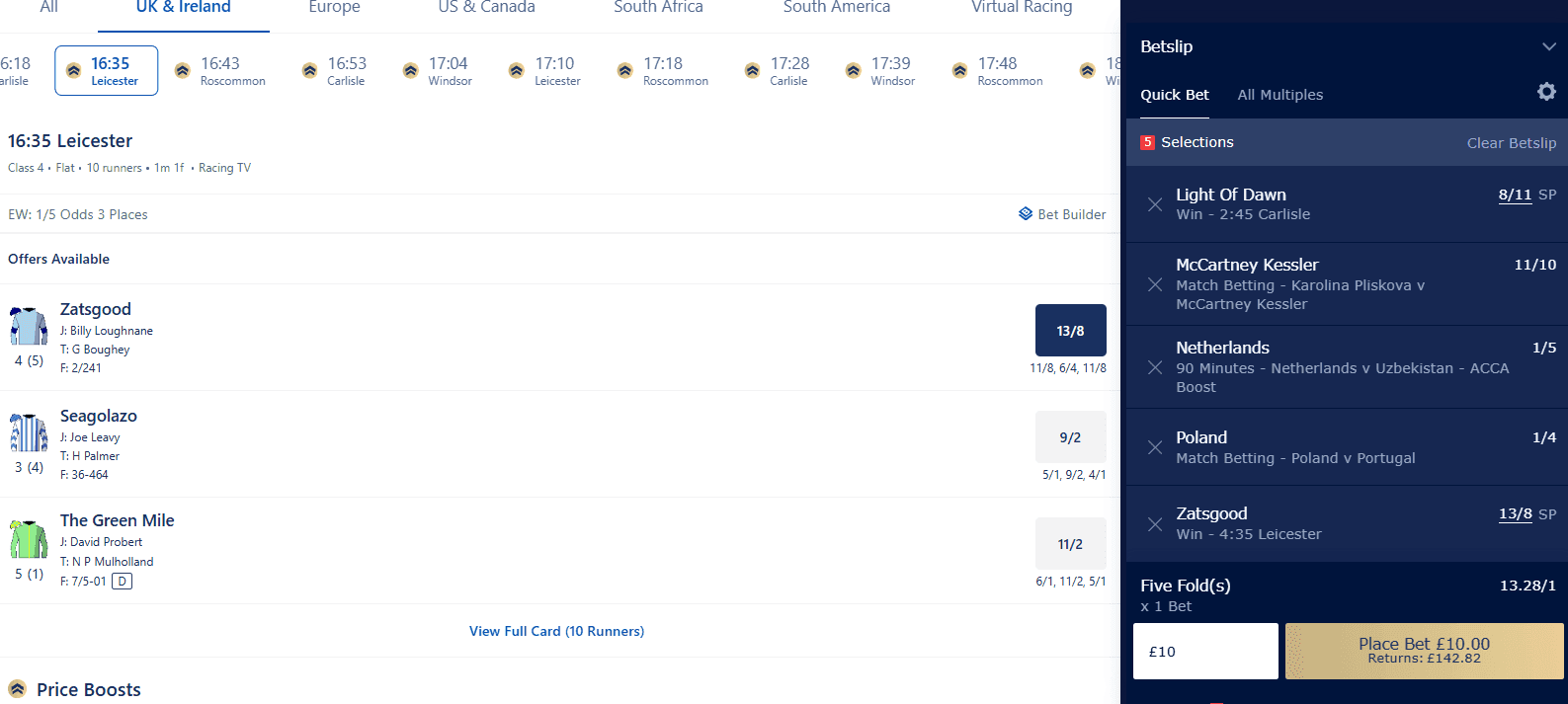
Credit: William Hill Sportsbook – Screenshot Captured by Claudia Hartley 8th June 2026
Here all five outcomes are unrelated, but they must all win to guarantee a payout. Even if four lose and that final horse comes second, the entire bet loses.
The all-or-nothing aspect of placing an accumulator is what makes them attractive (large odds) but also difficult to predict (small probability).
Even a five-fold made entirely from odds-on favourites can still have a surprisingly low overall probability. If you choose odds of 1.50 exclusively, then your fivefold only has a 13.2% chance of coming in, despite each selection having a 66.7% chance on its own.
How Five Fold Betting Works
Regardless of the operator you’re betting with, building a five-fold is simple. You choose five outcomes, add them to your slip and choose the option for accumulator. That’s it, your bookmaker will calculate the odds for you and you can place your bet.
Remember, unlike some multiple bets (like yankees, super yankees etc), five-folds use the same stake across all five selections. That means if you want to put £5 on, it’s divided equally over the five selections - so £1 each.
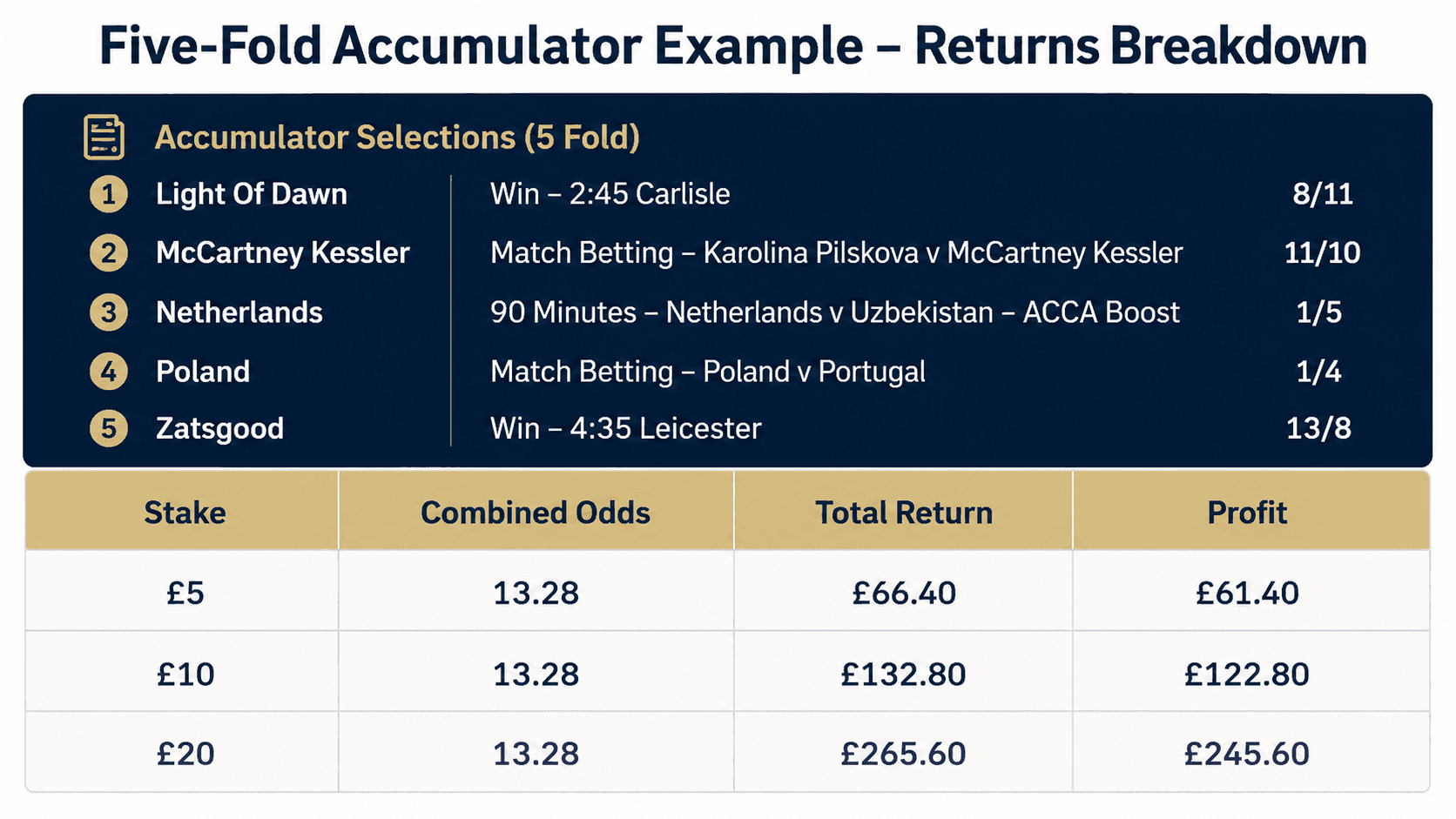
Using our same selection from above, let’s work out the odds and your potential return from a £10 stake.

Credit: AI Generated - Captured by Claudia Hartley 8th June 2026
You can see that the more selections, the larger the return. The appeal is obvious; the returns are much larger than if you backed those selections individually. But the risk increases hugely as every single outcome has to win.
Understanding Probability in Five Fold Bets
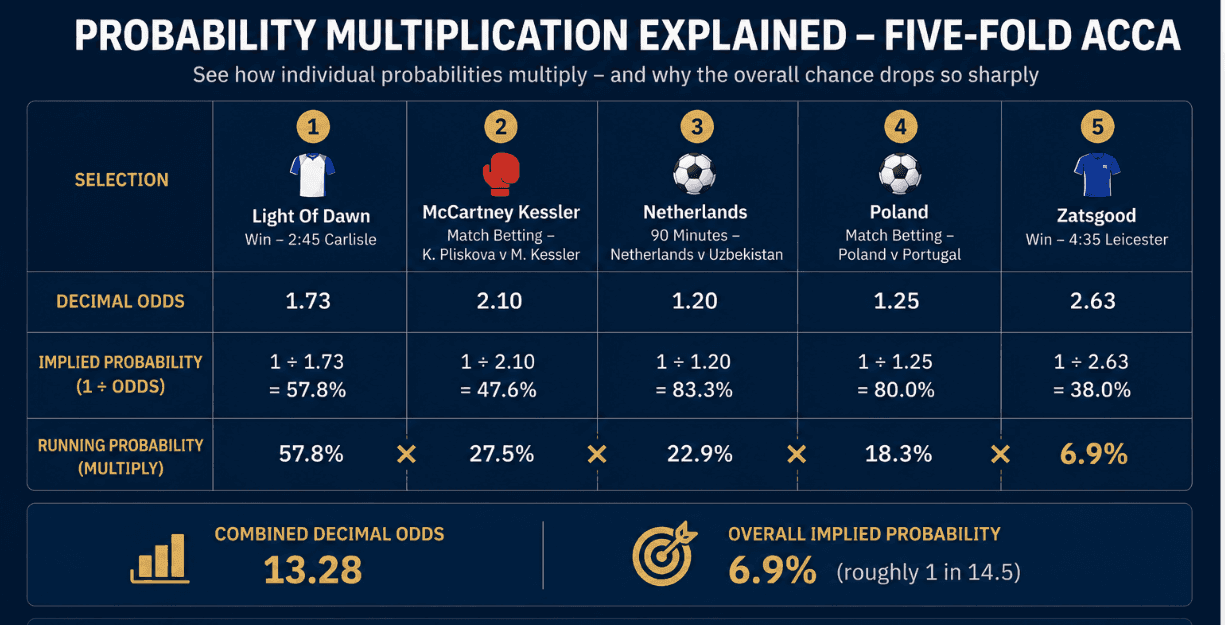
Probability multiplication is the key concept behind accumulator betting, and it’s one of the things that I see bettors underestimate all the time.
Here’s how it works in a five-fold acca:
Credit: AI Generated - Captured by Claudia Hartley 8th June 2026
This dramatic drop in probability doesn’t necessarily mean five-folds are always ‘bad bets’. It just means that the payout reflects the difficulty of landing every probability.
It’s also why accumulators can produce particularly long losing streaks. You might work out four football games perfectly, and get let down with an unlucky goal on the last one.
How Five Fold Returns Are Calculated
The formula to calculate your return for any acca is: Stake x Combined Odds = Total Return
Remember that your stake stake is included within the total return figure.
Credit: AI Generated - Captured by Claudia Hartley 8th June 2026
This multiplication effect is both why accas generate large payouts from modest stakes, but also why the probability is so low. They both work in exactly the same way. That means your higher returns aren’t ‘free’ they just reflect the lower chance of success.
Why Five Fold Betting Works (and Where It Fails)
Compounded Odds
The biggest attraction of a five-fold is being able to create larger payouts from smaller stakes. If you’re betting several short-priced selections, you’ll get a much bigger overall price than if you backed them individually.
Compounded Probability Risk
The issue with those larger payouts is that probability compounds too - in the opposite direction [1]. Every added selection introduces another way for the bet to fail.
Pros & Cons
Pros
Higher potential returns
Simple accumulator structure
Widely available across UK bookmakers
Flexible across multiple sports
Cons
All selections must win
Higher variance than singles
Difficult to maintain consistent hit rates
Five Fold Betting vs Other Bet Types
Five Fold vs Singles
Singles produce lower returns but significantly lower variance. Even with short-priced singles you can still finish profitable with three or four wins from five, in a five-fold accumulator, it’s all or nothing.
Five Fold vs Doubles
Doubles involve only two linked selections, meaning the probability remains much higher than a five-fold. Returns are smaller, but consistency should be better.
Five Fold vs Trebles
A treble contains three selections instead of five. You benefit from greater returns than a double and higher probability than a fivefold.
Five Fold vs Four Folds
Like trebles, adding a fourth selection ups the returns but lowers the probability.
Five Fold vs System Bets
System bets allow partial returns when some selections lose. They require a larger stake as your stake is per line, but they offer more protection than accas.
Best Sports for Five Fold Betting
You can place a five fold acca on any sport at all, including mixing different sports within the same accas, but below are some of the UK’s most commonly chosen sports.

Credit: AI Generated - Captured by Claudia Hartley 8th June 2026
Drivers of Value in Five Fold Bets
If there’s a golden rule to always keep in mind it’s that your selection quality matters much more than the potential payout size. To ensure good quality selections, as well as looking for an edge you also need to consider:
Independence: If you choose events that are correlated (i.e. Arsenal to win, Arsenal to score in the first half and so on) then your acca could lose on one event, rather than five. You need to spread your events out so they’re totally independent.
Long shots: While longer odds can be beneficial to system bets, they’re not a good tactic in accumulators. A speculative 5.50 outsider will inflate your potential returns, but it’s going to weaken the probability far more than that’s worth.
Common Five Fold Betting Mistakes
Several mistakes repeatedly appear in accumulator betting, here’s what to avoid.
Chasing Huge Payouts
Large potential returns do seem attractive, but they can distort decision making. It’s really important not to add selections just to increase the payout.
Forcing Extra Selections
If you’ve got three really solid selections, don’t scrabble for a fourth and fifth. In a bet where every selection has to win, you need to be as sure as possible about every selection.
Misunderstanding Probability
Five favourites do not automatically create a ‘safe’ accumulator - there’s no such thing! Even odds-on selections lose regularly in sport.
Overestimating Favourites
Short-priced teams can still underperform due to squad rotation, fixture congestion, tactical changes, or just variance. As the saying goes, there’s no such thing as a safe bet.
Ignoring Correlation
Selections from the same match can carry overlapping risk exposure [2]. It’s crucial to make totally independent selections for five fold bets.
Five Fold Betting and Bankroll Management
Accumulator betting generally requires stricter bankroll discipline than singles. This is because hit rates are much lower, so your stake will need to remain smaller in order for you to effectively weather dry spells.
Many bettors, including myself, use flat staking systems where your accumulator stakes remain consistent regardless of recent results.
So if my usual single bet stake is £50, my usual fivefold stake might be just £10. This reflects the much-increased variance with accumulators.
It’s also essential to be realistic about your expectations. A five-fold accumulator is highly unlikely to produce regular consistent returns over short periods. Variance can remain high even with a very well disciplined selection process.
When Five-Fold Betting Works Best
Five-fold accumulators tend to work best when:
- Selections are independent
- Odds remain within realistic ranges
- Staking stays disciplined
- You avoid betting emotionally
- You make selections using proper analysis
When to Avoid Five-Fold Accumulators
When to Avoid Five-Fold Accumulators
You chase previous losses
Force unrealistic payout targets
Combine heavily correlated selections
Build emotionally driven bets
Five-Fold Betting Checklist
Before placing a five-fold accumulator, here are the questions that I like to be able to tick off.
Are all my selections independent?
Is the combined probability still realistic?
Is the stake size manageable for my bankroll?
Am I selecting value rather than chasing payout size?
Conclusion
Five-fold accumulators combine five selections into one ‘all-or-nothing’ bet. This means you benefit from compounded odds for that larger return, but suffer from compounded probability, reducing overall likelihood.
Having a clear understanding of that balance is exceptionally important.
Five-fold betting can suit bettors looking for higher-return accumulator structures. But variance remains high and losing streaks are entirely possible even when you’ve taken the time to study the form and make solid selections.
Having realistic expectations and being disciplined with your bankroll matter much more than chasing the biggest possible payout.
FAQs
What is a five-fold bet?
A five-fold bet is an accumulator containing five selections combined into one wager. Every selection must win for the bet to produce a return.
How many selections are in a five-fold accumulator?
A five-fold accumulator contains exactly five selections.
Do all five selections need to win?
Yes. Even just one losing selection means no payout. If a selection is voided instead then the bookmaker will usually recalculate as a four-fold.
How are five-fold returns calculated?
Returns are calculated by multiplying all decimal odds together and then multiplying that figure by your stake.
What happens if one selection loses?
If one selection loses, the entire five-fold accumulator loses.
Is a five-fold riskier than a treble?
Yes. A five-fold includes more selections than a treble, meaning the overall probability of success is lower.

Claudia Hartley is a versatile content writer and editor with a strong footing in digital publishing, particularly within the iGaming and affiliate space. With nearly a decade of experience, she has built a reputation for producing clear, engaging, and well-researched content that connects with readers while meeting SEO goals.
Comments
0 comments
No comments yet. Be the first to share your thoughts!
References
- 1.Statistics Resources: Compound Events - ASC, 28th May 2026. Accessed June 8, 2026
- 2.Independence and Dependence - Jenny Gage, Nrich, 14th March 2013. Accessed June 8, 2026
Related Resources to Betting Academy
- Learn How Betting Odds Work in Sports Betting
- What Is Correct Score Betting and How Does It Work?
- What Is Head-to-Head Betting and How Does It Work?
- What Is Value Betting and How Does It Work?
- How Goliath Bets Work in Sports Betting
- Combination Bets Explained
- Cash Out or Let It Ride? How to Make the Right Call on Your Acca
- How Futures Betting Works 2026 Explained with Value Odds and Risk Factors
- Double Betting Explained: The Expert Strategy Playbook 2026
- Card Betting Explained: Strategy, Odds & How to Find Value
- Treble Betting Explained: How it Works
- Single Betting Explained: Odds, Probability & Value Guide
- System Betting Explained
- European Handicap Betting Explained
- Spread Betting Explained: Expert Playbook & Strategy Guide 2026