
Betting Academy
Accumulator Betting Explained: Strategy, Odds & Expert Guide 2026
Learn how accumulator betting works with expert insights, key risks, and proven strategies to find value and make smarter multi-bet decisions. I got sucked into the hype surrounding Igor Tudor and overvalued the infamous new manager bounce. This led me to backing Tottenham to win in some of my recent 3-leg accas. The other selections performed well, but Spurs proceeded to lose 4 in a row. In this guide, I’ll teach you how to calculate the true probability of each individual leg more accurately than online bookmakers and determine whether or not it deserves a place in your acca! Odds are a bookmaker's representation of probability, not a guarantee of outcome. Accumulator betting involves real financial risk. Only bet what you can afford to lose.

SportsBoom offers honest and impartial UK bookmaker reviews to help you make informed choices. While we may earn commissions through affiliate links, our content remains independent and free from promotional influence. For more information, see our Content Transparency and How We Review pages.

Accumulator Betting Explained
What Is Accumulator Betting?
An accumulator, or acca, is a single bet combining multiple selections into one wager. Every leg must win for the bet to pay out.
What Is Accumulator Betting
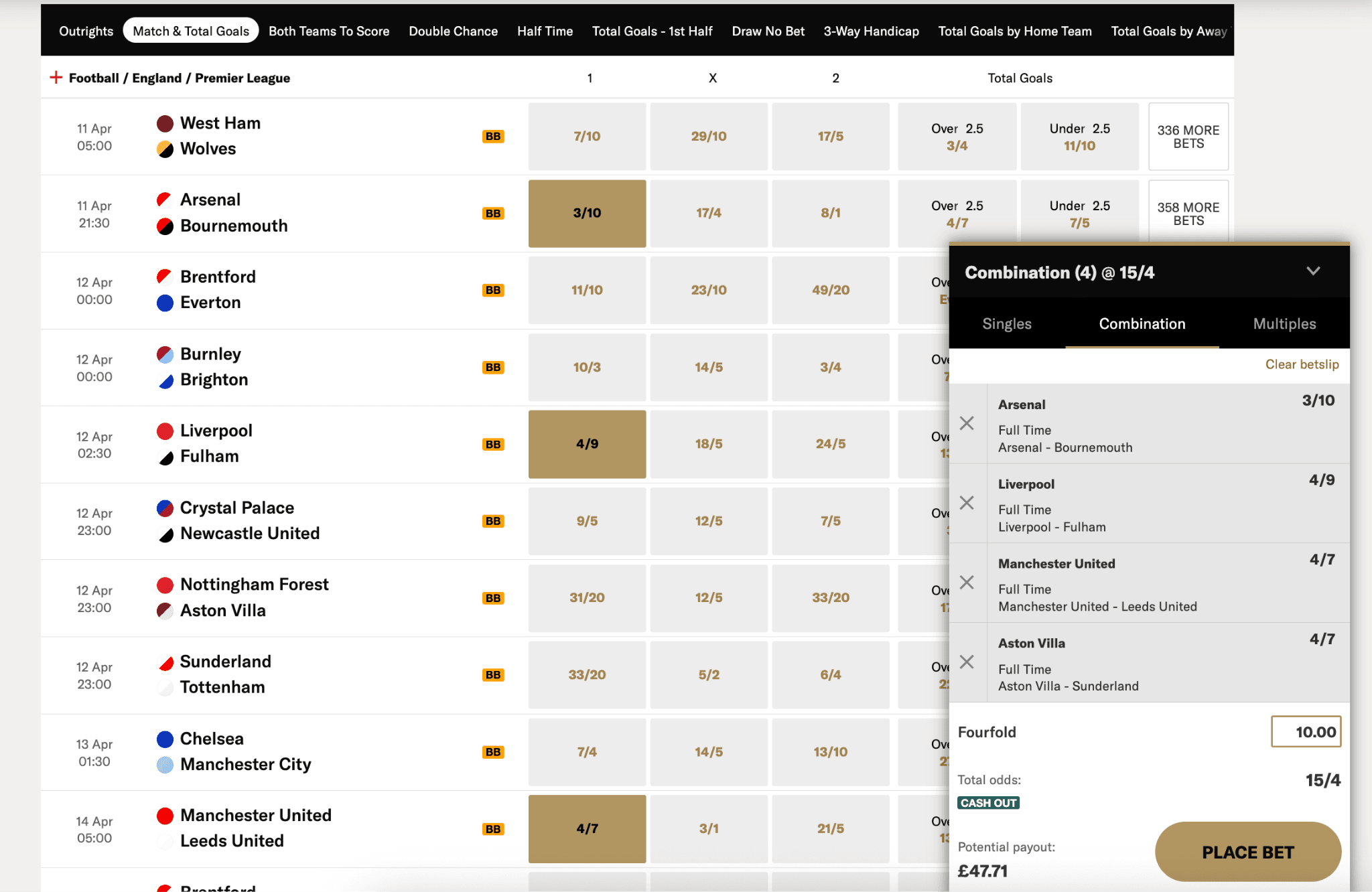
After checking out trusted betting operators, I was looking at a four-fold on four Premier League sides in the top 5 all to win at home (Arsenal, Liverpool, Manchester United and Aston Villa). Despite the potential £47.77 return, I ended up passing on the bet because Aston Villa have lost four of their last six, and Liverpool's 1.22 xG against at Anfield is a little high for my liking.
How to Bet Accumulator Properly
I start by identifying candidate matches across the major Premier League markets: 1X2 (match result), Over/Under goals, and Both Teams to Score (BTTS). For each match, I pull four core data points: expected goals for and against (xG), BTTS percentage over the current season, home/away performance divergence, and recent form across the last five to six fixtures.
How to Bet Accumulator Properly
Once I have the stats, I calculate my own true probability for the outcome I'm considering. I then convert the bookmaker's offered odds into their implied probability using the standard formula: divide 1 by the decimal odds and multiply by 100. If my true probability is at least 5% higher than the top bookmaker’s for Premier League betting implied probability, the selection goes on the slip.
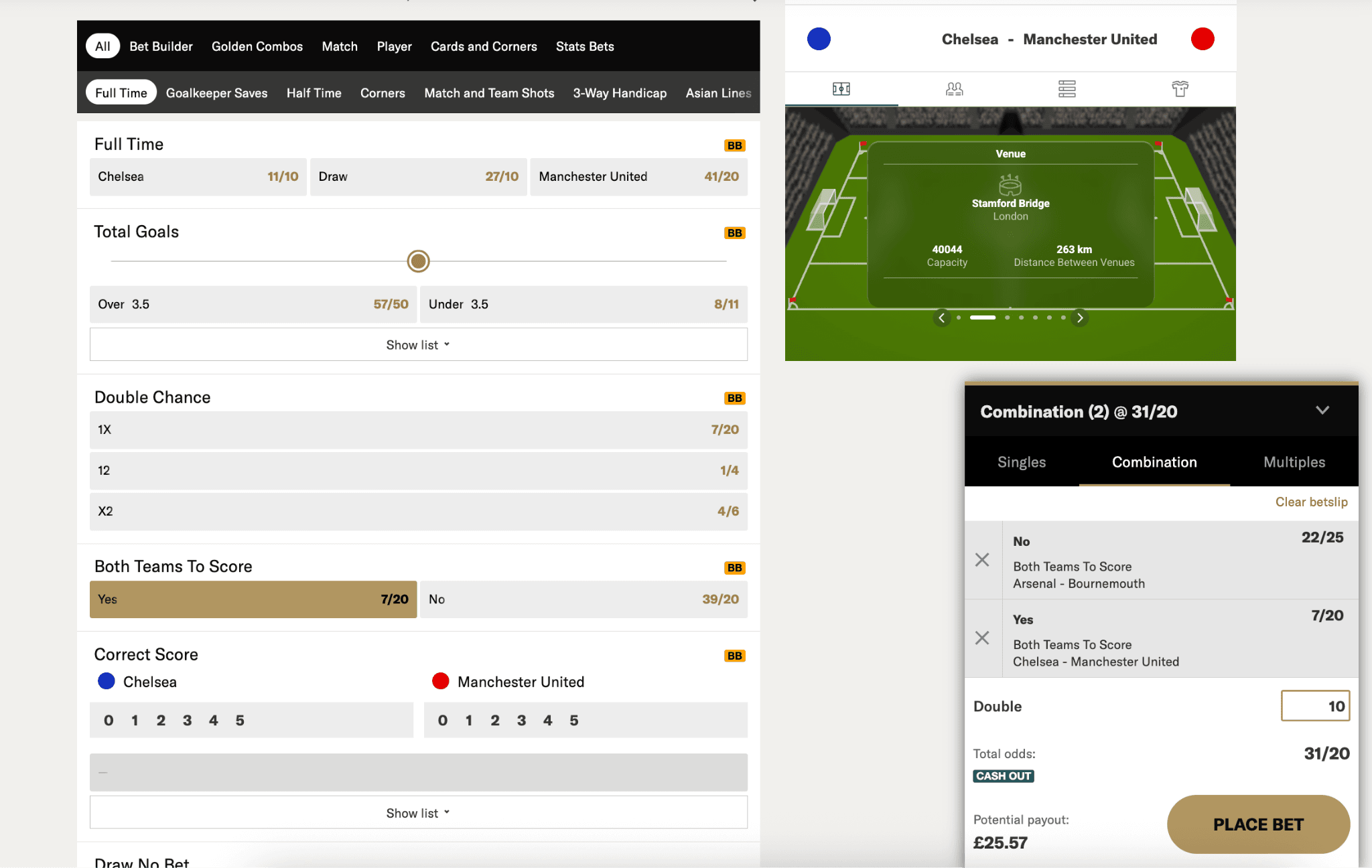
I recently built a two-leg acca around a pair of BTTS markets, staking £10 at combined odds of 31/20 for a potential return of £25.57.
Leg 1 — BTTS Yes: Chelsea vs Man United, 19th April (odds: 22/25)
The bookmaker's implied probability is 53.2%. My assessment came in higher. Chelsea carry an xG of 1.72 at home this season, they have no problems scoring at Stamford Bridge. The more telling stat is Man United's away record: they've failed to score in just 6% of away matches, making them one of the least likely visiting sides to go quiet in front of goal.
Leg 2 — BTTS No: Arsenal vs Bournemouth, 11th April (odds: 7/20)
The implied probability here is 74.1%. Arsenal have kept a clean sheet in 53% of their home games this season, an elite defensive record at the Emirates. On the other side, Bournemouth have failed to score in 20% of their away fixtures.
Each leg passed the 5% edge threshold independently as a single bet, so I combined them into an acca and took advantage of a 2.5x return.
Drivers of Real Value in Accumulator Betting
These are the three scenarios where I smash the place bet button with utmost confidence:
Two High-Confidence Selections in the Same Gameweek
Across 309 Premier League games this season, both teams scored in 172 of them, a BTTS rate of 56%. But that league-wide number hides big team differences. Manchester United have landed BTTS in 74% of their matches this season, and Chelsea and Liverpool in 65%.
When two separate fixtures in the same gameweek both show strong statistical cases for the same market, combining them into a two-leg acca can make sense.
Correlated outcomes across fixtures that bookmakers price independently
Fixture congestion creates measurable patterns bookmakers often ignore. Opta data from 2024/25 shows goalless draws nearly tripled after Christmas, jumping from 5.6% in the first 180 matches to 16.7% across the next 30.
If two fixtures in the same gameweek involve tired teams, markets like Under 2.5 goals or BTTS No can be justified. This is one of the rare cases where accumulator legs are logically connected.
Using Acca Insurance
Acca insurance can improve expected value on short accumulators. Over a season, if around 15% of your accas lose by one leg, insurance refunds can return a significant amount of lost stake, reducing your overall losses.
Case Study — 2-Leg Goal Totals Acca
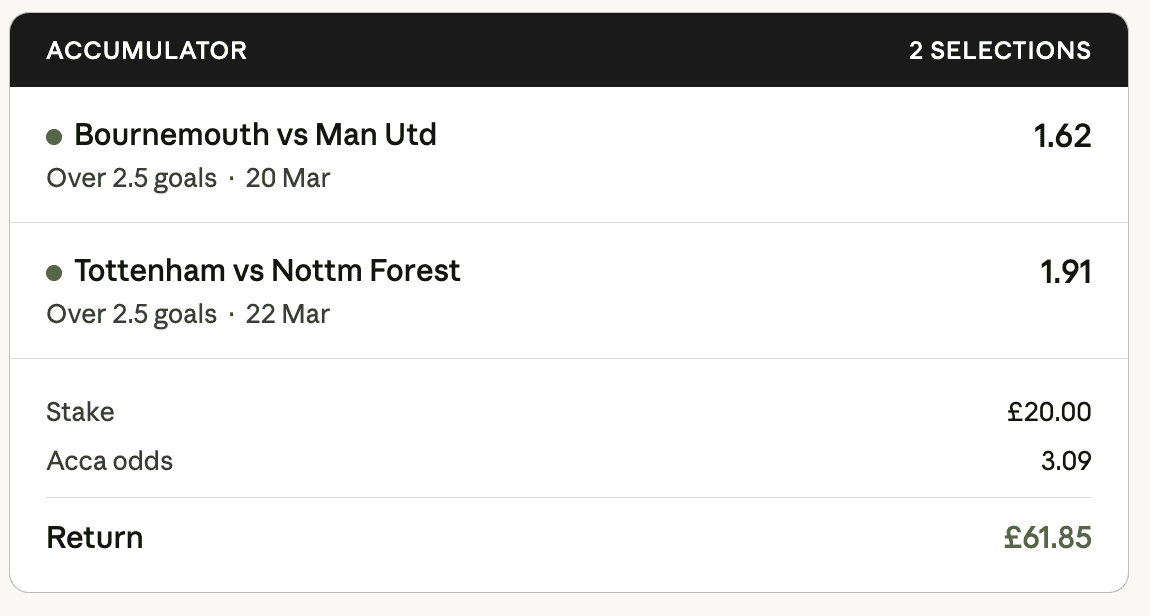
Heading into Matchday 3, I built a £20 two-leg accumulator at 3.09 for Over 2.5 in both Bournemouth vs Manchester United and Tottenham vs Nottingham Forest. I got the idea from SportsBoom’s tipsters who predicted both games to be goal fests.

2-Leg Goal Totals Acca
The logic for Bournemouth was solid. Their home xG sits at 1.61, and United's away record of scoring and conceding 1.63 per game each suggested a naturally open fixture. The match met expectations, featuring 31 shots on goal and concluding in a 2-2 draw.
In the other fixture, Forest's last five away games had all gone over 2.5 goals, and their average away fixture was averaging 2.63 goals. Spurs were also conceding almost two at home per game, and over 2.5 goals had landed in six of Tottenham's last seven matches.
The game was a total blowout as Igor Jesus, Morgan Gibbs-White and Taiwo Awoniyi all scored as Forest won 3-0. Both legs hit comfortably, and the £20 stake returned £61.85, a profit of £41.85.
Accumulators
Case Study — 2-Leg Goal Totals Acca
If you can figure out when to dump an acca, you’ve already won half the battle. Avoid these costly accumulator scenarios:
- 1
When the Compounded Bookmaker Margin Has Eroded All Mathematical Value
If each leg carries a 6% margin, a five-fold accumulator produces a 33.8% compound bookmaker edge (1.06⁵ − 1 = 1.338). In simple terms, for every £100 staked across these accas long-term, the bookmaker expects to keep about £33.80.
It gets worse with larger accas. A ten-fold accumulator with a 5% margin per leg compounds to 1.05¹⁰ = 1.629, meaning a 62.9% bookmaker edge is built into the bet before a ball is kicked.
I avoid building accas from high-margin markets like correct score, first goalscorer, or half-time/full-time because these markets already carry large margins. Instead, I focus on 1x2, over/under goals and Asian handicaps and rarely add more than four legs. - 2
When Multiple Acca Legs Involve Relegation-Threatened Teams You Expect to Lose
The current 2025-26 relegation battle is a live case study in statistical outliers. Leeds United sit in the relegation zone with just 31 points from 29 matches, yet their expected points total of 43.6 suggests a team performing far better than the table indicates, with attacking numbers that should place them closer to mid-table. A "reliable" acca leg built on Leeds' actual points tally would badly misjudge their true threat level.
- 3
When Your Acca Includes a Team Significantly Overperforming Their xG
This season, Tottenham Hotspur have an expected goals (xG) total of 34.34 but have actually scored 40 goals, significantly overperforming their chance quality. Arsenal’s 53.38 xG has also diverged from their 61-goal tally.
This matters because teams that consistently score more goals than their xG are usually overvalued in 1X2, handicap, and goals markets. Bookies adjust prices based on wins, league position, and goals scored, but if those goals are coming from low-probability chances, set pieces, or unusually clinical finishing, that level of scoring is unlikely to continue. Over time, most teams regress back toward their xG numbers.
Accumulator Checklist
My acca checklist forces you to take the rose-tinted glasses off and think like a savvy trader:
- Have I calculated the bookmaker's margin on each leg individually?
- Does each leg have a minimum 5% gap between my assessed true probability and the bookmaker's implied probability?
- Have I verified there are no significant injuries, suspensions, or confirmed rotation risks in the last 24 hours?
- Am I including every leg because I'd back it as a confident single?
- Does the acca contain five legs or fewer?
- Are all legs from liquid, tightly priced markets like 1x2, Asian handicap, or over/under?
- Does the acca's decimal odds return exceed 1 ÷ true combined probability?
Conclusion
To take your acca betting strategy to the next level, stick to 2 or 3 legs, focus on low-margin markets like 1x2 and BTTS, analyse individual selections, use highly predictive stats like xG for and against, and don’t forget to grab insurance if it’s available.
FAQs
How many legs should a football acca have?
Keep it to four or five. A four-fold with selections, each at 70% probability, gives roughly a 24% win chance, and if you add a tenth leg, that collapses to just 2.8%. More legs result in additional compounded risk.
Why do bookmakers love accas so much?
Because the house edge multiplies with every leg. With a 6% overround per selection, a five-fold accumulator generates a compound margin of 33.8% for the bookmaker, nearly six times the edge of a single bet.
Is acca insurance actually worth claiming?
Only if the terms are clean. Most acca insurance refunds your stake as a free bet if exactly one leg loses, typically requiring a minimum of four or five selections at set minimum odds.
Should I mix markets or stick to one type?
Stick to one where possible. Mixed market accumulators demand broader analytical skills, and adding a corners pick simply to reach a required number of legs violates the quality-over-quantity principle regardless of diversification benefits.
How do I know if a leg is actually adding value?
Only include a leg if you'd back it as a single. Because the compounding effect of accumulators works against the bettor, bad-value selections become significantly worse when combined.

Bruce Douglas is an experienced editor and copywriting professional with a proven track record in shaping high-quality content across multiple platforms. With a career spanning journalism, editorial management, and digital content strategy, he brings a keen eye for detail and a passion for precision to every project he works on.
Comments
0 comments
No comments yet. Be the first to share your thoughts!
Related Resources to Betting Academy
- How Goliath Bets Work in Sports Betting
- Combination Bets Explained
- Cash Out or Let It Ride? How to Make the Right Call on Your Acca
- How Futures Betting Works 2026 Explained with Value Odds and Risk Factors
- Double Betting Explained: The Expert Strategy Playbook 2026
- Card Betting Explained: Strategy, Odds & How to Find Value
- Treble Betting Explained: How it Works
- Single Betting Explained: Odds, Probability & Value Guide
- System Betting Explained
- European Handicap Betting Explained
- Spread Betting Explained: Expert Playbook & Strategy Guide 2026