
Betting Academy
Value Betting Explained: What it is & How it Works
Value betting is looking for odds that you believe are priced too long for the actual probability.

SportsBoom offers honest and impartial UK bookmaker reviews to help you make informed choices. While we may earn commissions through affiliate links, our content remains independent and free from promotional influence. For more information, see our Content Transparency and How We Review pages.

Value Betting Explained
For me, I spotted odds of 2/5 on both teams to score in a recent Chelsea v Man Utd game. It made sense, underdogs Man Utd had scored in all of their last five games and Chelsea were likely to be pushing hard to take the lead.
I took the bet and Man Utd failed to score - but was it a value bet? Lots of analysis and sports predictions agreed with me that the price had been strong. It’s just, sometimes value bets still lose - in the short term.
What Is Value Betting?
Value betting is finding odds that you believe are higher than the probability of an outcome happening. Rather than picking winners, you’re focusing solely on whether price reflects the probability.
The concept is really closely linked to expected value (EV), which measures whether a price produces positive long-term expectation across many similar bets. For example, odds of 3.00 imply a 33.3% chance of success. If you work out the true probability as closer to 40%, those odds offer value.
A value bet can still lose frequently over short samples. Probability reflects long-term expectation rather than certainty in single events.
How Value Betting Works
There are three steps to making value betting work:
- Finding the implied probability from the bookmaker’s odds
- Making your own assessment of the probability
- Comparing the two
Let’s work out all of these step by step.
Implied Probability = (Decimal Odds/1) x 100
So for odds of 3.00, the implied probability = (3/1) x 100 or 33.33
To make an assessment of the probability yourself, you need to understand the event, study the form, and decide on your own probability. This is a whole art by itself! If you’re betting on Premier League football, you’ll be looking at things like head-to-head form, goal differences, conditions, home vs away, injuries, and plenty more.
Once you’ve assessed your own probability and the bookmaker’s implied probability, compare the two. If your probability estimate is notably higher than the bookmaker’s, then you’ve found a value bet.
Understanding Implied Probability
We’ve covered how to work out implied probability already, but understanding it’s usefulness in value betting is a little different. That’s because odds don’t represent exact probability, they represent what the bookmaker thinks probability is - with an edge built in.
It’s important to keep that in mind, because odds represent probability estimates not certainty. That means even a losing bet can still represent value if the original price underestimated the true likelihood of success.
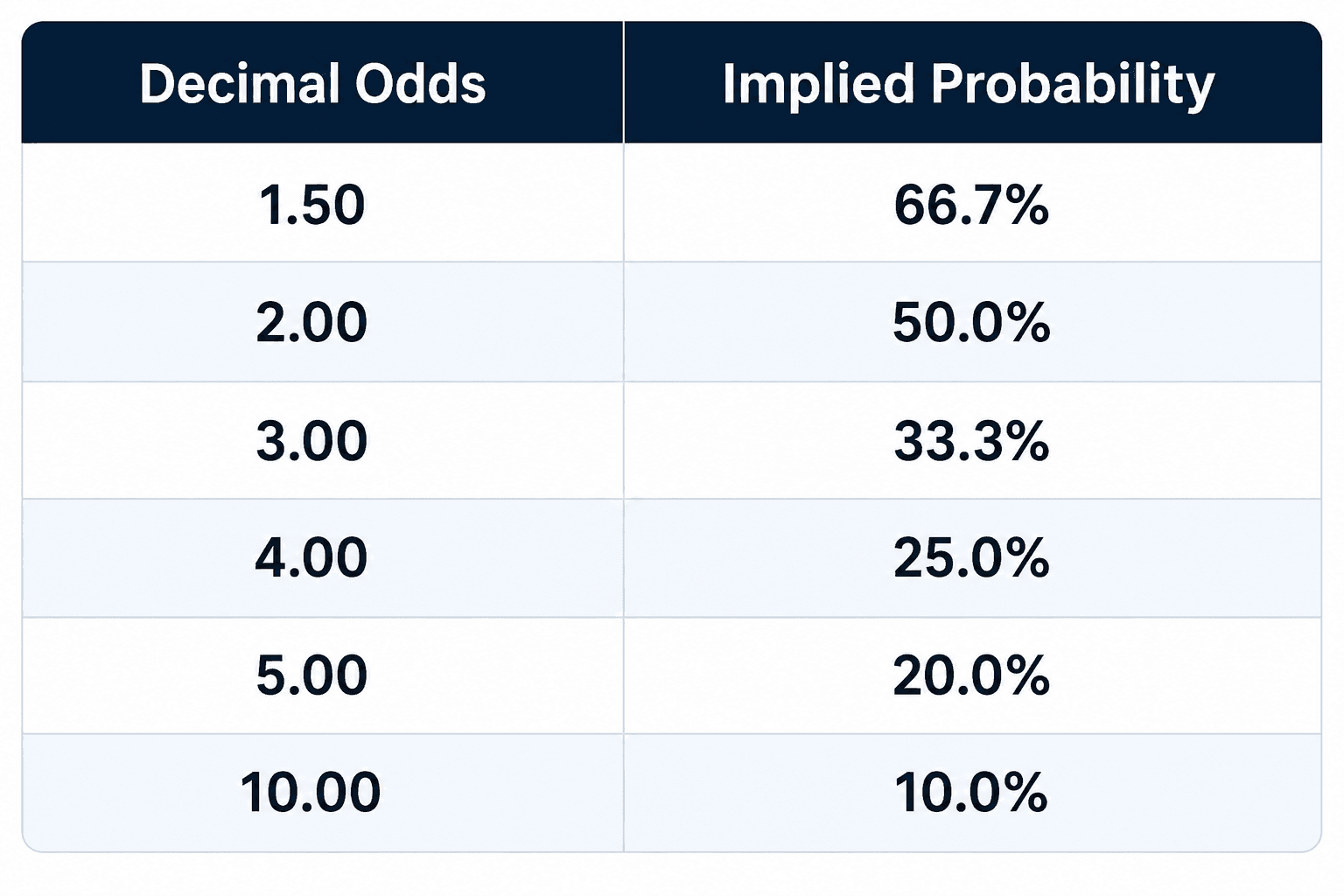
Caption: Decimal Odds to Implied Probability, AI-Generated, Captured by Claudia Hartley 26th May 2026.
How Bookmakers Build Margin into Odds
I mentioned about bookmakers building an ‘edge’ into their odds, sometimes known as margin or vig. This means that odds should always represent slightly lower implied probability than the actual chance - otherwise bookmakers wouldn’t make money!
In a two-outcome market with perfectly fair pricing, the combined implied probability would equal 100%. In reality, sportsbooks price more like the below:
Team A: 1.91 (52.4%)
Team B: 1.91 (52.4%)
Combined implied probability: 104.8%
That additional 4.8% represents the bookmaker’s margin. Knowing this, goes to show how difficult it can be to find value bets.
Fair Odds vs Market Odds
Market odds: The price offered by bookmakers
Fair odds: The true probability of the event (before margin)
To calculate fair odds as accurately as possible, you need to be using statistic models. This includes information like: historical performance data, injuries, lineup news, weather conditions, scheduling factors, and matchup analysis.
While essential for finding value bets, fair probability estimation remains subjective and imperfect. Different bettors can analyse the same event and reach entirely different conclusions.
Why Value Bets Still Lose
A value bet can still lose because:
- If the bet has odds longer than 2.0, then it statistically should lose more than 50% of the time.
- Probability reflects long-term expectation. If you only find one value bet, there’s no long-term strategy.
- Sport is influenced by randomness.
In football, this could mean betting a value bet at 1.90 for over 2.5 goals. Statistically, the teams have strong attacking indicators, but the game still ends below despite many high-quality chances. The same applies to any sport.
Closing Line Value (CLV) and Market Efficiency
Closing Line Value (CLV) is the difference between the odds you took and the final market price. Imagine you back a horse at 3.00, but before the start, it shortens to 2.80 due to large betting support. You got about .20 CLV.
This can be a useful tool to judge whether your original assessment lined up with the market (and in theory the actual probability).
The reason CLV is important is because major markets become more efficient as more information enters the market. Bookmakers adjust prices and you get closer to a true representation of the probability.
However, beating the closing line doesn’t necessarily mean you’ll win - just that the market ‘agreed’ with you.
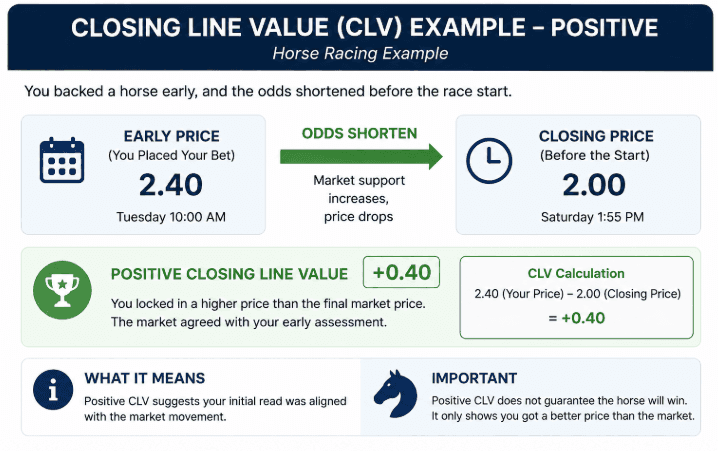
Caption: Closing Line Value, AI Generated, Captured by Claudia Hartley 26th May 2026.
Best Sports for Value Betting Analysis
Generally speaking, choosing sports with stronger statistical depth and/or clearer pricing variables is the easiest way to find value bets.
| Sport | Ideal Market | Risk Level | Why it Works |
| Football | Match odds & totals | Medium | Deep statistical data |
| Horse Racing | Win markets | High | Pricing inefficiencies |
| Tennis | Match betting | Medium | Matchup data |
| Rugby | Handicap markets | Medium | Structured scoring |
| Darts | Set betting | High | Short-format variance |

Why Value Betting Appeals to Bettors
Lots of bettors consider themselves value bettors, or at least rate the concept, why?
Analytical Decision-Making
Value betting focuses more on probability assessment than gut feelings or intuition. Using your skillset and knowledge in a maths-focused way feels like it should have an impact on your results.
Market-Based Thinking
Building the market, yourself, before comparing it to the bookmakers allows you to treat odds as prices rather than predictions.
Long-Term Framework
If you’re the kind of bettor that only has a bet sporadically, then value betting might not make sense. But if you bet semi-regularly then the long-term decision quality involved in value betting has a chance to shine through.
Why Value Betting Works (and Where It Fails)
Works: In moments where market odds don’t reflect true probability (like injuries, lineup changes, or market overreactions).
Fails: Heavily analysed markets (like major football, tennis, and horse racing) where obvious pricing errors can be hard to find.
Pros & Cons
Pros
Probability-focused framework
Encourages analytical betting
Focuses on long-term expectation
Cons
Variance is unavoidable
True probability is difficult to estimate
Efficient markets reduce obvious value opportunities
Common Value Betting Mistakes
Sometimes knowing about the mistakes is the best way to avoid them - for me it works anyway! Below are some common mistakes:
Confusing winners with value: A bet can lose and still be a value bet, just as a bet can win and not be a value bet. Value betting is about beating probability, not necessarily winning.
Overestimating true probability: Being accurate about probability is really difficult as proper statistical modelling takes time and should be done without emotion.
Ignoring bookmaker margin: Bookmakers always have a built-in margin, which it’s essential to consider when looking for value bets.
Judging results using very small sample sizes: If you’re having a ‘winning streak’ or finding consistently good CLV, it’s tempting to declare yourself a value betting genius, but value betting works over time.
Value Betting and Bankroll Management
Bankroll management matters in all kinds of betting, but especially in value betting as even when you get it right, it can produce long losing runs.
There are different ways to approach it including:
- Flat staking: same amount each bet
- Percentage staking: set percentage of your entire bankroll each bet
- Fixed bankroll limits: decreasing/increasing when you reach set parameters
The most important thing to remember is that it’s never a good idea to bet emotionally or chase losses.
Drivers of Value in Betting Markets
Potential value often comes from information and timing rather than predicting winners perfectly every time. Things that I always keep in the back of my mind include:
- Injuries: has this injury news skewed odds too far the other way?
- Lineup news: is a younger team playing, a star player missing?
- Weather: does this team really play badly on wet ground or is the market overreacting?
- Public betting bias: is the public overreacting to this story, or betting on a national favourite?
- Smaller markets: am I knowledgeable about this market and is it keeping up with recent events?
When to Avoid “Value” Assumptions
Value betting isn’t about picking winners, but you also have to be measured in your approach. A horse might not deserve to be 100/1, you might think the actual odds are more like 80/1 - that still has a tiny chance of actually happening. In this moment there might be value in the odds, but not enough.
Emotionally driven betting should always be avoided too - and remember that variance remains present regardless of your confidence level.
Value Betting Checklist
Before placing a bet, ask:
- Does the estimated probability exceed implied probability?
- Have I considered bookmaker margin?
- Is my analysis evidence-based?
- Have I acknowledged variance?
- Is my bankroll exposure controlled?
Conclusion
Value betting is all about understanding probability over picking winners. You’re always looking for the odds that underestimate the true likelihood of an outcome.
However, it’s not without its challenges. Factoring in bookmaker margin, market efficiency, and variance is essential. Also being realistic, sometimes even positive EV bets can lose regularly over short-term samples.
For me, value betting is best viewed as a long-term analytical framework. It can improve your results, but it’s definitely not a guaranteed path to profit.
Frequently Asked Questions (FAQs)
What is value betting in sports betting?
Value betting involves comparing bookmaker odds against your own estimated probability of an outcome occurring. If the odds appear higher than the true probability, you may have found a value bet.
How does implied probability work in value betting?
Implied probability converts odds into percentage form. For example, odds of 2.00 imply a 50% chance of success.
Can a value bet still lose?
Yes. Value bets can still lose regularly because probability reflects long-term expectation.
What is expected value (EV) in betting?
Expected value measures the long-term return of a betting decision. It’s based on probability and odds.
Why is bankroll management important in value betting?
Bankroll management helps control exposure during losing streaks. Even with positive EV bets, you can experience losing streaks.

Claudia Hartley is a versatile content writer and editor with a strong footing in digital publishing, particularly within the iGaming and affiliate space. With nearly a decade of experience, she has built a reputation for producing clear, engaging, and well-researched content that connects with readers while meeting SEO goals.
Comments
0 comments
No comments yet. Be the first to share your thoughts!
Related Resources to Betting Academy
- Champions League vs Premier League Betting
- 45% Betting Ads in Premier League Finale
- ASA Bans Instagram Gambling Ads Featuring Harry Kane and Erling Haaland
- Gambling Commission Highlights Surge in Illegal Lottery Crackdowns
- How to use Enhanced Odds
- The Grand National’s Betting Power
- Are Price Boosts Worth It?
- Is Cash Out Usage Increasing across UK Betting Sites?
- How Premier League Outright Markets Shift
- Banijay Reports €1.147bn Q1 Revenue Following Tipico Acquisition
- Illegal Casinos Target UK Players via “Not on GamStop” Searches – Investigation
- UK Gambling Market Faces Risks After Major Tax Increase