
Betting Academy
What Is Booking Points Betting and How Does It Work?
Booking points betting looks at the total disciplinary actions throughout a whole football match. It’s not about who wins, it’s about how many cards are handed out. You can place bets before kick-off, and with some bookies, you can bet in-play too.

SportsBoom offers honest and impartial UK bookmaker reviews to help you make informed choices. While we may earn commissions through affiliate links, our content remains independent and free from promotional influence. For more information, see our Content Transparency and How We Review pages.

Booking Points Betting Explained
Imagine a Premier League fixture that starts off with two yellow cards and a red within the first 20 minutes. Both teams are tackling hard, and the referee is continuing to get involved. If you’re watching a live booking points line, it’s going to rise.
Your job is to understand if that rise is justified, if this behaviour is likely to continue, and whether, in the end, it’s worth placing a bet.
What Is Booking Points Betting?
Booking points betting is a football market where you bet on whether the points in a match will finish over or under a bookmaker's line.
Each card is assigned a points value, and those values are added together to create a total booking points score. Red cards are higher (usually 25), yellow cards are lower (usually 10), and two yellows followed by a red is the highest (usually 35), but the actual points can vary depending on the bookie you’re betting with.
This makes booking points betting a market that heavily centres on discipline, fouls, and referee decisions rather than the ‘usual’ metrics for football betting.
The Premier League averaged 5.1 yellow cards per game in the 2024/25 season. The highest year ever by quite a margin [1].
How Booking Points Betting Works
For booking points markets, bookmakers assign point values to cards and also set either bands for booking points or a line for the match. It’s up to you to decide whether the total will finish over or under that band or line.
In this example, we’re betting that the World Cup match between England and Ghana will finish with between 40 and 55 booking points. At this bookmaker its straightforward points of 10 for a yellow and 25 for a red. So, our bet could win if we get any of the following combinations:
- 4 yellows - 40 points
- 5 yellows - 50 points
- 2 yellows and a red - 45 points
- 3 yellows and a red - 55 points
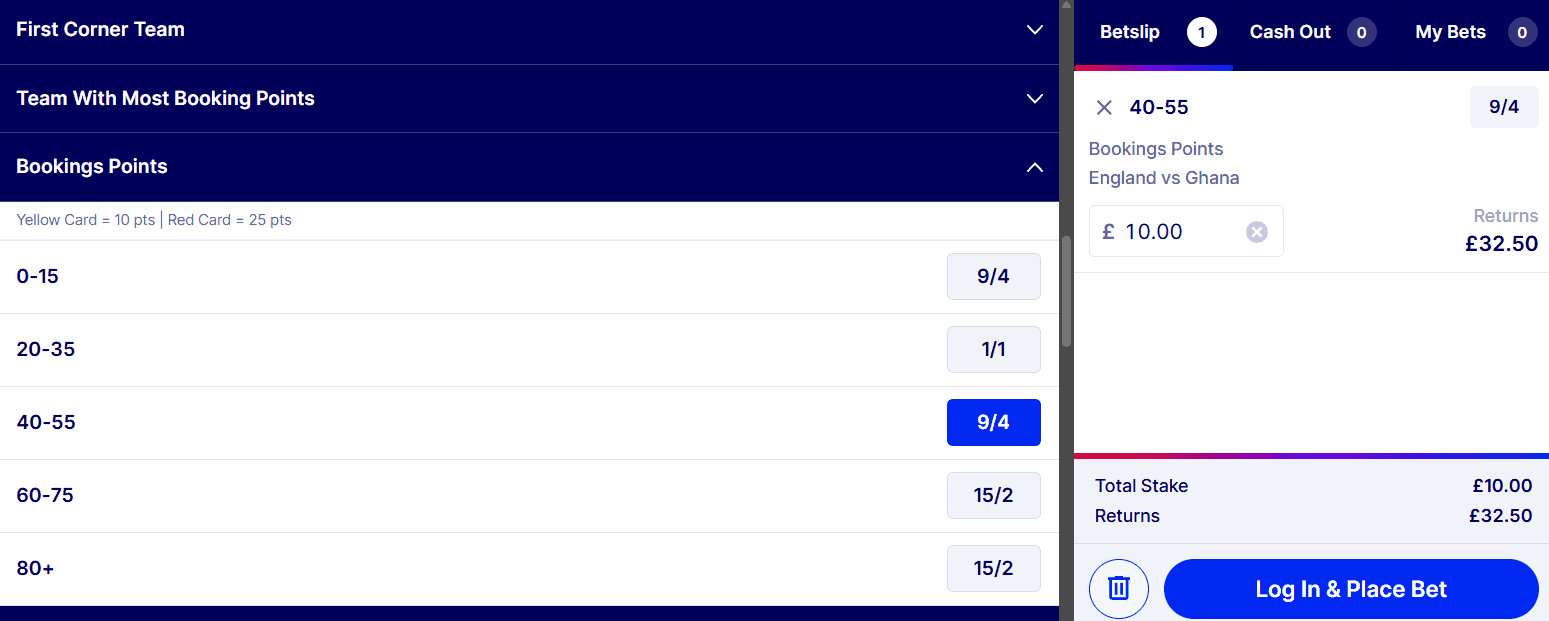
Betfred Sportsbook Interface, Claudia Hartley, 23rd June 2026 12:13
Understanding Booking Points Scoring
There is no universal booking points system used across all bookmakers. While 10 for yellow and 25 for red are most common, some bookies also have options for two yellows leading to a dismissal, and some have different scoring systems entirely.
That’s why it’s so important to check the points that your bookmaker uses, because it can vary between operators. This is a slightly less well-known market in the UK, which may be one of the reasons points scoring varies.
How Bookmakers Calculate Booking Points Odds
When pricing booking points markets, bookmakers will likely consider:
● Historical card averages
● Referee statistics
● Team disciplinary records
● Competition trends
● Match importance
● Rivalries
If a bookie is pricing up a fiercely competitive local derby that's officiated by a referee with a high card average, you’re going to see a higher booking points line. A routine fixture with two mid-league teams who are possession-focused? That’s likely to have a lower points line.
Factors That Influence Booking Points Markets
For a market that attracts a relatively small number of bets compared to total goals, match winner, etc., there’s a lot of nuance in booking points markets. Here are the factors I consider before placing a booking points bet:
Referee Tendencies: Really important and so easy to find. Look at the average cards per match for the referee who’ll be officiating; some just issue more cards than others[1].
Rivalry Matches: While it’s not always the case, often derbies and long-standing rivalries feature increased intensity that can lead to additional disciplinary action.
Relegation Battles: Matches where teams are battling it out for survival can produce more tactical fouls.
Team Styles: Aggressive pressing systems tend to increase foul frequency, and deep defense for extended periods can face disciplinary pressure too.
Game State: A team desperately chasing an equaliser late in a match may be more likely to commit tactical fouls.
Booking Points vs Other Card Betting Markets
Booking points is similar to other card betting markets, but not quite the same. Here’s how it compares.
Booking Points vs Yellow Card Betting
Yellow card betting focuses only on the number of yellow cards shown. Booking points considers red cards too, and on some sites also considers second-yellow dismissals.
Booking Points vs Team Cards
Team cards betting focuses on one team's disciplinary record. While booking points, markets include both sides.
Booking Points vs Player Card Betting
Player card betting focuses on whether a specific player receives a card. Booking points markets spread risk across the entire match instead.
Using Referee Data in Booking Points Betting
Referees play a significant role in booking points markets because they ultimately decide when disciplinary action is required. I always look into referee statistics, including:
- Average cards per match
- Average fouls awarded
- Home versus away card distribution
- Competition-specific trends
That’s because some referees may allow more physical contact in domestic competitions and be a little stricter in European fixtures, for example. Remember, though, past referee trends definitely provide context, but they don’t guarantee future decisions.
Team Discipline Analysis for Booking Points
Like the referee, team style can heavily influence card totals. Look at metrics like:
- Tackles attempted
- Fouls committed
- Pressing intensity
- Defensive actions
- Possession percentage
- Tactical foul frequency
A team spending long periods without possession may be forced into repeated defensive actions that could increase foul frequency. In the same way those aggressive pressing systems can lead to more fouls too.
Live Booking Points Betting Strategy
In-play booking points markets introduce a layer of additional information that you didn’t have before kick-off. This means you can look for:
- Early yellow cards
- Referee consistency
- Match intensity
- Tactical adjustments
- Scoreline pressure
If you’ve got an FA Cup tie with six yellow cards before half-time? That may well exceed its booking points line. But remember variance. A more chill second half can reduce that card frequency dramatically.
Common Booking Points Betting Mistakes
Several errors appear regularly in card markets.
Relying Only on Rivalry History: Past meetings can provide context, but you’ve also got to consider that managers, players, referees, and even just circumstances might have changed.
Ignoring Referee Assignments: Referees are human. The same fixture can produce very different points depending on who’s refereeing.
Assuming Aggressive Teams Always Receive Cards: It might not seem fair, but some aggressive teams commit tactical fouls effectively while avoiding disciplinary sanctions.
Ignoring Competition Differences: Different leagues play out differently!
Booking Points and Bankroll Management
Booking points betting, just like any type of betting isn’t guaranteed and experiences variance. So, it’s a good idea to manage your bankroll carefully.
- Use consistent stake sizes
- Track results over time
- Avoid emotional betting
- Bet only what you can afford to lose
Best Situations for Booking Points Analysis
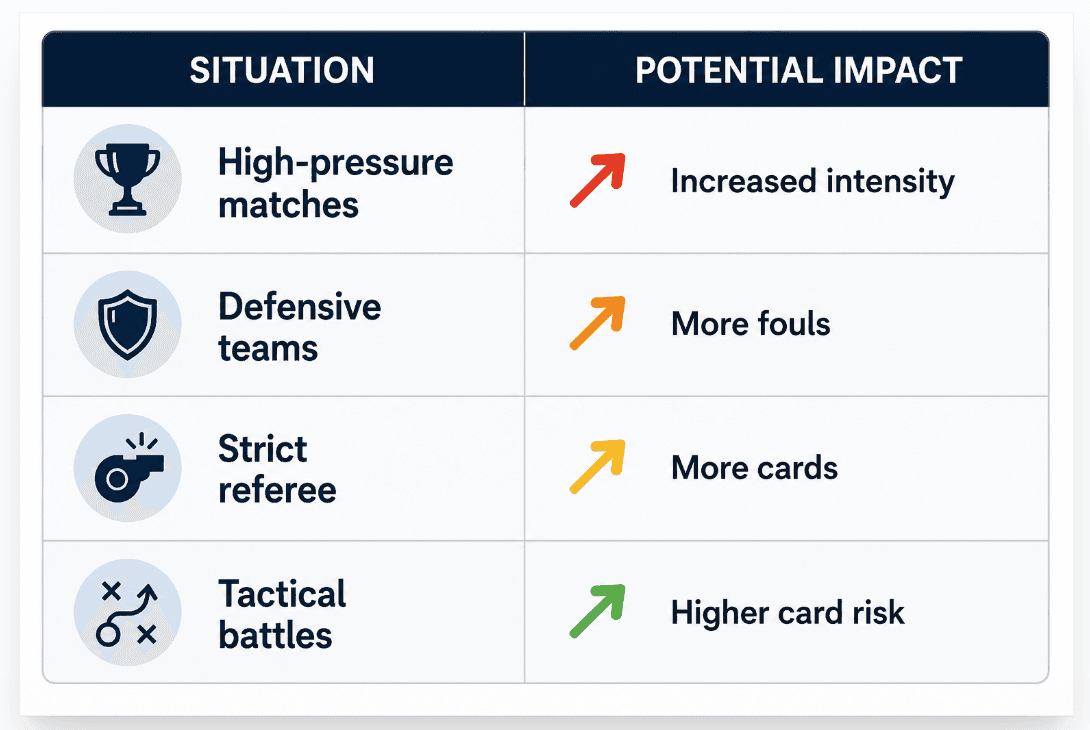
AI Generated, Captured by Claudia Hartley 23rd June 2026 13:47
These situations do not guarantee high booking points totals - remember you can always bet on the under! But they can provide useful starting points for your analysis. Our coverage of football is a great place to start looking as well.
When Booking Points Betting Works Best
Analysis always works best when you consider multiple sources of information. That way, you can work out the probability more accurately. I like to:
- Analyse referee statistics
- Understand team styles
- Compare my estimated probabilities with available odds
- Look at competition-specific trends
- Never forget bankroll management
When to Avoid Booking Points Betting
There are some situations where I swerve betting in this market, they include:
- Betting when I don’t have info on the referee
- Relying solely on team reputation
- If I’m just chasing previous losses
- If I’m not sure or ignoring bookmaker scoring rules
Whatever market you’re betting on, if key information is unavailable, passing on a market is preferable to making assumptions.
Booking Points Betting Checklist
- Who is the referee?
- What are both teams' card trends?
- Is the match likely to be competitive?
- What scoring rules does the bookmaker use?
- Is the stake appropriate for your bankroll?
- Does the available price accurately reflect the probability?
Conclusion
Booking points betting is all about the total disciplinary value accumulated during the match, with little attention paid to the result. That means the stats you’ll be looking at are quite different from many other football markets.
Referee decisions, team styles, tactical approaches, and match context can all influence card totals. Remember, though, even with the deepest analysis, football is unpredictable, and one nasty foul can change outcomes quickly.
Keeping bankroll management tight, only taking odds where you truly believe the probability is different, and looking at your results over a long period of time is the best way to treat this market.
Frequently Asked Questions (FAQs)
What are booking points in football betting?
Booking points are a numerical value assigned to disciplinary actions like yellow and red cards.
How are booking points calculated?
They are calculated by assigning point values to cards shown during a match, usually (though not always) 10 for yellow cards and 25 for red.
Are yellow cards worth different points than red cards?
Yes. Red cards always carry a higher points value than yellow cards, although scoring systems vary between bookmakers.
What affects booking points totals?
Referee style, team discipline, match intensity, tactical approaches, and competition context can all influence booking points totals.
Is booking points betting the same as card betting?
Not exactly, but it is very similar. Booking points betting focuses on the overall disciplinary score, while card betting can focus just on card counts, or team cards, or individual player cards.

Claudia Hartley is a versatile content writer and editor with a strong footing in digital publishing, particularly within the iGaming and affiliate space. With nearly a decade of experience, she has built a reputation for producing clear, engaging, and well-researched content that connects with readers while meeting SEO goals.
Comments
0 comments
No comments yet. Be the first to share your thoughts!
References
- 1.Referees - Players' Stats. Accessed June 23, 2026
Related Resources to Betting Academy
- Cash Out During Live Betting: What It Is and How It Works
- Betting Models Explained
- What is Five-Fold Betting & How it Works
- Learn How Betting Odds Work in Sports Betting
- What Is Correct Score Betting and How Does It Work?
- What Is Head-to-Head Betting and How Does It Work?
- What Is Value Betting and How Does It Work?
- How Goliath Bets Work in Sports Betting
- Combination Bets Explained
- Cash Out or Let It Ride? How to Make the Right Call on Your Acca
- How Futures Betting Works 2026 Explained with Value Odds and Risk Factors
- Double Betting Explained: The Expert Strategy Playbook 2026
- Card Betting Explained: Strategy, Odds & How to Find Value
- Treble Betting Explained: How it Works
- Single Betting Explained: Odds, Probability & Value Guide
- System Betting Explained
- European Handicap Betting Explained
- Spread Betting Explained: Expert Playbook & Strategy Guide 2026