
Betting Academy
Betting Odds Explained: How Betting Odds Really Work in 2026
One of my early horse racing accumulators helped me to understand odds in a way that I hadn’t quite grasped before. I’d got three short-priced favourites to win, one at 4/6 and two at even money. The final horse just scraped home for second, despite being the shortest-priced horse by far. That result taught me that odds are not predictions, they’re probability, with a bookmaker’s edge built in. After all, bookies aren’t taking our bets as a favour! It’s a business, so they have to make money. (Source: UK Gambling Commission) In this guide, I’ll help you to understand how betting odds work, seeing them as a pricing mechanism and not a prediction model. We’ll look at common mistakes and ways to help you think long-term. Remember, this is educational only, and no guide can guarantee you results. Only bet if you’re 18+ and always choose a UKGC-licensed site.

SportsBoom offers honest and impartial UK bookmaker reviews to help you make informed choices. While we may earn commissions through affiliate links, our content remains independent and free from promotional influence. For more information, see our Content Transparency and How We Review pages.
Betting Odds Explained
For straight win bets at licensed sites, a good bookmaker edge is considered to be around 3 to 4%. (Source: William Hill)
What Are Betting Odds?
Betting odds are prices. But what do betting odds mean? Well, they tell you two things:
- How much you’ll be paid if you win
- The implied probability of that outcome
Example: A £10 bet at 2/1 returns £30 (£20 profit plus your stake). In terms of probability, 2/1 implies roughly a 33% chance. Odds measure likelihood, not certainty.
How Do Betting Odds Work?
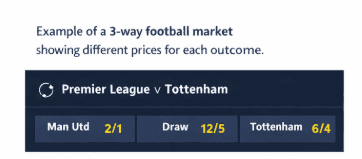
Odds convert probability into price. The higher the perceived chance, the shorter the odds - and the smaller the potential return. When you read our analysis of games, you’ll see the prediction part of the thinking built in. For price? Let’s look at a couple of examples, starting with the recent Manchester United vs Tottenham clash:
- Manchester United - 2/1
- Draw - 12/5
- Tottenham - 6/4
Here, the betting odds probability is close because the teams are considered broadly competitive. Small differences in perceived strength create small differences in price. A good way to increase that difference is to check out Premier League bet offers, in particular, boosted odds. (Oddschecker UK)
- Manchester City - 1/8
- Draw - 8/1
- Wrexham - 18/1
Here, the gap in quality (Premier League vs League Two) is reflected clearly. City’s implied probability is extremely high, so the price is very short. Wrexham is low, so the payout is larger.
How Do Betting Odds Work
Remember, the odds are not the bookmaker giving you a prediction; they’re giving you a price based on likely probability. If you’re after tips, check out our predictions page.
How Are Betting Odds Calculated?
Odds start with implied probability, then the bookmaker builds in a margin. The quick rule is:
Implied probability = 1 / odds.
Examples:
| Odds | Sum |
Decimal | 2.50 | 1 / 2.50 = 0.40 (40%) |
Fractional | 6/4 | 4 / (6+4) = 0.40 (40%) |
American | +150 | 100 / (150+100) = 0.40 (40%) |
How Are Betting Odds Calculated
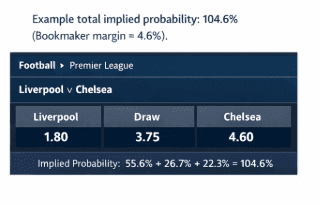
If you’re skipping ahead, you may have noticed that in real markets, the implied probabilities across all outcomes usually add up to more than 100%. That extra is the bookmaker's edge.
How to Read Betting Odds
My process for reading odds is simple:
- I translate the price into a probability
- I decide if that probability feels realistic
How? Let’s take a look at an example.
Let’s imagine we’re betting on a small field horse race. The favourite is 1/2, which implies a 66.7% chance. I ask myself, ‘Would this horse win roughly 2 out of 3 times in these conditions?’
If the answer is yes, it’s an accurate (or better than accurate) price; if the answer is no, then those odds are probably short.
If the odds seem long, then that’s usually when I have a bet, but only if I’m confident in my knowledge of the sport. No betting guide can guarantee results, even the very best football insights for UK fans, so sticking to the sports you enjoy means that win or lose, you’re still having fun. You can also check out some of the most trusted football betting platforms for a reliable experience.
Fractional Odds
Fractional odds are what we tend to use in the UK. Below, I’ll show you how to turn them into a percentage and then a probability.
Fractional Odds to Percentages
Formula: Denominator / (Numerator + Denominator)
Example: 6/4 is 4 / (6+4) = 4 / 10 = 40% implied probability
Converting Fractional Odds to Probability
I always add the two numbers first, then divide the bottom number by that total.
Example: 1/2 is 2 / (1+2) = 2 / 3 = 66.7%
Decimal Odds
Decimal odds are great if you’re after easy conversions. They’re also favoured by bookmakers as they allow much smaller changes, because they run to two decimal places.
Decimal Odds to Percentages
Formula: 1 / Decimal Odds
Example: 2.50 is 1 / 2.50 = 0.40 (40%)
Convert Decimal Odds to Probability
Take 1 and divide by the price.
Example: 1.80 is 1 / 1.80 = 0.555 = 55.5%
Remember, the lower the decimal, the higher the implied chance.
Best Sports for Betting Odds
In my experience, certain sports provide clearer pricing and more predictable odds movement. That’s down to liquidity, data availability, and the simplicity of the available outcomes.
- Football: A UK favourite, so markets are deep and heavily analysed. This makes pricing relatively efficient.
- Tennis: Thanks to its simple structure (two players, no draw), probability is easier to model.
- Horse racing: Larger fields and more volatility can create wider price variation. High liquidity in major races like the Cheltenham Festival, Royal Ascot, etc.
None of this makes outcomes 100% predictable; rather it affects how efficiently markets are priced.
Best Leagues for Betting Odds
Top-tier competitions tend to have the most consistent pricing because they attract the highest betting volume.
Think about it like this. If you were running a betting operation, where would most modelling time and risk management focus go?
- A huge televised football fixture
- A minor midweek event with limited turnover
High-volume leagues generally show tighter, more efficient pricing because both bookmakers and sharp bettors scrutinise them heavily. Smaller leagues and lower-profile events often have thinner liquidity, which can lead to sharper movements and wider margins.
The Premier League, Champions League, and major ATP tournaments attract enormous attention. That depth of market usually results in smaller pricing errors and steadier odds movement.
Understanding liquidity helps you interpret odds changes calmly, rather than emotionally.
Why Understanding Betting Odds Is Important (William Hill)
Understanding odds changes how you make decisions. Early on, I focused on outcomes, i.e., ‘who will win?’ That led to poor bankroll discipline and overconfidence in short-priced favourites.
Once I started translating odds into probability, my mindset shifted. A 1/3 shot stopped feeling ‘safe’ and instead became a 75% proposition, which still loses one in four times.
Odds shape your risk perception. If you don’t understand what a price truly represents, it’s easy to overestimate certainty or underestimate volatility.
Thinking in probabilities instead of predictions helps you approach betting methodically, manage exposure sensibly, and avoid emotional decisions.
Common Mistakes When Reading Odds (William Hill)
The most common mistake is treating short odds as guarantees. Favourites win often, but they still lose regularly! Ignoring implied probability makes those losses feel surprising when mathematically they’re not.
The opposite error is chasing high prices simply because the payout looks attractive. A 10/1 shot implies just a 9.1% chance.
The final mistake I see a lot is misunderstanding, or not counting margin. Many bettors never check whether a market totals well above 100%. This steadily reduces long-term value.
No strategy eliminates uncertainty, after all, betting is probability-based speculation, not a good way of making a steady income.
Tips for Using Betting Odds Effectively (William Hill)
Using tools as odds to evaluate risk, rather than crystal ball predictions, took plenty of mistakes and a fair bit of time. But the learning curve gave me a few tips:
- Translate every price into implied probability, before forming an opinion.
- Always think long term; small, predictable wins are better than speculative outsiders.
- Separate confidence from probability. A ‘strong feeling’ is nice, but it doesn’t change the maths.
- Stick to sports you understand well enough to question the price.
- Review decisions calmly, especially losses.
Using odds effectively requires more discipline than you might think.
Tips for Using Betting Odds Effectively
Odds Movement Explained
Odds move for lots of different reasons, but the main ones are:
- When new information becomes available: perhaps an injury, a team reconfiguration, change in ground conditions, or a horse being scratched from the card.
- When large or important betting activity happens: when lots of public money is placed on an outcome, or sharp money (an influential bettor) bets on an outcome.
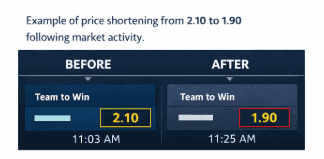
Example: A team opens at 2.10 and quickly shortens to 1.90. This means the implied probability has increased. Why? A sharp bettor placed a large bet on that team to win.
Odds Movement Explained
Safer Gambling and Responsible Betting Notes
Betting should always be approached responsibly and with clear limits.
Only bet if you are 18 or over and always use UKGC-licensed betting operators. Set deposit limits, avoid increasing stakes to recover losses, and treat betting as discretionary spending, never income.
This guide is educational only. No strategy or understanding of odds removes uncertainty, and no approach guarantees profit.
Conclusion
Betting odds are tools. They are not signals, predictions, or promises; they are simply probabilities expressed as price.
Learning to translate odds into implied probability shifts your mindset from emotion to analysis. It encourages long-term thinking, discipline, and a clearer understanding of uncertainty.
Experience taught me that outcomes are unpredictable, but probability is measurable. The more calculated you’re able to be when you interpret prices, the more rational your decisions become.
This guide is educational only. No understanding of odds removes uncertainty, and betting should only ever be undertaken responsibly by those aged 18 and over.
Betting Odds FAQs
Do higher odds mean better value?
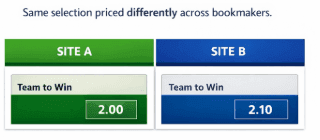
Not necessarily. Higher odds mean lower implied probability. Value depends on whether the price accurately reflects the true chance of an outcome — not how big the potential return looks. However, if one bookmaker offers higher odds than another for the same selection, that usually represents better value.
Why did the odds change after I placed my bet?
Odds move because markets react. Heavy betting volume, team news, injuries, weather, or even sharp money entering the market can shift prices. Odds movement reflects market activi-ty — not a guaranteed result.
Are the odds the same on all sites?
No. Different bookmakers use different pricing models, margins, and risk management strate-gies. Even small price differences can significantly affect implied probability and long-term returns.
How do bookmakers calculate betting odds?
Bookmakers start with probability models based on statistics, historical data, and market trends. They then adjust prices to include a margin (also known as the overround) to ensure profit over time. Odds are, therefore, a combination of probability assessment and built-in margin.
What does implied probability mean in betting odds?
Implied probability is the percentage chance of an outcome suggested by the odds. For ex-ample, decimal odds of 2.00 imply a 50% chance (1 ÷ 2.00). Understanding implied probability helps you assess whether a price offers genuine value.
Remember, betting should only be done by those aged 18+ using UKGC-licensed operators.

Claudia Hartley is a versatile content writer and editor with a strong footing in digital publishing, particularly within the iGaming and affiliate space. With nearly a decade of experience, she has built a reputation for producing clear, engaging, and well-researched content that connects with readers while meeting SEO goals.
Comments
0 comments
No comments yet. Be the first to share your thoughts!
Related Resources to Betting Academy
- How Goliath Bets Work in Sports Betting
- Combination Bets Explained
- Cash Out or Let It Ride? How to Make the Right Call on Your Acca
- How Futures Betting Works 2026 Explained with Value Odds and Risk Factors
- Double Betting Explained: The Expert Strategy Playbook 2026
- Card Betting Explained: Strategy, Odds & How to Find Value
- Treble Betting Explained: How it Works
- Single Betting Explained: Odds, Probability & Value Guide
- System Betting Explained
- European Handicap Betting Explained
- Spread Betting Explained: Expert Playbook & Strategy Guide 2026