
15 Best UK Betting Sites – Licensed Online Bookies for 2026
Patent Betting Explained: Meaning, Examples & How It Works
Patent betting uses three selections and turns them into seven bets. They are designed to purposely give punters multiple payout opportunities from a single wager at a licensed sportsbook.

SportsBoom offers honest and impartial UK bookmaker reviews to help you make informed choices. While we may earn commissions through affiliate links, our content remains independent and free from promotional influence. For more information, see our Content Transparency and How We Review pages.

Patent Betting Explained
With such a system, the punter bets on 3 singles, 3 doubles, and 1 treble. This makes it excellent for backing short-priced favourites where one losing leg would ruin a straight accumulator.
After reading this post, you’ll learn how each of these seven lines works. I’ll also talk about the pros and cons of this system and when and when not to use it.
What Is a Patent Bet?
A Patent bet is a system built from 3 selections that generates 7 bets:
- 3 singles
- 3 doubles
- 1 treble
If one selection wins, the patent returns a bit of coverage. If all three win, bettors get leverage.
For example, this past weekend, I could have built a Patent across three Premier League home favourites.
Arsenal at 1.50 to beat Fulham, Brentford at 1.90 against West Ham, and Bournemouth at 2.10 to see off Crystal Palace. With £10 per line, the total stake cost me £70.
All three home sides won. Therefore, the patent would have paid out across every line, so three singles, three doubles, and the treble, netting me £214.75.
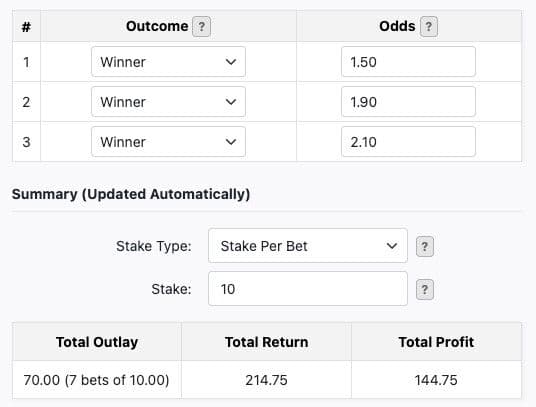
Credit: Patent Bet Calculator by Ace Odds – Screenshot capture by Samuel Barclay on 5 May 2026 – 13:13
A Patent includes singles, unlike a Trixie. That means one winning leg can still payout, whereas a Trixie returns nothing on a single winner.
How Patent Betting Works Step-by-Step
Placing a Patent bet includes three steps:
- Step 1: Choosing 3 selections
- Step 2: The bet slip generates 7 bets automatically
- Step 3: The unit stake applies to each of the 7 bets
If I were to use a Patent bet on three ATP matches: Sinner to beat Zverev, Alcaraz to beat Medvedev, and Draper to beat Rune. The bet slip would split those three picks into seven bets, 3x singles, 3x doubles, 1x treble, with each line costing the same amount.
Bet Type | Selections | Stake |
Single | Sinner | £10 |
Single | Alcaraz | £10 |
Single | Draper | £10 |
Double | Sinner + Alcaraz | £10 |
Double | Sinner + Draper | £10 |
Double | Alcaraz + Draper | £10 |
Treble | Sinner + Alcaraz + Draper | £10 |
Stake & Return Calculation
With a Patent bet, the total cost is seven times your unit stake, meaning a £10 stake on each line would cost £70 in total when betting on football matches.
Returns depend on how many selections win:
- 1 win - single return
- 2 wins - singles + doubles
- 3 wins - full payout
One win will rarely cover the £70 stake. Two wins may be break-even or produce a slight loss or profit. Three wins are full profit.
Patent vs Other Betting Systems
Patent vs Trixie
A Trixie covers the same three selections but excludes the singles. Therefore, it only provides four bets instead of seven. That makes it cheaper, but it needs two selections to return anything. A Patent, on the other hand, pays out with a single winner.
Patent vs Yankee
A Yankee uses four selections and 11 bets. This includes 6x doubles, 4x trebles, and 1x four-fold accumulator. It offers high upside but not singles for coverage. A Patent, though, keeps exposure lower with seven bets and offers built-in coverage through the singles.
Patent vs Accumulator
An Accumulator combines selections into one bet. Every leg needs to win for the bet to pay out. A patent, however, splits the same selections into seven individual bets, reducing max payout but allowing for partial returns if only one or two legs win.
Key Takeaway
Compared to other betting systems, a Patent balances coverage and stake size. It’s not the cheapest betting system, and it doesn’t offer the highest max payout. It does, though, allow for coverage via the singles.
Understanding Probability in Patent Bets
Each selection in a Patent has its own probability of winning. A golfer at 4.00 to win a tournament implies a 25% chance (1 ÷ 4.00). This does include the bookmaker's margin, however, so it’s slightly lower.
As a Patent combines 3 selections, this probability is multiplied. Three golfers at 25% x 30% x 40% give a treble around a 3% chance of landing. It’s possible to use this maths as an advantage, but remember, odds represent probability and not certainty.
Why Patent Betting Works (and Where It Fails)
The strengths and weaknesses of Patents come from the same source: its seven bets across three selections.
Coverage Advantage
Singles reduce total loss when selections fail. Even one winning leg will return something, something a Trixie or an Accumulator fails to offer.
Stake Exposure
Seven bets mean seven times the unit stake. A £10 Patent is really a £70 risk - something to keep in mind while using this betting system.
Pros & Cons
Pros
Returns are possible with just a single winner
Multiple payout paths across singles, doubles, and the treble
Cons
Higher total stake
Bookmaker's margin applies to all 7 bets
Probability multiplies
Drivers of Value in Patent Bets
There are three drivers of value with Patent Bets:
Strong individual selections: Each pick has independent supporting data from quality sources.
Balanced odds: Mix shorter and longer prices. Three selections with the same odds limits upside and coverage, whereas a mix, especially with the doubles and trebles, increases payout leverage.
Independence of outcomes: Selections must be from different events. Avoid betting on a football team to win as well as them scoring a certain number of goals.
The fastest way to build a poor Patent is by forcing three picks. Only use it if all three picks offer good odds, probability, and payout.
Risk & Bankroll Management
Always treat a Patent bet as seven bets, not one. Only risk a small percentage of a bankroll, never assume profit, and avoid increasing stakes due to losses. On a £1,000 bankroll, a good per-unit stake is around the £7 to £21 mark, depending on somebody's risk tolerance.
When Patent Betting Works
I find that Patent betting works when:
- I have 3 strong selections: Each pick stands on its own, and data from Opta and Fbref backs up my decision.
- The odds sit in a moderate range: Roughly 1.80 to 4.00, so the singles, doubles, and trebles all pay properly.
- Others think the same: Expert betting tips also suggest my outcome has a high probability.
When to Avoid Patent Betting
I tend to avoid Patent betting when:
- One or two selections feel weak: I’m leaning on the format to cover them rather than trusting the picks themselves.
- I’m forcing three picks together: Combinations are chosen to fit the seven-bet structure rather than because it makes sense based on data and mathematics.
- The odds are too short across each leg: When all-favourite Patents are at 1.30 and 1.50, they offer barely any payout.
Common Patent Betting Mistakes
I see the same errors come up time and time again:
Ignoring total stake: Treating £10 per line as a £10 bet, when it’s really a £70 stake across all 7 legs.
Assuming guaranteed profit: Coverage protects against the total loss, but it doesn’t completely remove risk.
Adding weak selections: Just making up the slip to perform a Patent bet instead of waiting for three strong selections.
Misunderstanding returns: Expecting one or two winners to deliver profit when the maths often only break even at three.
Common Patent Betting Mistakes
I see the same errors come up time and time again:
- Ignoring total stake: Treating £10 per line as a £10 bet, when it’s really a £70 stake across all 7 legs.
- Assuming guaranteed profit: Coverage protects against the total loss, but it doesn’t completely remove risk.
- Adding weak selections: Just making up the slip to perform a Patent bet instead of waiting for three strong selections.
- Misunderstanding returns: Expecting one or two winners to deliver profit when the maths often only break even at three.
Patent Betting Checklist
Before I place any Patent bet, I ask myself the following questions:
Are all 3 selections strong?
Are they independent?
Is the total stake acceptable?
Are the odds realistic?
Is the risk understood?
Does official league data support my decision?
Conclusion
Patent betting has its pros and cons. It offers payout flexibility due to multiple combinations, but it also increases total stake exposure, and the bookmaker's margin slowly eats away at potential profits. However, structure doesn’t change the underlying probability of each selection winning. Remember, bettors using a Patent strategy on a UKGC-licensed sportsbook must be 18+.
FAQs
What is a Patent bet?
A Patent is a system bet built from 3 selections that generates 7 bets: 3 singles, 3 doubles, 1 treble.
How many bets are included?
Seven bets in total, including 3 singles, 3 doubles, and 1 treble across 3 selections.
Is a Patent better than a Trixie?
No better, just different. A Patent includes singles for coverage. A Trixie excludes singles, but it’s cheaper.
Can you profit from Patent betting?
Yes, but usually only with two or three winners.
How much does a Patent cost?
Seven times the unit stake. £1 per line will cost £7, £10 per line will cost £70, and so forth.

Sam is a British content writer who’s now living in the Netherlands. He has 5+ years of experience producing SEO content for casino and sports bettors in Tier-1 markets. Working on campaigns for brands like Buzz Bingo, Paddy Power, Betfred, and Sun Bingo, he’s written 1M+ words of content spanning casino reviews, sportsbook reviews, slot guides, betting strategies, and industry news.
Comments
0 comments
No comments yet. Be the first to share your thoughts!
Related Resources
- Cash Out Explained: How It Works in Betting
- How Futures Betting Works 2026 Explained with Value Odds and Risk Factors
- Double Betting Explained: The Expert Strategy Playbook 2026
- Card Betting Explained: Strategy, Odds & How to Find Value
- Treble Betting Explained: How it Works
- Single Betting Explained: Odds, Probability & Value Guide
- System Betting Explained
- European Handicap Betting Explained
- Spread Betting Explained: Expert Playbook & Strategy Guide 2026