
15 Best UK Betting Sites – Licensed Online Bookies for 2026
Cash Out Explained: How It Works in Betting
During Matchweek 34, I could have placed a bet on Arsenal vs Newcastle. The Gunners were priced at 1.47 to win, so a £50 bet would have returned £73.50.

SportsBoom offers honest and impartial UK bookmaker reviews to help you make informed choices. While we may earn commissions through affiliate links, our content remains independent and free from promotional influence. For more information, see our Content Transparency and How We Review pages.

Cash-Out Betting Explained
The start of the match kicked off well for Arsenal. Eze ended up scoring in the 9th minute, putting Arsenal 1-0. If I were in the bet, I could have cashed out early here. However, there were still 80+ minutes in play, so the payout at that time wouldn’t be any good. It would have been better to wait until the 70th minute or so.
Arsenal ended up winning, so if anybody cashed out early, they lost out big time. The reason for that is because of how cash out probability works. In such a situation, the game had 80+ minutes remaining, so an equaliser from Newcastle could have happened. That’s why probability versus offered value and risk-to-reward trade-off play a role in using cash out bets.
The probability of Arsenal winning did look high, so bettors could have waited until the final whistle to cash out. But still, even if odds and probability show a good result, it’s still random and has the potential to change at any moment.
A bookmaker margin players a role in this as well. Every football sportsbook margin is different, and it can slowly eat away at probability and profits.
What Is Cash Out Betting?
Cash out is the option to settle a bet before the event finishes. It allows bettors to take profit, cut losses, and exit a bet that no longer feels worth it to hold.
In 2024, a Welsh punter called Ethan Conway cashed out a £219 acca for £5,130 with 15 minutes left. The fourth leg landed a minute later, costing him an £814,000 payout.
How Cash Out Works
The bookmaker calculates the current probability of a bet winning, applies their margin, and offers an adjusted payout. As the event unfolds, the cash out value changes automatically.
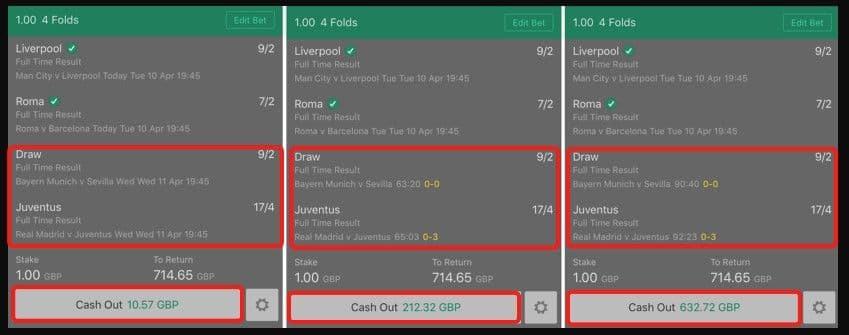
Credit: Onlinebetting.org.uk by Bet365 – Screenshot captured by Samuel Barclay on 5th May 2026 – 13:07
Say I backed a horse at 4.00 with a £50 stake, a potential return of £200. If the horse is leading by two furlongs, the bookmaker may offer a £130 cash out. It’s less than the maximum payout as the race isn’t finished, but it’s worth something as the horse is leading.
Expected value (EV) plays a role in this. This determines what a bet is worth mathematically based on the probability of it winning. If live form data on Racing Post suggests a horse has a 75% chance of winning, the holding bet of £200 will be valued at £150 (75% of £200).
How Bookmakers Calculate Cash Out Value
The value of a cash out is determined by four moving parts:
- Updated live odds
- Remaining time
- Game state Bookmaker’s margin
For example, in the 2026 Australian Open Final, Alcaraz dropped the first set to Djokovic 6-2. Despite Alcaraz going on to win, during this moment, his live odds would have shifted lower, and the cash out value would have dropped.
Understanding Cash Out vs Holding the Bet
- How to compare holding vs cashing out mathematically
- Exiting early reduces variance but lowers potential return
- Holding increases risk exposure
Holding the Bet
Holding a bet means waiting for the event to reach the final result. It pays in full. Holding does increase risk exposure, however. The unpredictability means it could lose and return nothing, even at the last minute.
Cashing Out
Cashing out means exiting the bet before the event is finished. It pays partially. Exiting early does reduce variance as it helps avoid full losses. On the flip side, it lowers potential return as bookmakers are still pricing in live odds, remaining time, etc.
Key Takeaway
Cash outs have lower potential value but reduce risk. Holding a bet increases potential value but increases risk.
Scenario | Outcome if Win | Outcome if Lose |
Holding the bet | £100 | £0 |
Cash out at £65 | £65 | £65 |
Cash Out vs Other Betting Markets
Cash out sits alongside several other types of markets at leading betting platforms, but each works differently.
vs Pre-Match Betting
Pre-match betting locks in a position before an event starts. It has fixed odds the moment the bet is placed. Cash out allows an exit from a position once the event is underway.
vs Live Betting
Live betting creates new positions while an event is ongoing. Odds shift based on what’s happening in the event. Cash outs work similarly, but it’s used to exit bets instead of entering them.
vs Hedging
Hedging uses separate bets on the opposite outcome to lock in profit or limit losses. Cash outs are handled differently. It allows bettors to exit early to reduce the chances of losing.
Key Takeaway
Cash outs help a punter get out of a bet, whether to protect themselves or to lock in profit. The other betting markets help a bettor enter bets, either before or during an event.
Understanding Probability in Cash Out Decisions
Odds reflect probability and not certainty. However, it’s possible to look at the odds to get an idea of how the bookmaker is ranking the probability of the outcomes.
When a bet is priced at 2.00, that implies a 50% chance of winning. The word “implies” here is strong. That’s because the bookmaker's margin is baked into this number, so it’s always skewed.
Cash outs work like normal bets, but the maths is different. If a bet has a potential full cash out of £65 on a £73.50 bet, the probability of a win is at 88% at that moment in time (£65 ÷ £73.50 = 0.88).
Drivers of Cash Out Value
There are four factors that drive the value of cash out bets:
Scoreline: A favourable goal/point can push the offer up; one against can drop it down.
Time remaining: The less time left, the closer the offer moves to full payout.
Match momentum: Injuries, red cards, etc., can shift live probability in either direction, changing the bet's value.
Market demand: Heavy in-play action on the opposite outcome can nudge cash out values down.
A late goal is a clean example. An 88th-minute goal can push an offer from £40 to £95 in seconds.
Partial Cash Out Explained
Partial cash out lets bettors exit a portion of their stake and keep the rest active. On a £100 bet, for instance, it’s possible to cash out £50 as guaranteed profit and keep the other £50 to run to full payout.
Risk & Bankroll Management
Cash out should be looked at as risk control, not a strategy. While it can protect a bettor from a loss, the margin from the bookmaker can eat away at profits.
A bettor cashing out 20 times a month at an average margin of 3% leaks £60 a month in expected value. This is before even accounting for any full payout wins that have been missed.
That being said, only use cash out when the probability has changed meaningfully against the original bet. As a result, it then offers protection instead of capping profits.
When Cash Out Makes Sense
I use cash outs when:
- There’s a change in probability: A red card, injury, or scoreline shift that generally alters the bet’s chance of winning.
- Risk reduction is needed: When the stake is too large for the bankroll, or the outcome would create a damaging impact.
- An uncertain late-game scenario occurs: Close finishes where momentum has flipped, and the original read no longer holds.
When to Avoid Cash Out
I avoid cash outs when:
- Reacting emotionally: When I feel nerves are taking over instead of probability and data.
- A small fluctuation in odds appears: Minor in-play shifts generally don’t justify locking in a reduced return, as it’s still random.
- Overpaying bookmaker margin: If the bookmaker's margin is high, low-value cash outs aren’t worth it.
- Data doesn’t support my decision: When data from Opta or Fbref doesn’t support my cash out gut feeling.
Common Cash Out Mistakes
The same errors come up time and time again:
- Cashing out too early and missing the full payout
- Misunderstanding cash value as a “guaranteed” win
- Cashing out to avoid losses rather than to manage risk
- Taking offers without comparing them to the bet’s true chance of winning
Cash Out Checklist
Before I cash out, I go through the following checklist:
- Is the offer fair relative to probability?
- Am I reacting emotionally?
- What is the expected value of holding?
- Is risk reduction justified by official league statistics?
- Is my decision supported by expert betting tips?
Conclusion
Cash out bets provide protection, but at a cost. That’s why it should be used sparingly. Although it can be looked at as convenience, hidden costs like margin and potential full wins can quickly eat away at a bankroll. Remember, bettors must be 18+, and they should play on UKGC-licensed platforms if they’re based in the UK.
FAQs
What is cash out betting?
Cash out betting is the option to settle a bet before the event finishes.
How is cash out calculated?
The bookmaker takes the live probability of the bet winning, applies their margin, and produces an adjusted payout rate.
Is cash out worth it?
It depends. It’s worth using if the probability has shifted massively. It’s not worth it if it’s being used emotionally.
Can you use a partial cash out?
Yes, on most UKGC-licensed platforms, partial cash out is offered.
Does cash out reduce profit?
Almost always. The bookmaker’s margin is built into every offer, meaning cash out values sit below the mathematical fair value.

Sam is a British content writer who’s now living in the Netherlands. He has 5+ years of experience producing SEO content for casino and sports bettors in Tier-1 markets. Working on campaigns for brands like Buzz Bingo, Paddy Power, Betfred, and Sun Bingo, he’s written 1M+ words of content spanning casino reviews, sportsbook reviews, slot guides, betting strategies, and industry news.
Comments
0 comments
No comments yet. Be the first to share your thoughts!
Related Resources
- How Futures Betting Works 2026 Explained with Value Odds and Risk Factors
- Double Betting Explained: The Expert Strategy Playbook 2026
- Card Betting Explained: Strategy, Odds & How to Find Value
- Treble Betting Explained: How it Works
- Single Betting Explained: Odds, Probability & Value Guide
- System Betting Explained
- European Handicap Betting Explained
- Spread Betting Explained: Expert Playbook & Strategy Guide 2026