
15 Best UK Betting Sites – Licensed Online Bookies for 2026
Why 12-Leg Acca Betting Is So Difficult: Understanding the Math and Odds
If you go into a bookies on a Saturday afternoon, you’ll more than likely see people armed with betting slips bearing numerous differing selections in order to win thousands from just a £1 wager on a 12-game accumulator. While the potential payout is appealing, the probability of winning a 12-leg accumulator is extremely low due to how compound probability works. As you can see from the bet slip below, a 12-leg accumulator with a £1 wager came up trumps for a lady in Kent back in 2017.

SportsBoom offers honest and impartial UK bookmaker reviews to help you make informed choices. While we may earn commissions through affiliate links, our content remains independent and free from promotional influence. For more information, see our Content Transparency and How We Review pages.

Understand why 12-leg acca betting is so difficult
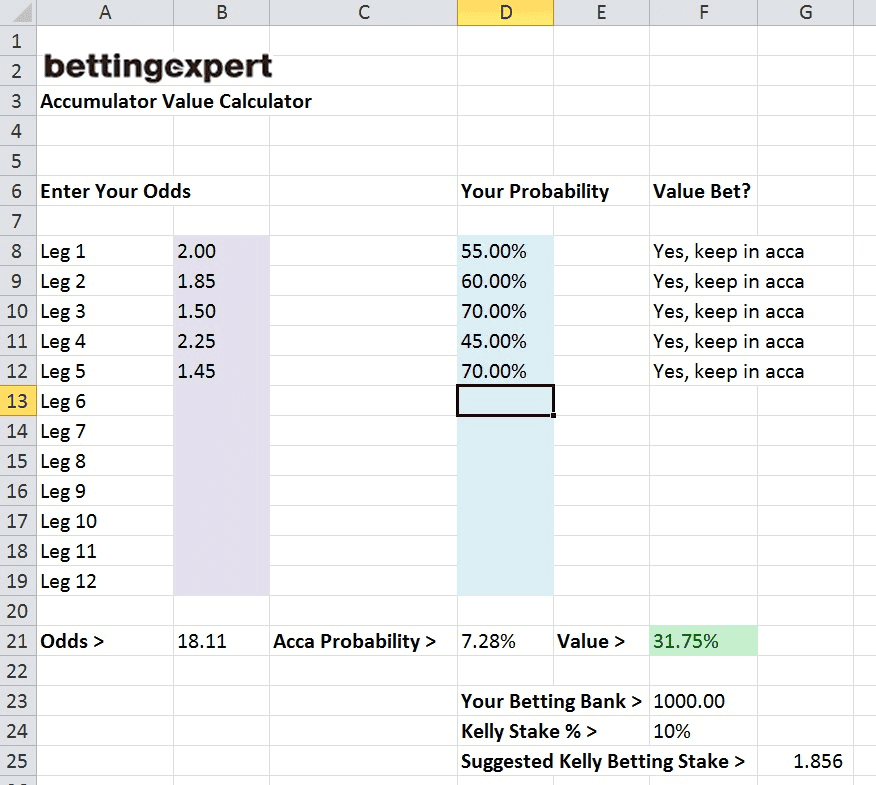
The Multiplication Principle
To find the total odds, multiply the decimal odds for each selection. A 12-way accumulator with 1.50 odds on each leg will have total odds of 1.50^12 = 129.75. A £10 stake would pay nearly £1,300.
There are two drawbacks to this method of betting odds calculation: the fact that you are multiplying the bookmaker's edge for every selection, and the fact that each time you add a new selection, you are multiplying rather than adding the chance of winning.
Therefore, you nearly always have far less chance of winning than you originally thought you did.
The Multiplication Principle
The Compounding Margin
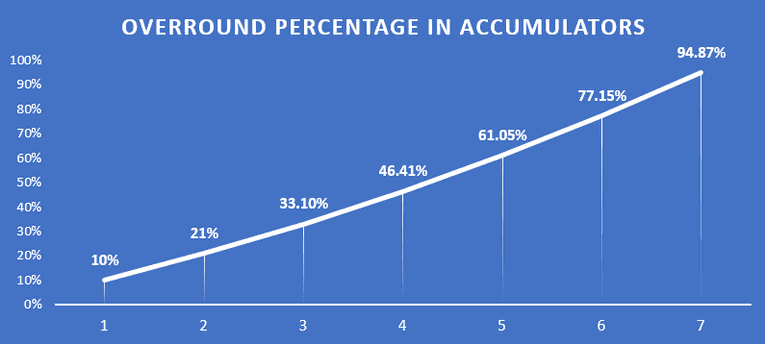
Each wager includes the bookmaker's profit margin (or "overround") added up from all bets on every game and then multiplied together on any multi-bet. For example, betting on four different results could see the house's edge increase from roughly 5% just for your first selection to almost 19% for your entire multi-bet accumulator.
The bookmaker's overall profit margin would be enormous if the accumulator were made up of 12 legs, as you can see from the image below.
The Compounding Margin
Even with the ability to predict accurately, there would be no value left in the sum total of the accumulator's legs.
Probability in Action
Football betting with 12 different teams, all with an estimated chance of winning of 50% on the punters’ side, you will still miss out on those winning bets because of the bookmakers’ margin of 52.36% on average per leg.
What's more, when you compound probabilities, if just one leg goes wrong, then you will no longer have any chance whatsoever of winning 0.5236¹², or 0.02% (1 in 5,000 chance).
You can see how cruelly you will be punished if you make a little mistake with your selections when dealing with 12 legs.
Understanding Accumulator Risk
UK betting sites love promoting accumulators because they rarely win, and they try to make their products look like they are good value through their marketing. But, no matter what, the odds of winning are still brutal.
When you are betting on anything with 12 legs, there is a tremendous amount of variance in the odds. Variance is how much your bankroll will fluctuate.
If you bet 12 legs and miss the final leg, you lose all the money bet on that 12-leg accumulator, no matter how well you performed on the previous 11 legs.
The Multiplying Effect of Additional Selections
The 12-leg accumulator has geometric progression in both odds and risk. For example, suppose you have an average of 2.0 for each leg. The total odds will therefore be 2^1, 2^2, 2^3, etc. Therefore, the total odds of winning with the addition of one leg will be 2*2^12= 4096 (or 4097 times more than you were winning). Each leg you add also multiplies your chances of winning since each additional leg is highly unlikely to win.
Because of the geometric progression, the bookmaker's margin also increases.
For instance, if you assume the margins on the twelve legs in the above example are about 5% per leg, when you add together all twelve legs, the effective margin will equal 60% since you have added all twelve; however, after multiplying together all of the overrounds, the margin will be greater than 70%.
A Strategic Alternative
Professional gamblers normally do not take 12-leg accumulators. Instead, they take smaller bets that involve value picks, such as trebles or fourfolds.
Some professionals also take advantage of positive correlation by pairing related selections, but even accumulators face a major challenge in the form of compound probabilities, variances, and geometric progressions.
The Final Whistle
The prospect of winning a 12-leg accumulator is highly unlikely. This is because the odds are stacked in geometric progression. This means that the final odds are heavily stacked in favour of the bookmaker.
This is where compound probability eventually takes its toll.
Over time, even minor errors compound. This is because accumulator variance eventually leads to an all-or-nothing approach.
These are essentially cheap forms of entertainment for the average person - like a lottery ticket disguised as a betting slip.
It is important that we keep this in mind and never forget that the primary purpose is to have fun.

Lucie Turner is an experienced freelance content writer who has carved out a strong niche in the iGaming and casino space. Since 2015, she has worked with a wide range of international clients across the UK, US, and Europe, building a reputation for producing content that is both informative and genuinely engaging.
Related Resources to Bridging
- How Futures Betting Works 2026 Explained with Value Odds and Risk Factors
- Double Betting Explained: The Expert Strategy Playbook 2026
- Card Betting Explained: Strategy, Odds & How to Find Value
- Treble Betting Explained: How it Works
- Single Betting Explained: Odds, Probability & Value Guide
- System Betting Explained
- European Handicap Betting Explained
- Spread Betting Explained: Expert Playbook & Strategy Guide 2026