
Betting Academy
Arbitrage Betting Explained: A Practical Guide For 2026
My first foray into arbitrage betting was a learning curve, to say the least. I spotted a good one - two different prices on the same football match, a clear discrepancy, simple maths, or so I thought. I placed both bets, sat back, and only later realised I’d rounded the stakes incorrectly. That clever ‘locked-in’ edge disappeared into pennies of loss.

SportsBoom offers honest and impartial UK bookmaker reviews to help you make informed choices. While we may earn commissions through affiliate links, our content remains independent and free from promotional influence. For more information, see our Content Transparency and How We Review pages.

Arbitrage Betting Explained
Video Explanation of Arbitrage Betting
That was the moment I understood something important: arbitrage isn’t luck, and it isn’t clever spotting alone. It’s all about structure. Since then, I’ve tracked every arb in a spreadsheet, calculated before clicking, and passed many more opportunities than I’ve taken.
In this guide, I’ll walk you through exactly how I identify, calculate, and execute arbitrage positions across multiple sports, step by step.
What Is Arbitrage Betting?
The first time I recognised an arbitrage properly, it was during a Saturday Premier League slate. I was comparing odds after I’d read our analysis, and I noticed one bookie had Home at 2.20 while another had Away at 2.10 in a two-outcome market. That shouldn’t happen, not if markets are perfectly aligned.
Arbitrage betting is making use of these moments to place bets on all possible outcomes of the same event at different prices, while the combined implied probability is below 100%. When that happens, the maths allows structured coverage across outcomes.
Key terms:
- Back: betting on an outcome to happen
- Lay: betting against an outcome (exchange terminology)
- Implied probability: calculated as 1 / decimal odds
Even 1 to 2% arbs, when executed correctly and repeatedly, can compound meaningfully over time.
How Arbitrage Betting Works (Core Mechanics)
Arbitrage always starts with implied probability. The formula to work this out is simple: Implied probability = 1 / decimal odds
If the sum of implied probabilities across all outcomes is less than 1, then an arb exists. That’s all there is to it, mathematically anyway!
Let’s take a look at an example of a two-way football market (Draw No Bet) using Arsenal vs Manchester City at the Emirates Stadium earlier this season.
- Odds:
Arsenal: 2.10 - Man City: 2.05
Implied probabilities:
- 1 / 2.10 = 0.476
- 1 / 2.05 = 0.488
Total = 0.964 (96.4%)
That 3.6% gap is the opportunity window.
Let’s say we have a £100 stake that we need to distribute proportionally.
- Stake A = (Total Stake × Opposing Odds) / Sum of Odds
- Stake B = Remaining balance
In our example, that’s:
Outcome Odds Stake Potential Return
Arsenal Win 2.10 £48.80 £102.48
Man City Win 2.05 £51.20 £104.96
Net result: Around £2 to £4 positive coverage, depending on rounding.
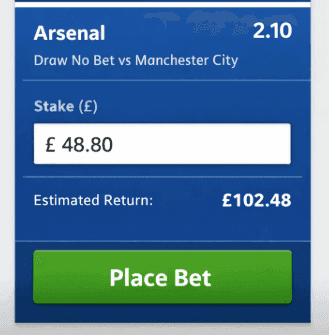
How Arbitrage Betting Works
Risk Points:
- Odds shifting mid-placement
- Stake rounding creates negative drift
- Partial bet acceptance
- Bet rejection due to limits
I calculate first, then I place both bets within seconds. If one price moves before I complete the second leg, I cancel the position. Discipline arguably matters more than speed, but both really matter.
Best Sports for Arbitrage (Multi-Sport)
Not all sports produce arbs equally, but these are often more reliable.
Football
Three-way match result markets create surprisingly frequent cross-market discrepancies, especially around major Premier League fixtures. After reviewing football betting insights for UK fans, I’ll often compare 1X2 markets and handicap variations pre-kickoff.
Tennis
Two-outcome markets make tennis clean for arbs. ATP and WTA events are especially good in the early rounds, often showing price lag across bookies.
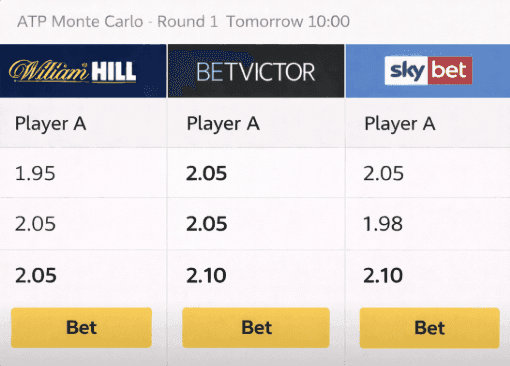
Tennis arbitrage
Basketball (NBA)
Spread and moneyline markets in the NBA can move quickly, especially around injury news. I’ve found there are sometimes short windows pre-tip where one betting site lags on spread adjustment. Speed is your friend here, but don’t let it trip you up with your calculations.
Horse Racing
Price differences across books are common before major meets like the Cheltenham Festival. Each runner priced independently creates fragmentation opportunities. While you’ve got more outcomes, so more maths to do, if you put in the time, this is a good market to spot arbs.
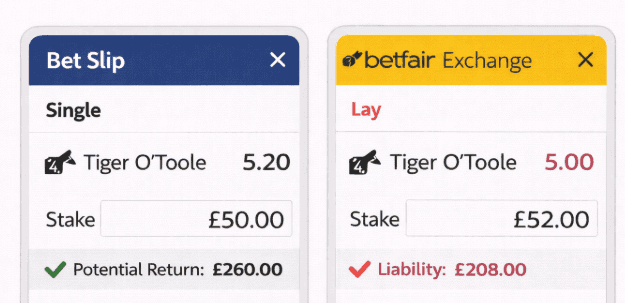
Horse Racing.
Across sports, the principle is identical. Find an implied probability below 100% (calculate that twice!), allocate your stake with discipline, and then place the bet quickly.
Best Leagues and Markets
Some leagues are simply more ‘arb-friendly’ than others, mostly because pricing behaviour differs.
The ideal league is usually a high-liquidity one (it’s popular). This means there are multiple bookmakers reacting to the same information at slightly different speeds.
League/Market | Typical Odds | Arb Frequency/Reliability |
Premier League 1X2 | 1.60 - 4.50 | Moderate, especially before kick-off. |
NBA (Moneyline & Spread) | 1.80 - 2.20 | Short, fast-moving windows |
NFL (Spread) | 1.90 - 1.95 | Tight markets with smaller gaps |
ATP/WTA (Match Odds) | 1.50 - 3.00 | Good in early rounds |
Cheltenham (Win) | 2.00 - 15.00+ | More calculation needed |
The Premier League and NBA tend to offer smaller but cleaner discrepancies. Tennis is mechanically tidy because it’s two-way. Cheltenham and other major horse racing meetings are messier, with more runners and more maths, but occasionally wider price gaps.
Calculating Stakes & Guaranteed Profit
If you’ve got as far as spotting the arb, then you’re already doing great, but this is the part where most people slip up. Allocating your stake correctly is what really makes arbitrage betting work.
For a two-way arb, this is my framework:
- Calculate your implied probabilities and confirm the total is less than 1
- Decide your total stake
- Allocate your stake proportionally using the formula below
Stake A = (Total Stake × Odds B) / (Odds A + Odds B)
Stake B = Total Stake − Stake A
Example:
£50 on Team A at 2.20
£60 on Team B at 1.95
Team A wins = £110
Team B wins = £117
Profit depends on allocation accuracy. If those stakes weren’t proportionally calculated, you’re exposed on one side.
Three-way markets follow the same logic, but you divide proportionally using each outcome’s implied probability share, like this:
Check if the arb exists (1X2 market)
Pick your three prices (Home / Draw / Away) and calculate implied probability:
- Home: 2.80
- Draw: 3.60
- Away: 3.00
Implied probabilities:
- 1 / 2.80 = 0.3571
- 1 / 3.60 = 0.2778
- 1 / 3.00 = 0.3333
Total = 0.9682 (96.82%)
Because that’s under 1, a three-way arb exists.
Calculate the target “equal return” payout
Payout = Total Stake / (1/Odds 1) + (1/Odds 2) + (1/Odds 3)
If the total stake is £100:
Payout = 100 / 0.968253968… = £103.28 (rounded)
That means you’re aiming for ~£103.28 return, whichever outcome lands.
Allocate stakes per outcome
Stake on outcome i = Payout / Odds i
- Home stake = 103.28 / 2.80 = £36.89
- Draw stake = 103.28 / 3.60 = £28.69
- Away stake = 103.28 / 3.00 = £34.43
Total staked: £100.01 (rounding drift is normal)
Worst-case return: £103.28
Worst-case coverage: ~£3.27 before any fees/limits/void weirdness.
Tiny-but-important habit: after rounding, I always sanity-check the lowest return minus total stake. If it’s tight, I’ll shave a penny or two off the ‘oversized’ leg to keep the worst-case side positive.
Multi-leg arbs (rare, but they exist) require proportional distribution across all outcomes based on implied probability weights. These are firmly in spreadsheet territory, not mental maths!
Winning vs Coverage - Timing & Risk
Arbitrage isn’t about ‘winning’ at all; in fact, it’s one of the very few types of betting that isn’t. Instead, it’s about coverage.
Coverage only works if both sides get placed at the intended prices.
I’ve had situations where I calculated an arb, placed the first leg, and by the time I clicked the second, the odds had shifted. That meant my arb was gone, and my position was exposed.
At that point, you’ve got three options:
- Accept exposure
- Hedge at worst odds
- Cancel and reset
If possible, I always choose to reset.
The lesson here is simple: calculate quickly, place decisively, and if anything changes mid-process, pass. There will always be another opportunity. Forcing it is how small percentage edges disappear.
Pros & Cons of Arbitrage Betting
Pros
Structurally low exposure when calculated correctly
Consistent, repeatable process
Not reliant on predicting outcomes
Cons
Stake limits can reduce profitability
Bets can be partially accepted
Accounts can face restrictions
Small errors wipe out thin margins.
The trade-off is clear. You’re sacrificing upside for stability. You won’t hit huge wins, because you’re grinding percentage gaps.
If you’re comfortable with small, structured returns and tight discipline, it works. If you prefer variance and big swings, it probably won’t suit you.
4 Drivers of Arbitrage Value
Not every price difference is worth touching. Over time, I’ve found there are four main drivers that make arbitrage realistic rather than just theoretically possible.
Market Inefficiency
This is the obvious one; without it, arbitrage cannot work. Two bookies must price the same outcome differently. Often, I’ll see this in tennis matches where one site has Player A at 1.85 while another is still sitting at 2.00 after late money came in. That lag creates the gap, but speed is key as it’s usually brief.
Line Movement Speed
Some markets correct instantly, while others don’t. NBA spreads can adjust in seconds after injury news, but lower-profile tennis matches might drift more slowly.
Tip: The slower the reaction, the longer your calculation window.
Stake Management
An arb only works if the stakes are proportionally allocated. There are plenty of punters who can spot a 2% edge, and plenty of them who then wipe it out by rounding lazily. Only precision protects the margin.
Cross-Sport Opportunities
Football and the NBA are structured. Tennis and horse racing can be slower to sync across firms. Cheltenham week, for example, often produces fragmented pricing. More maths, yes, but sometimes wider windows.
Different sports require the same logic. The only thing that changes is speed and discipline.
Settlement Rules
Settlement is where your theoretical profit meets reality.
A full arb assumes both legs are fully accepted and settled normally. But partial bets (annoyingly) happen. If one side is accepted at £100 and the other at £60, you’re exposed unless you rebalance quickly.
Voids are another consideration. If one side of a two-way arb is voided due to a rule interpretation, your coverage disappears.
Example: £50 at 2.20 and £52 at 2.05. If the 2.05 leg is voided, you’re left with £50 at 2.20 exposed. That’s no longer an arb, it’s a standard bet.
Live markets add timing risk and aren’t a good idea for a beginner (probably not for a pro to be honest!) Pre-match, you have breathing room. I always double-check rules before placing both sides.
Common Arbitrage Mistakes
- Miscalculating Stakes
If your implied probabilities sum to 0.98 but your allocation isn’t proportional, you can accidentally create negative coverage. When you’re working with small percentage gaps, you can’t afford to be sloppy with the maths.
- Ignoring Line Changes
If you place the first leg and the second price drops from 2.05 to 1.98, your margin might vanish instantly.
- Partial Bets and Liquidity Assumptions
Just because a price exists doesn’t mean you’ll get your full stake accepted. I’ve had situations where one side was capped at £25 while the other allowed £200.
- Restrictions
Cross-book activity can lead to restrictions. If your second leg gets limited consistently, the strategy becomes harder to execute cleanly.
How I Evaluate an Arbitrage Opportunity (Professional Method)
I don’t rush arbs anymore. I follow the same checklist every time.
How I Evaluate an Arbitrage Opportunity
- 1
Identify discrepancy
Compare markets across sites. I’m looking for clear decimal gaps. - 2
Calculate implied probabilities
1 / odds for each outcome. Confirm the total is below 1. If it’s tight (0.995 or similar), I usually pass. - 3
Allocate stakes proportionally
Decide on the total stake you’re happy with. Calculate the payout target and then allocate your stake precisely. - 4
Assess reliability & limits
Are both bookies likely to fully accept the stake? Any recent restrictions on your account? Is this in-play and likely to suspend? - 5
Execute or pass
If everything lines up, I place both legs quickly. If anything feels unstable, I move on. There’s no room for error with arbitrage betting, so it really isn’t worth it.
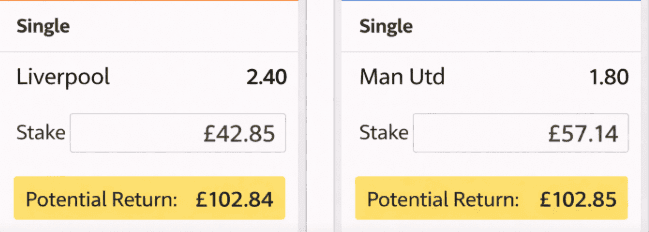
Here’s how it works in practice:
Actual Odds:
Home: 2.40
Away: 1.80
Implied Probability Less Than Zero?
1 / 2.40 = 0.4167
1 / 1.80 = 0.5556
Total = 0.9723
£100 Stake Distributed Proportionally:
Outcome Odds Stake Return
Home 2.40 £42.85 £102.84
Away 1.80 £57.14 £102.85
(Adjusted proportionally for equal return target in spreadsheet.)
The numbers tell me whether it works. My experience tells me whether it’s worth executing.
And sometimes, in fact often, the correct decision is simply: pass.
Arbitrage Betting Match Patterns
Over time, I’ve noticed arbs tend to appear in fairly predictable situations. There’s not a constant flood of them, but enough to notice a pattern.
- Early lines before market correction
This is the classic one. A bookmaker posts early prices on a Premier League fixture, money comes in elsewhere, and one book is slower to adjust. I’ll play these if liquidity is solid and limits aren’t restrictive. I’ll pass if it’s a niche league with £20 caps.
- Live in-play discrepancies
In-play can throw up short windows when one site suspends and reopens slightly off-market. I’ll only touch these if I’ve already calculated the range beforehand. If I’m scrambling mid-point, it’s far too easy to make a mistake, so I’ll leave it.
- Multi-bookmaker promotions
Occasionally, boosted prices, Premier League bet offers, or enhanced odds create temporary distortions. I’ll consider it if the boosted leg doesn’t distort the maths elsewhere. If it relies on awkward rollover terms or unclear settlement rules, then I’ll pass.
The key isn’t chasing every type. It’s knowing which patterns suit your process and acting only when you’ve run through every stage of the checklist, and you’re confident in the maths.
Arbitrage vs Other Markets
Arbitrage sits in a very different category from most betting markets, because the result doesn’t actually matter at all. You’re backing a pricing problem, not an outcome.
Singles / System Betting
With singles or systems, you’re backing your opinion. You accept variance in exchange for upside. Arbitrage removes opinion entirely.
Example: Instead of backing Arsenal outright at 2.10, you’re distributing stakes across outcomes to remove exposure. Far less upside, far less volatility.
Accumulators
Accas rely on multiple outcomes landing. One leg fails, and the whole thing collapses. Arbitrage is the opposite; it’s designed so that any outcome settles profitably if calculated correctly. You sacrifice potential big payouts for small, controlled returns.
Spread or Totals Markets
Occasionally, arbs appear in spreads when one site moves from say -6.5 to -7.5 and another lags. If the implied probability gap is genuine, it’s playable. But spreads move quickly, so the window can close in seconds.
Each has its place. Arbitrage is about coverage, while pretty much everything else is about prediction.
When I Avoid Arbitrage Betting Completely
There are plenty of situations where I simply don’t get involved.
- Extreme line volatility: If prices are swinging every few seconds, there’s every chance of placing the first half of the bet only for the price to leap and me to be left with a single.
- Low liquidity & tiny percentage gaps: A 0.5% theoretical edge disappears quickly with rounding or stake limits.
- Restrictions: Bookmakers do not like arbitrage bettors. If one firm is already limiting me heavily, the second leg may not be placeable at the scale I need.
Example: Two-way market shows 0.99 implied probability. Looks close. But one side caps me at £15 and the other at £200. Sometimes discipline simply means walking away, and in this kind of bet, you’d be having two singles, not an arb.
Arbitrage Betting Checklist
Before I click anything, I run this five-point mental checklist:
- Clear odds discrepancy identified
- Implied probability below 1 (calculated twice)
- Stakes allocated proportionally
- Both sides are likely to accept full stake
- No obvious line movement risk
Let’s run through an example together:
Point 1 - Check
Home 2.40
Away 1.80
Point 2 - Check
Implied total = 0.972
Point 3 - Check
Stakes calculated for £99.99 total are £42.85 and £57.14
Point 4 - Check
Both firms are showing stable limits.
Point 5 - Check
Market not suspended.
Only then do I execute. If any one of those boxes isn’t ticked, I don’t convince myself it’s ‘close enough’. Close enough is how 2% edges become 0% - or worse.
FAQs
What is an arbitrage bet?
An arbitrage bet is when you place bets on all possible outcomes of the same event at different prices, where the combined implied probability is under 100%. In practice, it’s not about predicting the winner. It’s about spotting a pricing mismatch and distributing your stakes correctly.
How do I calculate guaranteed profit?
Start with implied probability (1 / decimal odds). If the total is below 1, calculate a target payout and divide your stakes proportionally. I always run the numbers twice and check the lowest return minus my total stake before placing anything.
Which sports suit arbitrage best?
High-liquidity sports like football, the NBA, and tennis are usually cleaner. Tennis is particularly tidy because it’s two-way. Horse racing can work too, but it involves much more calculation.
How fast do I need to act?
Fast enough to beat line movement, but not so fast that you skip the maths! I calculate first, and then place quickly, always keeping an eye on the odds. If odds move mid-process, I reset.
Can arbs fail?
Yes - and they often do. Things like unexpected stake limits, voids, partial acceptance, or calculation errors can all cause an arb to fail. That’s why structure matters more than speed.

Claudia Hartley is a versatile content writer and editor with a strong footing in digital publishing, particularly within the iGaming and affiliate space. With nearly a decade of experience, she has built a reputation for producing clear, engaging, and well-researched content that connects with readers while meeting SEO goals.
Comments
0 comments
No comments yet. Be the first to share your thoughts!
Related Resources to Betting Academy
- How Goliath Bets Work in Sports Betting
- Combination Bets Explained
- Cash Out or Let It Ride? How to Make the Right Call on Your Acca
- How Futures Betting Works 2026 Explained with Value Odds and Risk Factors
- Double Betting Explained: The Expert Strategy Playbook 2026
- Card Betting Explained: Strategy, Odds & How to Find Value
- Treble Betting Explained: How it Works
- Single Betting Explained: Odds, Probability & Value Guide
- System Betting Explained
- European Handicap Betting Explained
- Spread Betting Explained: Expert Playbook & Strategy Guide 2026