Betting News
Gambling Minister Merry-Go-Round: Why UK Horseracing Could Pay the Price
UK gambling minister Baroness Twycross stays at DCMS, but her hold on the brief is unconfirmed, seven ministers in six years, and horseracing's betting levy may be the one paying the price.

Credit: Getty Images
British horseracing's finances run on a levy most fans never think about, and a ministerial post most people couldn't name. Both are currently in flux at the same time.
With Baroness Twycross's future in the UK's gambling brief unconfirmed, and the Gambling Commission's Financial Risk Assessments beginning to reshape how high-value bettors are checked, racing finds itself watching two separate stories that could combine to hit its funding model from an angle few outside the sport are currently tracking.
An Unfamiliar Question Mark
As announced earlier this week, Twycross is set to retain her position at the Department for Culture, Media and Sport, but the department has not confirmed whether she will continue holding the gambling brief specifically[1].
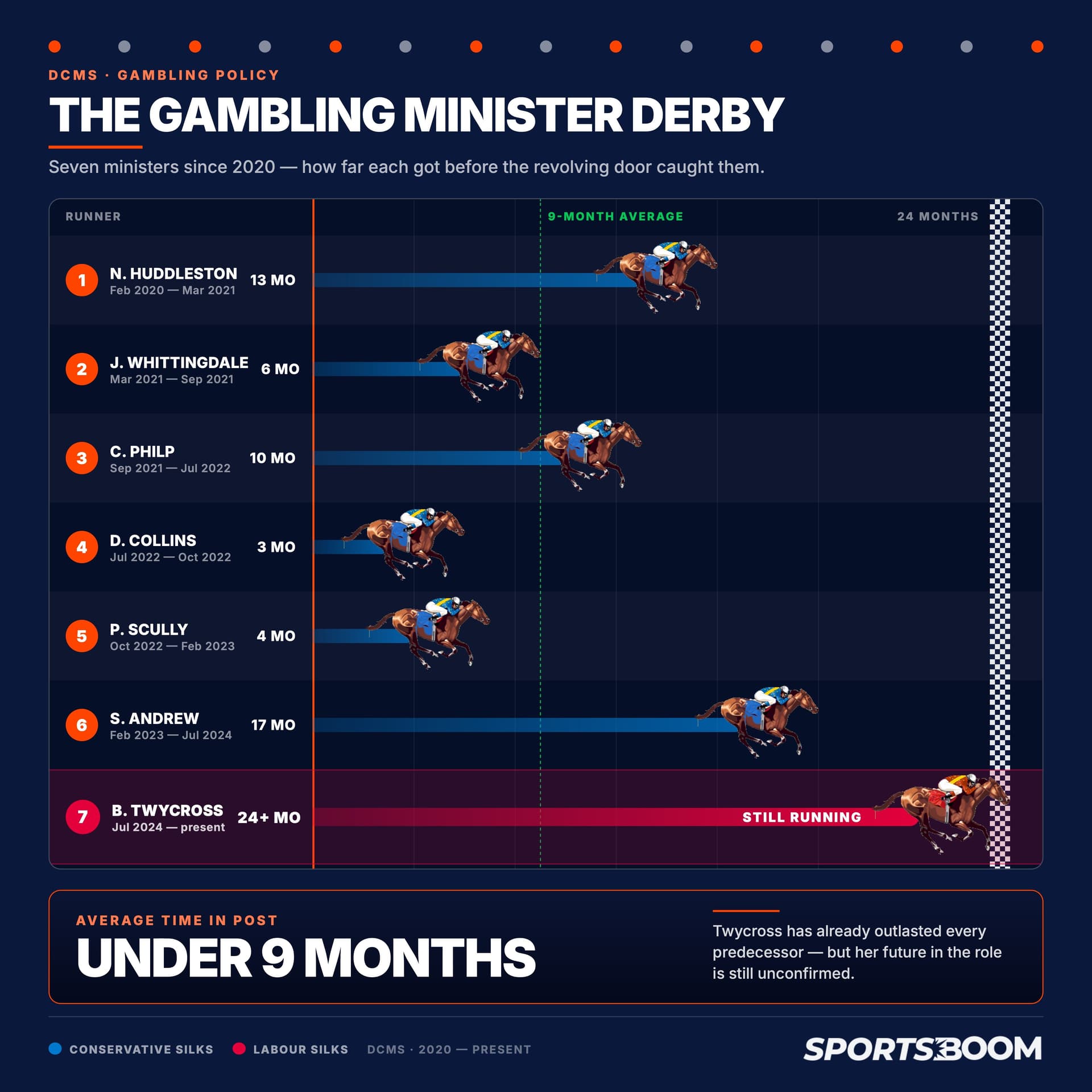
It's a small but notable detail, given Twycross has now served longer in the role than any of her six predecessors combined tenure-for-tenure since the post was formalised in 2020.
Seven Jockeys, One Saddle
Nigel Huddleston held the gambling brief from 2018 until March 2021, when he was replaced by John Whittingdale, who served roughly six months before Chris Philp took over in September 2021. Philp resigned within the year, protesting Boris Johnson's leadership during the Partygate fallout, with the Gambling Act white paper reportedly already sitting with the Prime Minister at the time. Damian Collins followed for three months, Paul Scully for four, and Stuart Andrew for the longest stretch of the six at seventeen months.
All six were Conservative appointments, cycling through under three different Prime Ministers within a single parliament. The average tenure across those six completed terms was under nine months.
Twycross took over in July 2024 under the incoming Labour government, becoming the first non-Conservative minister to hold the brief in this period.
Reform has moved slowly regardless of who's held the post.
The Gambling Commission has only now committed to publishing the full evidence and methodology behind its Financial Risk Assessment rollout this Autumn, following questions from the Culture, Media and Sport Committee on why that evidence wasn't published alongside the original decision. Loot boxes and further advertising reform remain unresolved several ministerial terms into a review process that began in 2020.
The Sport Betting Its Prize Money on the Rules Being Right
Unlike most sports like football, darts, or snooker, British racing's prize money isn't funded through broadcast deals or ticket sales, but via a statutory levy on bookmakers' profits from bets placed on racing.
That structural dependence puts racing in a different position to most sports when it comes to gambling policy, and it's a position currently being tested by the FRA rollout.
The British Horseracing Authority has raised concerns that Financial Risk Assessments could push high-spending punters toward unlicensed operators.
Racing stakeholders are not included in the FRA implementation groups shaping the rollout, as those groups are reserved for parties directly involved in conducting the checks.
The Gambling Commission's Acting Chief Executive Sarah Gardner has agreed to hold separate meetings with racing stakeholders instead[2].
The Numbers Behind the Concern
Betting turnover per race fell 1.2% in 2025/26, following a 7.7% drop the year before, leaving turnover 9.2% below the three-year average and 19% below 2021/22 levels.
Over the same period, the Horserace Betting Levy reached a record £108.9m in 2024/25.[3] The levy is calculated on bookmakers' gross profit rather than turnover, meaning yield can rise even as underlying betting activity falls.
The levy funds £77.13m of 2026 prize money directly, a 6% increase on 2025.
The government confirmed in March that it will not change how the levy is calculated, despite calls from racing for a review.
Reading the Levy's Warning Signs
Taken together, the figures point to a widening gap between what the levy shows and what's actually happening underneath it.
Turnover per race has fallen in each of the last two years, yet the levy itself hit a record high over the same period, a divergence that's only possible while enough high-value betting activity remains in the regulated market to sustain bookmaker margins.
If FRAs reduce that activity further, the same calculation method that produced a record levy in 2024/25 could just as easily produce a falling one in the years ahead, with prize money the most direct casualty.
The Gambling Commission's Autumn evidence publication and any decision on Twycross's future role are both likely to shape how, and how quickly, that risk plays out.
Editor's Insight
The revolving door at DCMS hasn't served racing well. A sport whose prize money runs directly through a betting-linked levy needed a minister in post long enough to properly understand that funding mechanism before it started showing strain, and for six years, it hasn't had one.
Twycross staying on would be a chance to change that. Whether she does may end up mattering more to British racing's finances than anything decided in the FRA consultation itself.
Comments
0 comments
No comments yet. Be the first to share your thoughts!
Related Resources to Betting News
- The Saturday 3pm Table: What Happens When You Strip the Premier League Back to Its Original Slot
- Supercomputer Predicts: England's 2030 World Cup Squad
- Did Chelsea Make a Mistake Selling Andrey Santos? Data Analyses His £50m Move to Manchester United
- The Curse of the Quarter-Final: Why History Says England Can't Win in Miami
- Is Lewis Hamilton About to Fix Ferrari’s Silverstone Curse?
- Does Wimbledon's £64.2m Record Prize Pot Actually Change Who Wins?
- Can Bingo-Casino Brands Win Back UK Players?
- Cluster-Pay Slots vs Payline Slots: Which is Easier?
- Survey Finds Three in Four UK Adults Struggle to Spot Illegal Betting Ads
- Are Casino Sister Sites Confusing UK Players?
- Are Low-Stakes Slots Safer for New Bettors?
- 30+ Unregulated Gambling Sites Targeting Young UK Men, Entain Finds
- Open Banking and Safer Casino Deposits
- Are Instant Win Games Rigged?
- Are No-Wagering Bonuses Becoming the New Trust Signal?
- Gambling Minister Signals Support for Growth of Regulated Betting Industry
- Polymarket Row Highlights BGC's Big Tech Concerns
- Why RTP Can Mislead Slot Players
- Cascading Reels vs Traditional Slots
- Why the UK Gambling Commission Won't Reveal Its £26m Plans

Louis Hobbs is the Sports Editor at SportsBoom, overseeing daily coverage across a wide range of sports while shaping the site’s editorial direction and breaking news agenda.
When he’s not editing the website from home or SportsBoom’s London office, Louis can usually be found in the darts or snooker press room. He has covered both sports extensively for SportsBoom, reporting live from venues for over three years and building strong relationships across the professional circuits.
With a background in interviews, exclusives and live event reporting, Louis combines on-the-ground insight with sharp editorial judgement to ensure SportsBoom delivers authoritative, engaging and timely sports journalism.