
Football Betting Academy
Clean Sheet Betting Explained: The Expert Strategy Playbook 2026
Early in my betting journey, much like plenty of other punters, I used to back dominant teams to keep clean sheets, because it seemed logical. They were a far superior squad, perhaps with a home advantage, often against an opponent with a low goal average. Then came the 89th-minute consolation goal. What I’d got skewed was simple - reputation is not the same as defensive control. Possession doesn’t equal suppression. Since then, I’ve built a filtering framework around structure, tempo, and motivation. I use this logic whenever I study football betting platforms for bonuses, delve into other tipsters’ picks, and make my own markets.

SportsBoom offers honest and impartial UK bookmaker reviews to help you make informed choices. While we may earn commissions through affiliate links, our content remains independent and free from promotional influence. For more information, see our Content Transparency and How We Review pages.

Clean Sheet Betting Explained
What Is Clean Sheet Betting?
I’ve bet clean sheets in pretty much every way you can. Whether it’s a standalone ‘Yes’, a ‘win to nil’, as part of Premier League bet offers, or even a late in-play angle, the key is knowing what you’re actually betting on.
Clean sheet betting means backing a team to concede zero goals across 90 minutes plus stoppage time. If the opponent scores even once, the bet loses, even if your team wins comfortably.
Football clean sheet betting isn’t so much a badge of honour for big clubs as a filtering market. I’m not trying to guess the whole story of the match. I’m just narrowing it down to one variable: will this team concede a goal?
Manchester United hold the longest clean sheet streak in Premier League history, with 14 clean sheets in a row in the 2008/09 season.
How Clean Sheet Betting Works
Clean Sheet betting is one of the simpler betting types; you’ll find it in plenty of our expert football betting tips for - but it still demands precision. After all, one goal slips through, and that’s it. Remember, extra time and penalties don’t count, just your 90 minutes plus stoppage.
The good news is, because you’re layering basically defensive ‘perfection’ onto a match, odds are naturally higher than your basic 1X2s. The bad news? The margin in these markets is wider, too, so pricing discipline matters.
Let’s take a look at an example of how to narrow down the likely margin:
This looks like it’ll be a fairly close run game. Sunderland average scored 1.0 and conceded 1.2, while Fulham average scored 1.4 and conceded 1.5.
There’s no big swing here, with no massive suppression and no explosive offense. That’s your first clue. This doesn’t scream dominance; it suggests containment.
The issue for Clean Sheet betting is obvious. A 1-1 draw sits squarely inside the most likely range. That’s not the type of structural profile I look for in a clean sheet market.
What Does “Clean Sheet” Mean in Betting?
A clean sheet means a team concedes zero goals within 90 minutes plus stoppage time.
If you’re betting on Clean Sheet - Yes, your chosen team cannot concede.
If you’re betting on Clean Sheet - No, your chosen team must concede (any number of goals).
How to Bet On a Clean Sheet Properly
I never approach football clean sheet betting strategy by scanning for the strongest team. I scan for the lowest-threat opponent.
The process goes like this:
I shortlist only two or three matches on a full weekend slate.
I remove all of the games with high tempo or transition-heavy styles.
I accept that the hit rate will be modest.
We’ve had a look at a ‘nearly’ bet, let’s take a look at an easy skip:
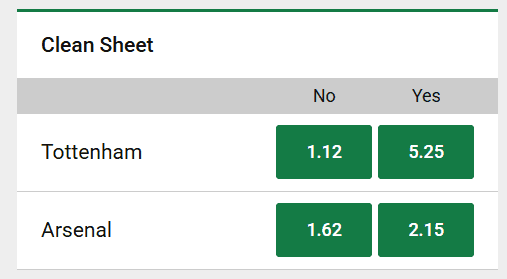
We’ve had a look at a ‘nearly’ bet
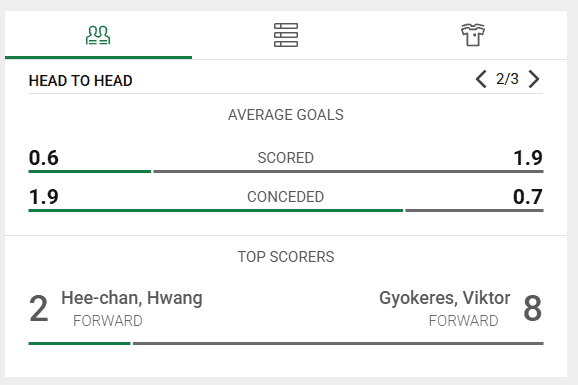
head to head record
In this match-up, we’ve got a derby on our hands, that’s an instant tick for chaos. You’ll get aggressive transitions, high intensity, and not one, but two teams capable of sustaining pressure.
Clean Sheet Betting Pros & Cons
Pros
Higher returns than simple match-winner markets
Clear defensive focus
Strong edge in low-tempo fixtures
Cons
One lapse ends the position
Late goals are heart-breakingly common
Market margins are wide
While backing a 2.40 clean sheet price may look attractive, if the opponent averages 12 shots per match, the exposure is too high. Clean sheet betting only rewards discipline - certainly not optimism.
The 3 Drivers of Clean Sheet Value
I filter every match through three drivers.
Match Control
Does the favourite suppress shots and control territory?
Look for: A side averaging 65% possession and allowing under 8 shots per game.Risk Profile
How does the team behave when leading?
Look for: Teams that manage the game at 1-0 rather than pushing for 3-0.
Motivation State
Is one team protecting position while the other must chase?
Look for: A title contender facing a mid-table side.When all three align, a clean sheet bet becomes realistic.
Motivation State
Is one team protecting position while the other must chase?
Look for: A title contender facing a mid-table side.When all three align, a clean sheet bet becomes realistic.
How to Narrow Clean Sheet Selections (The Professional Method)
It’s tempting to start with the ‘who keeps a clean sheet’ question, but it’s much faster to eliminate games first.
- 1
Remove volatility
Derbies, high-tempo sides, transition-heavy teams - gone.
- 2
Test opponent threat
If the underdog averages over 1.2 goals or double-digit shots, that’s probably worth skipping too.
- 3
Test opponent threat
If the underdog averages over 1.2 goals or double-digit shots, that’s probably worth skipping too.
- 4
Check motivation asymmetry
Title race vs mid-table comfort compresses the risk - tick. Relegation six-pointer? No thanks
Filter
Pass Requirement
Tempo
Low transition
Shot Volume
Underdog under 9 or 10
Lead Behaviour
Favourite reduces risk
Motivation
Ideally clear asymmetry
Let’s take a look at an example:
Arsenal’s defensive numbers lean toward control. Wolves average just 0.6 goals scored. But Wolves still generate spells of home pressure. One set piece changes everything.
In the end, the ‘Yes’ price didn’t look inflated. The ‘No’ side was short. Structurally, there was no edge.
So I passed.
Clean Sheet vs Other Markets
Clean Sheet betting isn’t always the best way forward; in fact, it mostly isn’t! Here are some examples of when other markets might be the smarter choice.
Clean Sheet vs 1X2
If Arsenal are 1.45 to win and 2.20 to keep a clean sheet, I ask: Is defensive suppression truly part of the edge? If Wolves are capable of scoring once, 1X2 may be safer.
Clean Sheet vs Asian Handicap
In narrow-margin games like Sunderland vs Fulham, +0.25 or -0.25 handicaps make more sense. A 1-1 draw destroys a clean sheet but still protects a handicap position.
Clean Sheet vs Win to Nil
Win to Nil is stricter. A 0-0 draw wins Clean Sheet ‘Yes’ but loses Win to Nil.
Example: a top side in a cautious away fixture may suppress but not overcommit. Clean Sheet offers more flexibility, but lower odds.
While the question we ask is often which pays more, we’ve got to change that thinking to which market makes sense for the likely structure of this game.
The Clean Sheet Patterns System
Over time, I’ve noticed most viable clean sheet bets fall into three structural patterns. If a match doesn’t fit one of these, it’s almost always worth leaving alone.
- Controlled Heavy Favourite
A dominant home side is facing an opponent with low shot volume and limited counter threat. The key is not just superiority, but suppression.
Example: A very strong, defensive team hosting a side averaging under 0.8 goals away. City score early, control possession above 65%, and reduce transition risk.
Exception: If the favourite rotates heavily or plays high-risk full-backs, better to leave alone.
2. Low-Tempo Containment Match
Two cautious teams, slow build-up, limited attacking depth. These often project toward 0-0 or narrow 1-0 outcomes.
Example: Mid-table Serie A fixture where both sides average close to 1 goal scored and prioritise shape over aggression.
Exception: If one side is chasing points late in the season.
3. Motivation Imbalance
One side is protecting their position, the other is lacking urgency.
Example: A title contender facing a mid-table side with little at stake. The contender manages risk rather than chasing margin.
Exception: The underdog’s survival depends on their output.
Best Sports for Clean Sheet Betting
Football is where clean sheet betting naturally belongs. The scoring frequency is moderate, match tempo varies, and defensive suppression is measurable. Outside football, I only get involved when the scoring format itself creates structural predictability.
Sports with controlled possession cycles or clear territory dominance can occasionally produce shutout conditions.
One sport I usually avoid for clean sheet angles is basketball. The scoring volume is simply too high. Even the weakest team will almost always score repeatedly.
Hockey
Ice hockey can offer clean sheet opportunities, but only in specific territory-dominance scenarios.
Scoring is lower than in basketball, but still frequent. A shutout usually requires clear puck control and a strong goaltending edge.
Example: A top-seeded NHL team at home against a side averaging under 2.3 goals per game, with a backup goalie confirmed. If the favourite controls shot attempts (35+ projected shots) and suppresses power-play exposure, a clean sheet becomes realistic.
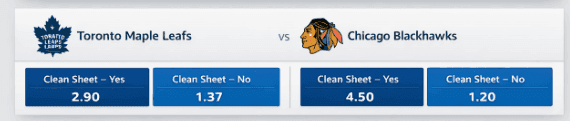
Hockey clean sheet
Exception: If the underdog projects multiple power-play opportunities.
Baseball
Baseball’s fixed format - nine innings, structured outs - creates interesting shutout angles.
A clean sheet equivalent here means backing a team not to concede a run.
Example: An elite starting pitcher facing a bottom-tier batting lineup averaging under 3.5 runs per game. If bullpen depth is strong and weather conditions suppress hitting, it could happen.
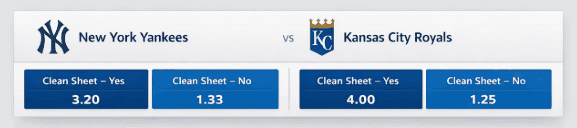
Baseball clean sheet
Exception: The format length matters. Over nine innings, even weak offences can scrape one run through sequencing. That’s why I only consider this angle when the pitching gap is clear and the lineup strength is asymmetric.
American Football
American football has structured scoring increments (3s and 7s), which helps margin modelling. However, true shutouts are rare.
Example: An elite defence facing a rookie quarterback behind a weak offensive line. If projected possession favours the dominant team and weather suppresses passing efficiency, a zero-point concession scenario becomes plausible.

American Football clean sheet
Still, even poor teams can generate a field-goal range once. For me, NFL clean sheets are only worth it in extreme mismatches.
Other Sports (Selective Use Only)
In lower-scoring sports like rugby or cricket, clean sheet equivalents are rare. Why? Scoring formats favour accumulation over suppression.
Liquidity is another issue. Outside major leagues, markets are thin, and margins widen quickly. If I can’t model territory dominance clearly, I skip it.
Football remains the cleanest structural environment for this market.
Best Leagues for Clean Sheet Betting
Some leagues naturally produce better clean sheet environments than others. I’m looking for tactical discipline and teams that manage risk once ahead.
| League | Typical Match Traits | Why Clean Sheet Works |
| Serie A | Tactical, compact shape | Favourites often protect 1-0 leads
|
| Premier League | Intense but structured top sides | Elite teams suppress weaker attacks
|
| La Liga | Possession-dominant favourites | Lower mid-table shot volume
|
| Bundesliga | Aggressive transitions | Only viable in heavy mismatches
|
| Ligue 1 | Talent gaps at top | Clear suppression in top vs bottom
|
In Serie A, I’m comfortable backing a home favourite clean sheet when they’re known to reduce tempo after scoring. In the Bundesliga? I avoid mid-table clashes entirely; the pace expands too quickly, and late goals are common.

Clean Sheet Checklist
Before I place any clean sheet bet, I run through this:
- Underdog averages under 1.0 goals scored
- Underdog shot volume under 9-10 per match
- Favourite controls possession (60%+)
- Favourite reduces tempo when leading
- No derby or high-emotion fixture
- Clear motivation imbalance
- Price reflects suppression, not reputation
If two or more boxes fail, I pass. Remember the Arsenal vs Wolves game I talked about? It ticked most metrics, but not all of them. Wolves still generated enough pressure to make that 1-1 possibility likely - and the price wasn’t generous enough to compensate.
Conclusion
For me, clean sheet betting is something to be enjoyed infrequently and only when the situation calls for it. It’s not a dangerous market, but it’s a very specific one. The upsides are great - odds are longer, but you have to be precise.
If I could go back and start my clean sheet betting journey again, I wouldn’t change the mistakes. They taught me quickly (and painfully effectively) that dominance isn’t enough. You’ve got to tick off the whole list.
FAQs
What is Clean Sheet betting?
Clean Sheet betting in football means backing a team to concede zero goals in 90 minutes plus stoppage time. The Clean Sheet Betting meaning changes slightly in other sports, but the key principle is no points or goals conceded.
Is Clean Sheet betting the same as Win to Nil?
No. Win to Nil requires your team to win and concede zero. A 0-0 draw wins a Clean Sheet ‘Yes’ bet but loses a Win to Nil. I only choose Win to Nil when I’m confident that dominance, not just suppression, is likely.
Why do Clean Sheet bets fail so often?
Late goals, transitions, and emotional game states. Even controlled matches can shift in the final 15 minutes. Even in some Clean Sheet betting tips, you’ll find tipsters underestimating how often one chance is enough.
When should I avoid Clean Sheet betting?
Derbies, high-tempo fixtures, or matches where both teams average over 1.3 goals scored. Look through good, clean sheet betting examples first, to try to understand the patterns, before placing the bet yourself.

Claudia Hartley is a versatile content writer and editor with a strong footing in digital publishing, particularly within the iGaming and affiliate space. With nearly a decade of experience, she has built a reputation for producing clear, engaging, and well-researched content that connects with readers while meeting SEO goals.
Comments
0 comments
No comments yet. Be the first to share your thoughts!