
Football Betting Academy
Team Total Goals Betting Explained: Expert Strategy, Data & Real Examples (2026)
I wish I had become a believer in Mikel Arteta’s defensive system at Arsenal sooner. I was convinced Chelsea was going to score over 1.5 goals against Arsenal on the 1st of March, as they were averaging 1.7 goals per match and generating 1.5 xG away. However, despite dominating possession, Chelsea just couldn’t get shots on target with Arsenal’s towering defenders, Saliba and Gabriel, not giving an inch. The game ended 2-1 to Arsenal. Lesson well and truly learnt, I’ll never back the over against a top defensive team when playing at home. In this guide, I’ll help you avoid making similar mistakes and share my latest betting predictions. Betting should always be fun, not a way to make money. Only bet what you can afford to lose, set limits, and never chase losses. If gambling stops being enjoyable, take a break.

SportsBoom offers honest and impartial UK bookmaker reviews to help you make informed choices. While we may earn commissions through affiliate links, our content remains independent and free from promotional influence. For more information, see our Content Transparency and How We Review pages.
Team Total Goals Betting Explained
What Is Team Total Goals Betting
Team total goals is a wager on how many goals one specific team will score in a match. The bookie sets a line (typically 0.5, 1.5, or 2.5), and you bet over or under.

Team Total Goals Betting.
For example, I opened BetMGM, one of the best Premier League betting sites, and was considering backing Arsenal Over 2.5 Team Goals at 23/20 against Bournemouth on 11th April. However, after analysing Arsenal's average home goal record (2.33) and xG in their last 10 matches (1.557), I decided to pass on the bet.
Manchester City is the only team during the 2025/2026 EPL season to average 2 goals scored per match. Source: FootyStats
How to Bet Team Totals Properly
I scan some of the best online bookmakers looking for team total prices that intuitively look off. When I spot one, I build my own handicap line independently before comparing it to the market price.
How to Bet Team Totals Properly
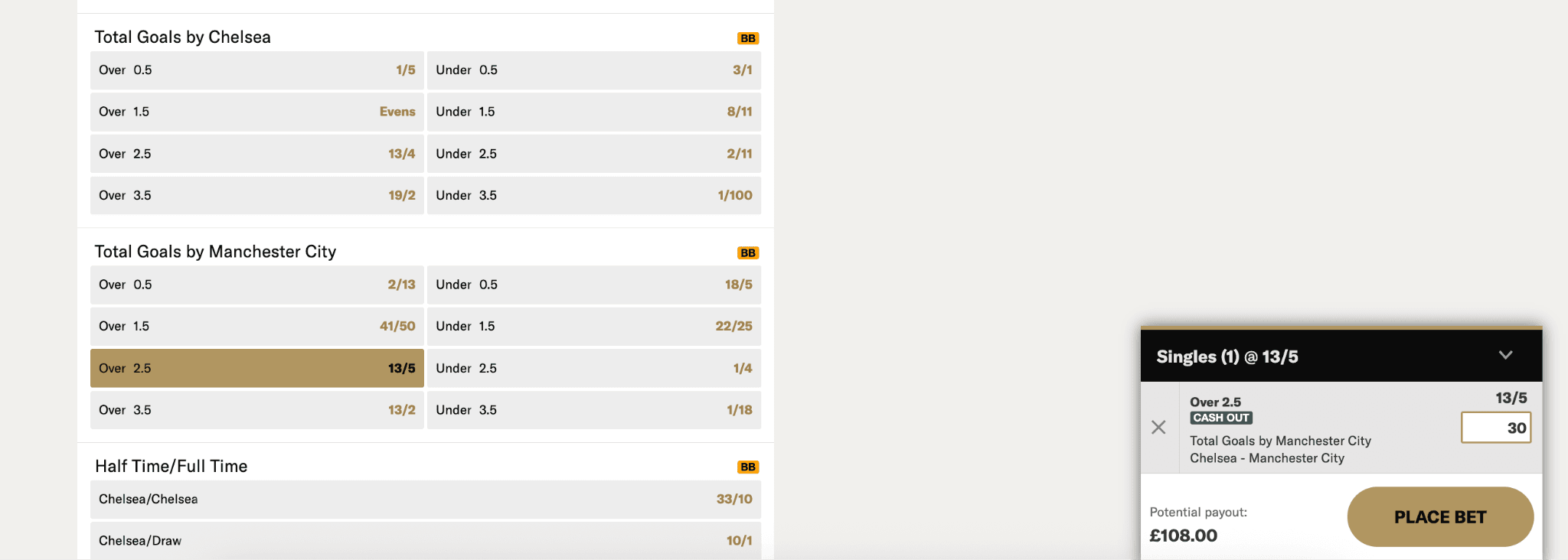
For example, Manchester City Over 2.5 team goals at Chelsea on 12th April, the line is set at 13/5, implying roughly a 28% probability. To me, that looks a little low, so I decided to crunch the numbers.
City are averaging 2.03 goals per game in 2025-26, taking 14.41 shots per match with an xGA against of just 1.13. Erling Haaland has scored 22 Premier League goals this season alone.
On the flip side, Chelsea are conceding 1.23 goals per game at Stamford Bridge this season, with 63% of their fixtures going over 2.5 combined goals. In their last five matches, Chelsea conceded 14 goals, nearly 2.8 per game.
Running those numbers through my own model, I have City Over 2.5 team goals closer to 38%, a 10-point gap on the bookmaker's implied probability of 28%, making City at 13/5 worth taking.
Best Sports for Team Totals
| Sport | Typical Line | Scoring Frequency | Predictability | Why It Works |
| Football | Over/Under 0.5-2.5 goals | 2.93 goals per game in 2024-25 (very high), dropping to ~2.48 in 2025-26 | High | Defensive mismatches, injuries, and game state regularly create bookmaker inefficiencies |
| Basketball (NBA) | Over/Under 105-120 pts | Top teams averaged around 121.9 pts per game in 2024-25; league average ~113 | High | High scoring frequency, back-to-back fatigue, and pace mismatches generate consistent edges |
| Rugby Union | Over/Under 20-30 pts | Top teams averaged ~37.9 pts per game; weaker teams around 18-22 | Low-Moderate | Bonus point system encourages attacking play, while kick-heavy tactics suppress totals |
| Cricket (T20/IPL) | Over/Under 160-180 runs | Average IPL total reached 191 in 2024, record high | Moderate | Pitch and weather data are often underpriced; venue-specific scoring trends are exploitable |

Drivers of Real Value
These are the situations where bookies price team goal totals based on old data and market bias and are slow to adjust odds.
The New Manager Bounce on Attacking Output
Between 2003/2004 and 2012/2013, Premier League new managers have averaged 1.17 points per game compared to just 1.03 before the change, a 13.5% uplift in results. The improvement is usually driven by more attacking intent rather than defensive stability.
The biggest example I can think of is when Vítor Pereira took over at Wolverhampton Wanderers F.C. in 2024-25, improving results from 0.56 PPG to 1.40 PPG across his first five matches, a 150% increase, with Wolves scoring at a noticeably higher rate during that run.
The window is short, usually five to seven games, but team total overs on a newly energised attacking side are often underpriced while bookmakers are still using the previous manager’s data.
Defensive Injury Cascades
This is the most consistently underpriced variable I track. When a team loses a first-choice centre-back, trusted football betting platforms adjust the match result market quickly, but team total lines on the opposing side often move slowly, if at all.
However, the effects on goal totals are still strong. For example, Tottenham’s shot conversion rate dropped from 14% to 9% when they lost both starting centre-backs, Cristian Romero and Radu Drăgușin, simultaneously in 2024-25.
Home Advantage Is Structurally Underpriced for Attacking Output
Home teams consistently outperform their away equivalents in attacking output, and this effect is stronger in team total markets than most punters realise. Arsenal F.C. averaged 2.4 xG per game at home in 2024-25 compared to 1.9 away, a 26% difference in attacking output purely driven by venue.
When I assess team total overs, I weight home fixtures more heavily and look for cases where a bookmaker sets a home team total at the same level as their away average.
Case Study — Forest Over 1.5 Team Goals at Spurs, 22nd March 2026
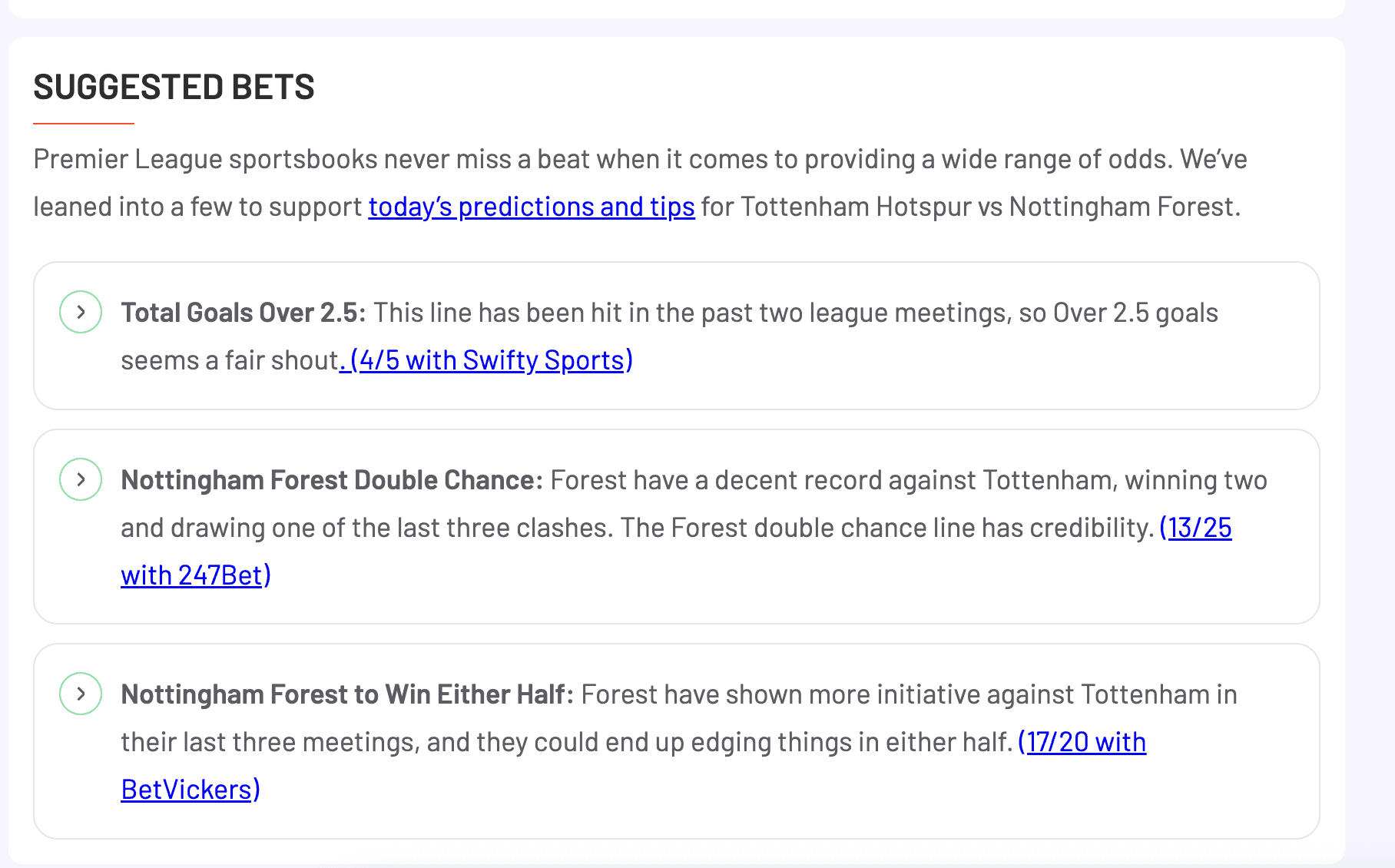
I decided to put £50 on Forest to score over 1.5 goals at 8/11 against Tottenham on 22nd March. I got the idea from SportsBoom’s tipster, who was predicting a high-scoring affair and backing over 2.5 total goals.
Case Study team total goals
Going into this fixture, Tottenham had conceded in every single home Premier League game in 2026. They were averaging 2.0 goals conceded per home game across their last 10 matches.
Forest, while not a scoring machine, averaged 1.13 away goals throughout their campaign, which I thought was more than enough against a Spurs side that is imploding and riddled by injuries (Maddison and Kulusevski out).
The setup looked good, a leaky home defence meeting a solid away attack. At 8/11, the bookmaker was implying roughly a 58% chance of Forest scoring twice or more. My assessment had it closer to 67%.
The first goal came right at halftime. A Neco Williams corner was met in the box and finished clinically by Igor Jesus. The second arrived just after the hour mark; Hudson-Adoi found Gibbs-White all along just outside the box, who slotted it home. My £50 bet ended up returning £86.36.
When to Avoid Team Totals
There are specific match conditions that look superficially attractive but are structurally flawed for team total betting, including:
- 1
Backing Overs Against Arsenal's Defence
Arsenal have now held the Premier League's best defensive record in back-to-back seasons. In 2024-25 they conceded a league-low 34 goals, gave up the fewest xG (35), and conceded the fewest big chances (58) in the division.
Backing any team over 1.5 goals against this side, regardless of their own attacking form, is a tough bet to win. I had Everton Over 1.5 team goals at the Emirates on the 14th of March based on their 1.22 average xG, but the Toffees didn’t even get on the scoreboard.
- 2
When the Scoring Rate Is in Freefall
This is a macro-level trap that catches punters who are still pricing team totals based on recent seasons. Goals are being scored at just 2.48 per game in 2025-26, the third-lowest rate in Premier League history and the lowest since 2008-09.
Backing overs at lines priced for a 3+ goals-per-game environment, like in previous seasons, when the actual rate is 2.48, is a recipe for disaster.
- 3
When a Team Takes an Early Lead and Shuts Up Shop
When a team takes an early lead, their attacking output collapses. They stop pressing, drop their defensive line, and prioritise the result over additional goals.
Opta Analyst's game state analysis of the 2024-25 Premier League makes this concrete. Leicester were outshot 33 to 11 while in the lead across multiple matches, they defended their advantage almost entirely at the expense of attacking intent.
Team Total Checklist
If I can't answer yes to the majority of these, I don't place the team total goals bet, no matter how good it seems in my head:
- Does the team have a clear attacking pattern over their last 6+ games?
- Is their xG per game above 1.5 at home/1.2 away?
- Have they scored in each of their last five matches?
- Is the opposition conceding regularly?
- Is the opposition missing key defensive personnel?
- Are there any significant injuries or suspensions to the attacking team's first-choice forwards or creative players?
- Does the implied probability sit below your own assessed probability by at least 5%?
Conclusion
Predicting team total goals comes down to combining powerful statistics like xG and average goals conceded with game dynamics like home ground tactics, new manager boost, and injuries. When you can accurately quantify the impacts of these factors on scoring, you’ll be able to spot mispriced lines.
FAQs
Are team totals profitable?
They can be, but the market is tightening. The 2024-25 Premier League averaged 2.93 goals per game, one of the highest-scoring seasons on record, which inflated Overs returns. Goals then dropped 12.2% the following season, and the trend has continued. Many bettors are still pricing team totals like it’s 2024.
Is xG reliable?
It’s the strongest single metric available, but it's not perfect. Studies have shown post-match xG predicts match outcomes with about 65.6% accuracy, outperforming most other models.
Are overs or unders better?
The current environment is leaning towards unders, as there has been a 12% drop in goal totals. Blindly backing overs based on previous high-scoring seasons is a common mistake.
Do big teams always hit overs?
No, this is a major trap. When big teams go ahead early, they often control the game rather than keep attacking. Historical data shows teams leading by one goal only scored about 75% of the remaining goals in matches.
How important is game state?
It’s one of the most underrated factors in team total betting. Teams that score first go on to win around 84-85% of home matches, which shows that leads are usually protected rather than extended. An early goal can completely change whether a team total bet wins or loses.

Bruce Douglas is an experienced editor and copywriting professional with a proven track record in shaping high-quality content across multiple platforms. With a career spanning journalism, editorial management, and digital content strategy, he brings a keen eye for detail and a passion for precision to every project he works on.
Comments
0 comments
No comments yet. Be the first to share your thoughts!