
15 Best UK Betting Sites – Licensed Online Bookies for 2026
Bet Builder Explained 2026: Strategy, Odds & How It Works
It’s Saturday, 3 pm, and Arsenal vs Aston Villa is playing. An 18+ bettor places a Bet Builder on a UKGC-licensed sportsbook. Arsenal to win, over 2.5 goals, Saka to score. Total odds add up to 4.50. With a stake of £20, that’s a £90 return. Arsenal wins 4-1, the match goes over 2.5 goals, but Saka doesn’t score. The slip loses.

SportsBoom offers honest and impartial UK bookmaker reviews to help you make informed choices. While we may earn commissions through affiliate links, our content remains independent and free from promotional influence. For more information, see our Content Transparency and How We Review pages.
Bet Builder Explained
Though Bet Builders look attractive due to their payout potential, they can drain a bankroll quickly. This is because each leg needs to land, probability compounds aggressively, and matches rarely align clearly.
What Is a Bet Builder?
What Is a Bet Builder
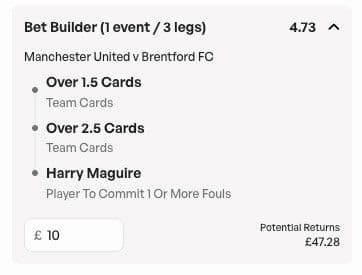
A Bet Builder combines multiple selections from the same match into one bet. For example, match outcomes, goal markets, cards, corners, or player props. Every leg must land for the slip to win. The structure stacks correlated outcomes into a single price, which raises the total payout potential but compounds risk as each leg is added.
A Betfair punter turned £10 into £3,000 during 2026’s Carabao Cup Final Bet Builder at odds of 304/1. Source: Betfair.
How Bet Builder Betting Works
A Bet Builder works by picking a single match and adding multiple selections on a football betting platform. The odds will then automatically combine into one price, and a stake can be placed.
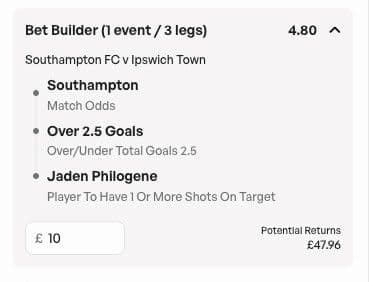
Total Bet Builder Odds = 4.80
Total Bet Builder Odds = 4.80
In the above example, a £10 stake would return about £48. However, it’ll only pay out if all three land.
How Bookmakers Price Bet Builders
Bookmakers price Bet Builders based on three factors:
- Probability of Each Selection: The odds for each leg.
- Correlation Adjustment: Legs that reinforce each other (for example, team to win + over goals) get shortened as if one lands, the other has a higher chance of landing as well.
- Bookmaker Margin: Profit built into the bet for the bookmaker (vig), typically 5-8% per leg.
Singular odds don’t just multiply together. They’re adjusted for positive correlation and dependency between events. Comparing the odds between the best premier league betting sites can also produce more favourable odds between Bet Builder combinations.
Understanding Correlation in Bet Builders
Correlation is the relationship between selections within the same match.
Positive Correlation
Positive Correlation
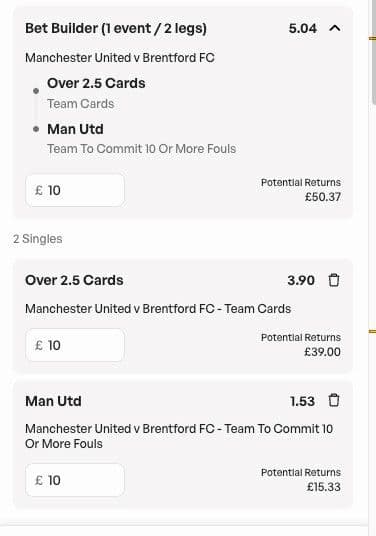
A positive correlation is when two selections reinforce each other. If one lands, the other has a high chance of landing as well.
For example, the above Bet Builder is for Man Utd over 2.5 cards and Man Utd to commit 10 or more fouls. Both work together.
However, because of this, the odds are impacted. The two singles are 3.90 x 1.53 = 5.96, but the Bet Builder odds are 5.04 (aka positive correlation).
Negative Correlation
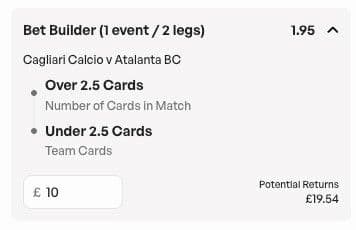
Negative Correlation
A negative correlation is when two selections work against each other. If one lands, the other is less likely to land.
For example, the above Bet Builder combines Atalanta under 2.5 cards with a match over 2.5 cards. That means that Cagliari will need to be responsible for most of the bookings, which is an unusual outcome.
The odds reflect this as well. Single odds come to 1.29 x 1.29 = 1.664, but the Bet Builder prices at 1.95. That’s the bookmaker's algorithm recognising that the chance of this happening is low, producing a negative correlation.
Why Bet Builders Work (and Where They Fail)
Narrative-Based Betting
Bet Builders work best when bettors create a story from them. For example, team domination, scoring multiple goals, and a star player scoring. It makes sense. Each leg works together with the others. If one leg lands, the chances that the others will increase.
Probability Reality
Each leg of a Bet Builder must land for the slip to cash in. Probability compounds as well. A 4-leg slip where each selection has a 70% chance of winning feels good. However, 0.70⁴ = 24%. Using data sources like Opta and FBref can improve the probability, but the results are still random.
Pros & Cons
Pros
Higher potential returns from a single match
Flexible market combinations across goals, cards, corners, and player props
Smaller stake can target outsized payouts
Cons
High variance, so long losing streaks are expected
Dependent outcomes inflate perceived value
Pricing inefficiencies vary between bookmakers
One missed leg loses the entire stake
Bet Builder vs Accumulators
A Bet Builder is multiple legs on the same event. An accumulator is multiple legs on different events. Bet Builders introduce correlated risk, and accumulators introduce independent probability risk.
Understanding Bet Builder Odds
Combined odds can look attractive, but they hide low probability behind big numbers. Implied probability is simply 1 ÷ decimal odds, so a Bet Builder priced at 4.5 sits at 22% (1 ÷ 4.5 = 0.22). Therefore, it has a 1 in 5 chance of hitting, meaning the higher the odds, the lower the chance.
Compounding catches bettors out the most. Probability is multiplied across each leg. If four selections have a 70% chance of winning, the slip itself 0.70 × 0.70 × 0.70 × 0.70 = 0.2401 has a 24% chance of paying out. That’s why odds only reflect probabilities and not certainty, and losing streaks with Bet Builders are inevitable.
Drivers of Value in Bet Builders
Value in Bet Builders is driven by three key factors:
- Mispriced Player Props: When a striker is priced at 1.8 for 2+ shots, but data services like StatsBomb show just 1.6 shots per 90.
- Incorrect Correlation Pricing: Bookmakers can sometimes underweight how strongly two legs reinforce each other.
- Underestimate Defensive Resistance: Official league stats reveal teams that suppress xG far better than the narrative suggests.
This is why “logical combinations” tend to fail. They bundle dependent outcomes that share a single trigger. If it doesn’t trigger, the entire slip fails.
Overbuilt slips, slips that just chase odds, are also not recommended. Slips should target one or two genuine edges, not five connected guesses.
Risk & Bankroll Management
Bet Builders have high variance, so losing streaks are normal. That’s why I recommend a 1-2% bankroll risk per slip. For example, if I had a £1,000 bankroll, I’d risk no more than £10 to £20 per Bet Builder. This saves me from ruining my bankroll on one or two bets.
With such a betting strategy, never chase losses or use strategies like the martingale. Avoid overloading on selections as well. One or two good selections that correlate with one another are good enough.
When Bet Builders Work
My Bet Builders tend to work when they have the following traits:
- Limited Selections (2-3 legs): Try to keep compounded probability above 30-40%
- Clear Tactical Alignment: Selections should reflect genuine match dynamics.
- Strong Statistical Backing: Hit rates from Opta, FBref, or StatsBomb should support every leg.
When to Avoid Bet Builders
I avoid bet builders when the following appears:
- Overbuilt Slips (4+ Legs): Each added leg decreases the probability of a payout.
- Unpredictable Matches: Derbies, relegation six-pointers, cup ties, etc., where form goes out the window.
- Emotional or Narrative-Heavy Betting: Backing a favourite team, chasing a loss, building a slip around “the story” instead of the data.
Common Mistakes
My most common mistakes with a Bet Builder are:
Adding too Many Selections: Every extra leg compounds the risks faster than it increases the payout.
Ignoring Correlation: Combining legs that share a single trigger means betting on the same outcomes, not different ones.
Chasing High Odds: Building slips for the payout rather than the read. Big odds don’t mean big rewards.
Overestimating “Logical” Outcomes: Assuming Ipswich will win and by over 2.5 goals just because they’re at home isn’t logical. Data needs to back this up.
Bet Builder Checklist
Before making a Bet Builder, I always ask myself the following questions:
- Are the selections realistic together?
- Is the correlation understood?
- Is the probability acceptable?
- Is the stake controlled?
Conclusion
Bet Builders are flexible but also complex. They allow bettors to construct a match narrative from a single bet, but the requirement for every leg to align makes them sensitive to variance and correlation.
The bettors who’ll win using such a strategy are the ones with data-backed stories. They also respect probability, manage stake sizing, and treat each slip as a calculation rather than a prediction.
For sharper match-by-match angles backed by data, expert betting tips and predictions can help. Aligning with professional sports predictions can be used as an added layer of confidence for betting.
FAQs
What is a Bet Builder?
A single bet combining multiple selections from a single match.
Are Bet Builders better than accumulators?
They are different, not better. Bet Builder covers one match, whereas accumulators cover more than one event.
How do bookmakers price Bet Builders?
Algorithms calculate the leg’s probability, odds get adjusted for correlation, and then they add margin (vig).
Why do Bet Builders lose often?
Compounding probability. Four legs at 70% each give a slip just 24% chance of cashing out.
Can Bet Builders be profitable long-term?
Possible, but it isn’t easy. It requires disciplined stake sizing, data-backed selections, and shopping for the best odds.

Sam is a British content writer who’s now living in the Netherlands. He has 5+ years of experience producing SEO content for casino and sports bettors in Tier-1 markets. Working on campaigns for brands like Buzz Bingo, Paddy Power, Betfred, and Sun Bingo, he’s written 1M+ words of content spanning casino reviews, sportsbook reviews, slot guides, betting strategies, and industry news.
Comments
0 comments
No comments yet. Be the first to share your thoughts!